Oil prices supported a stronger Canadian dollar, while the US dollar weakened against the Canadian dollar for the fourth consecutive day, with the market focusing on US economic data and the Federal Reserve's outlook.
2026-01-22 14:51:36
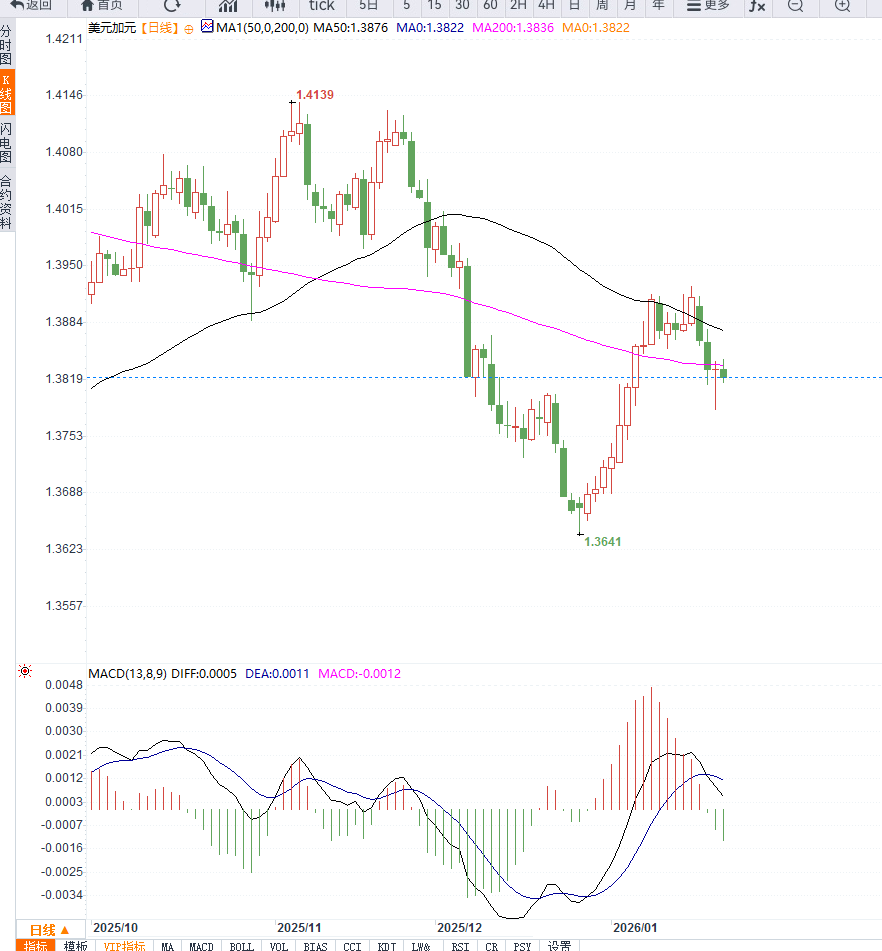
During Thursday's Asian trading session, the US dollar continued its fourth consecutive day of decline against the Canadian dollar (USD/CAD), briefly approaching the 1.3830 level.
The weakness of this currency pair is primarily attributed to the strength of the commodity currency, the Canadian dollar, which has benefited from the robust performance of international oil prices. As one of the largest suppliers of crude oil to the United States, Canada's currency is closely linked to oil prices; when oil prices rise, the Canadian dollar is typically boosted, thus putting downward pressure on USD/CAD.
 WTI crude oil remained around $60.50 per barrel, consolidating after four consecutive days of gains. While oil prices were supported by easing geopolitical risks, global supply and demand fundamentals remain under pressure.
The International Energy Agency (IEA) reiterated that despite upward revisions to its forecast for crude oil demand growth this year, supply will still significantly exceed demand, keeping concerns about oversupply alive.
Meanwhile, US industry data showed that crude oil inventories rose by about 3 million barrels last week, which also limited the potential for oil price increases. Geopolitically, market risk appetite has improved.
US President Trump said on Wednesday that he would not use military force to seize Greenland and would temporarily suspend tariffs on European countries that oppose his position on Greenland. This series of conciliatory statements reduced market concerns about escalating global trade and political conflicts, providing support for risk assets, but simultaneously weakening safe-haven demand, putting short-term pressure on the US dollar.
Despite this, the dollar has not weakened significantly. The market is currently awaiting a series of important US economic data, including weekly initial jobless claims, annualized GDP growth rate, and the personal consumption expenditures (PCE) price index.
These data will provide important clues about the health of the U.S. economy and the trajectory of inflation, and will further influence the Federal Reserve's future interest rate decisions. Regarding the outlook for monetary policy, Federal Reserve officials recently stated that they are in no hurry to begin an easing cycle until there is clearer evidence that inflation is consistently moving toward the 2% target.
The market is still pricing in a probability of a cumulative 50 basis point rate cut this year, but this expectation has clearly subsided compared to before, thus limiting the downside of the dollar.
From a technical perspective, the USD/CAD pair continues its short-term downtrend, but no oversold signals have yet appeared. The pair is currently seeking support around 1.3800; a break below this level could lead to further declines towards the 1.3750 support area. Conversely, if the US dollar rebounds due to strong US economic data, the upside resistance levels to watch are 1.3880 and 1.3920.
The Relative Strength Index (RSI) is in the weak zone but has not reached oversold levels, indicating that downward momentum still exists but is not strong; the moving average system is in a bearish alignment, and the short-term technical outlook is bearish.
Editor's Note:
The current USD/CAD exchange rate exhibits a clear pattern of "oil price versus dollar game": oil prices, as a core supporting factor for Canada's export-oriented economy, remain high against the backdrop of easing geopolitical risks, thereby boosting the Canadian dollar; while the US dollar lacks clear directional impetus until macroeconomic data and the Federal Reserve's policy path become clear.
As the market gradually digests the impact of Trump's easing tariff stance, investors are turning their attention to upcoming US economic indicators, which will be key catalysts driving the next phase of the US dollar and USD/CAD exchange rate movement. Stronger data could lead to a rebound in the US dollar, while weaker data could further strengthen the Canadian dollar, causing USD/CAD to continue its correction.
The weakness of this currency pair is primarily attributed to the strength of the commodity currency, the Canadian dollar, which has benefited from the robust performance of international oil prices. As one of the largest suppliers of crude oil to the United States, Canada's currency is closely linked to oil prices; when oil prices rise, the Canadian dollar is typically boosted, thus putting downward pressure on USD/CAD.
WTI crude oil remained around $60.50 per barrel, consolidating after four consecutive days of gains. While oil prices were supported by easing geopolitical risks, global supply and demand fundamentals remain under pressure.The International Energy Agency (IEA) reiterated that despite upward revisions to its forecast for crude oil demand growth this year, supply will still significantly exceed demand, keeping concerns about oversupply alive.
Meanwhile, US industry data showed that crude oil inventories rose by about 3 million barrels last week, which also limited the potential for oil price increases. Geopolitically, market risk appetite has improved.
US President Trump said on Wednesday that he would not use military force to seize Greenland and would temporarily suspend tariffs on European countries that oppose his position on Greenland. This series of conciliatory statements reduced market concerns about escalating global trade and political conflicts, providing support for risk assets, but simultaneously weakening safe-haven demand, putting short-term pressure on the US dollar.
Despite this, the dollar has not weakened significantly. The market is currently awaiting a series of important US economic data, including weekly initial jobless claims, annualized GDP growth rate, and the personal consumption expenditures (PCE) price index.
These data will provide important clues about the health of the U.S. economy and the trajectory of inflation, and will further influence the Federal Reserve's future interest rate decisions. Regarding the outlook for monetary policy, Federal Reserve officials recently stated that they are in no hurry to begin an easing cycle until there is clearer evidence that inflation is consistently moving toward the 2% target.
The market is still pricing in a probability of a cumulative 50 basis point rate cut this year, but this expectation has clearly subsided compared to before, thus limiting the downside of the dollar.
From a technical perspective, the USD/CAD pair continues its short-term downtrend, but no oversold signals have yet appeared. The pair is currently seeking support around 1.3800; a break below this level could lead to further declines towards the 1.3750 support area. Conversely, if the US dollar rebounds due to strong US economic data, the upside resistance levels to watch are 1.3880 and 1.3920.
The Relative Strength Index (RSI) is in the weak zone but has not reached oversold levels, indicating that downward momentum still exists but is not strong; the moving average system is in a bearish alignment, and the short-term technical outlook is bearish.
Editor's Note:
The current USD/CAD exchange rate exhibits a clear pattern of "oil price versus dollar game": oil prices, as a core supporting factor for Canada's export-oriented economy, remain high against the backdrop of easing geopolitical risks, thereby boosting the Canadian dollar; while the US dollar lacks clear directional impetus until macroeconomic data and the Federal Reserve's policy path become clear.
As the market gradually digests the impact of Trump's easing tariff stance, investors are turning their attention to upcoming US economic indicators, which will be key catalysts driving the next phase of the US dollar and USD/CAD exchange rate movement. Stronger data could lead to a rebound in the US dollar, while weaker data could further strengthen the Canadian dollar, causing USD/CAD to continue its correction.
- Risk Warning and Disclaimer
- The market involves risk, and trading may not be suitable for all investors. This article is for reference only and does not constitute personal investment advice, nor does it take into account certain users’ specific investment objectives, financial situation, or other needs. Any investment decisions made based on this information are at your own risk.