A revaluation of white petroleum: Can lithium prices break through their ceiling?
2026-01-22 21:51:01
In 2025, the lithium carbonate market bottomed out amidst oversupply and sharp price declines. With the explosive growth in demand for modular energy storage, the restructuring of the geopolitical landscape, and the structural impact of technological routes, the industry is facing a critical turning point in 2026, with the momentum of price increases potentially far exceeding market expectations, becoming the core trading theme in the commodity sector.
2025 will be the most challenging year for the lithium carbonate market in recent years, with the dual pressures of severe oversupply and weaker-than-expected demand from electric vehicles leading to continued downward pressure on prices.
The price of 99.5% lithium carbonate in Asia hit a four-year low this year, with the Argus price assessed at only US$11,600 per ton on December 9, down about 80% from the peak at the end of 2022.
In the first half of the year, the resumption of production at lithium mica projects and the expansion of lithium extraction capacity from salt lakes further suppressed prices. At that time, the market generally believed that inventory was plentiful and failed to anticipate the potential for explosive growth in demand.
However, the market turning point gradually emerged in the second half of the year.
As high-cost production capacity is gradually cleared and industry inventory continues to decrease, lithium carbonate prices have begun to rebound. As of December 29, the price has increased by 56% from the beginning of the year of $10,798.54 per ton, closing at $16,882.63 per ton.
More importantly, structural changes on the demand side are accelerating the supply-demand reversal: China's major battery manufacturers continue to increase their operating rates, and the price of lithium carbonate futures on the Guangzhou Futures Exchange broke through the 100,000 yuan per ton mark in November, reaching a high point since the beginning of last year.
From the perspective of trading patterns, when market expectations of demand enter a structural growth phase, futures prices often become a leading indicator of spot market trends, and the current trend of rising prices linked to futures prices has begun to take shape.
If the demand for lithium carbonate previously relied mainly on electric vehicles, the energy storage sector will become the core engine driving demand growth in 2026, opening up a "second growth curve" for lithium demand.
Modular, commercially viable energy storage systems (ESS) with continuously increasing adoption rates are driving new demand for lithium carbonate, with growth rates far exceeding market expectations.
According to Argus Consulting, the global installed capacity of energy storage systems will reach 273 gigawatt-hours in 2025 and is expected to increase to 359 gigawatt-hours in 2026. The Chinese market alone will contribute 182 gigawatt-hours of new demand, becoming the core engine of global lithium demand growth.
Overseas markets also performed strongly: in the UK, 34.5 gigawatts of battery storage projects have already secured priority grid connection, representing about one-third of its current total installed capacity; in Europe, driven by auction policies, annual installed capacity for energy storage is projected to increase from 10.1 gigawatts in 2023 to 17.6 gigawatts in 2030, representing a compound annual growth rate of over 8%.
Saudi Arabia has jumped to become the world’s third largest energy storage market in just a few months, completing the deployment of approximately 11 gigawatt-hours of projects in the first quarter of 2025 alone.
Energy storage systems are rapidly transitioning to containerized modular deployment, with over 80% of them adopting lithium iron phosphate (LFP) technology, which can flexibly connect to substations, solar power plants, or peak-shaving power plants, significantly expanding their application boundaries.
This design successfully avoids the traditional grid access bottleneck—the project can be directly connected to the grid on the distribution side without waiting for the high-voltage transmission line upgrade cycle that can take several years, significantly shortening the implementation time.
In China, large-scale energy storage power stations can be put into operation in as little as 81 days from the start of construction, while the construction cycle for new power transmission corridors or gas-fired power plants can be as long as 5-7 years. This efficiency advantage, against the backdrop of grid congestion and high renewable energy curtailment rates, has directly driven the immediate demand for lithium carbonate.
The demand for lithium in energy storage systems has shifted from simply "peak shaving and valley filling" to higher value-added grid ancillary services.
Batteries can provide key services such as frequency regulation, inertial support, and grid congestion relief. These services cannot be achieved with zero emissions and fast response by traditional peak-shaving power sources such as gas turbines, making them a core support for the stable operation of the power grid.
These high-value-added services can lock in stable revenue streams over many years, significantly improve the return on investment of energy storage projects, drive capital inflows, and thus create sustained growth momentum for lithium demand.
For example, the initial revenue of French energy storage projects mainly comes from ancillary services such as primary and secondary frequency regulation, with a clear charging model and strong pricing power; while the sharp rise in electricity market clearing prices further highlights the scarcity premium of fast-response assets such as batteries.
The structural choice of technological routes has become a key variable in amplifying the demand for lithium carbonate. Lithium iron phosphate (LFP) technology has become the dominant route for stationary energy storage and power batteries. Its lithium consumption intensity is significantly higher than that of high-nickel ternary batteries, which directly boosts the demand elasticity of lithium carbonate.
Data shows that China's total battery production reached 1.29 terawatt-hours from January to October 2025, a surge of 53% year-on-year, with lithium iron phosphate batteries accounting for as much as 79% of the production. In October, the domestic power battery installation volume was close to 170 gigawatt-hours, with lithium iron phosphate batteries accounting for nearly 80%, confirming its dual dominant position in the fields of energy storage and transportation electrification.
In terms of consumption intensity, lithium iron phosphate batteries consume 30%-50% more lithium per kilowatt-hour than high-nickel ternary batteries. The main reason is that their energy density is lower, and the number of cells needs to be increased to ensure cycle life.
This technological characteristic, against the backdrop of explosive growth in energy storage installations, has directly amplified the demand-pull effect on lithium carbonate, becoming a key technological logic driving up prices.
Iola Hughes of BenchmarkMineralIntelligence points out that lithium iron phosphate has become "the best technology choice for the vast majority of energy storage applications," and its industrialization process is unstoppable thanks to technological iteration and cost optimization.
Geopolitical competition and global policy orientation are reshaping the lithium carbonate value chain, further reinforcing the logic of rising prices. Key minerals have become a core agenda of US foreign policy, and Western economies are accelerating the localization of supply chains and regional collaboration.
China dominates key supply chains, while the United States has also included lithium in its list of critical minerals, promoting the construction of domestic mines and processing plants. For example, the ThackerPass lithium project, supported by the United States, has made breakthrough progress. The European Union has provided special financing to support companies such as Vulcan Energy Resources and provided a subsidy of 360 million euros to European Metals Holding. Canada has announced 6 billion Canadian dollars in funding through 26 investment programs to strengthen regional supply chains.
This “G7 coordinated action” has driven capital to concentrate in regions such as North America and Europe, but the new capacity release cycle is long and it is difficult to alleviate the supply and demand tension in the short term.
To stabilize prices and ensure supply chain security, Howard Klein, co-founder of RKEquity, advocated for the establishment of a strategic lithium reserve in the United States. This would create stable, large-scale basic demand to keep lithium carbonate prices within a range where companies can obtain reasonable returns.
This proposal has garnered widespread attention because the core pain point for the lithium industry is not insufficient demand, but rather the distortion of investment signals caused by extreme price fluctuations.
In addition, global policies are continuously strengthening the demand for energy storage: Europe is warning of the economic costs of curtailing renewable energy, forcing the grid to deploy battery backup power; China is vigorously promoting integrated wind, solar and energy storage projects. In June, solar and energy storage and integrated wind, solar and energy storage projects accounted for 80% of the newly installed generation-side energy storage capacity. The demand for energy storage driven by policies is entering a period of large-scale release.
Gerardo del Real, publisher of DigestPublishing, emphasized that regional cooperation between the United States, Canada, and potentially Mexico will significantly enhance supply security and reduce the risk of global supply chain disruptions.
North America has abundant lithium reserves, and regional collaboration can accelerate the implementation of production capacity. However, it is difficult to make up for the supply and demand gap caused by the surge in energy storage demand in the short term, which provides geopolitical support for the rise in lithium carbonate prices.
This product was tracked a bit late, but overall, the lithium carbonate market in 2026 will present a pattern of "explosive growth in demand, limited increase in supply, and support from geopolitical policies." The trend of supply and demand rebalancing will be established, and the potential for price increases is expected to exceed most people's expectations.
On the demand side, energy storage and electric vehicles are driving global lithium carbonate demand growth, which is expected to far exceed supply growth. On the supply side, after the clearing of high-cost capacity, the release of new capacity will lag, making it difficult to quickly match demand growth. Technologically, lithium iron phosphate's dominant position is being consolidated, amplifying demand intensity. Geopolitically, supply chain restructuring and policy support are expected to further tighten supply. Under the combined effect of these multiple factors, lithium carbonate prices are expected to continue their rebound, becoming one of the most certain commodities to rise in 2026.
For investors, it is crucial to focus on key catalysts such as the progress of energy storage installations, the expansion of lithium iron phosphate production capacity, the localization of Western supply chains, and the implementation of strategic lithium reserve policies, in order to seize trading opportunities arising from supply and demand reversals.
At the same time, we must also be wary of potential variables such as the accelerated release of production capacity and the risk of technological substitution caused by the rapid rise in prices. JPMorgan is optimistic about the short-term trend of lithium prices, but remains cautious about the medium-term trend.
In the short term, the supply-demand gap driven by energy storage will remain the core contradiction in the market.
From a technical perspective, lithium carbonate futures contracts have reached the level required for a measured increase on both the daily and monthly charts. However, if the surge in energy storage and electricity demand cannot be disproven under the AI narrative, or if the data provides preliminary verification, then after the measured increase, the price of lithium carbonate may have the opportunity to continue to rise proportionally, similar to silver.
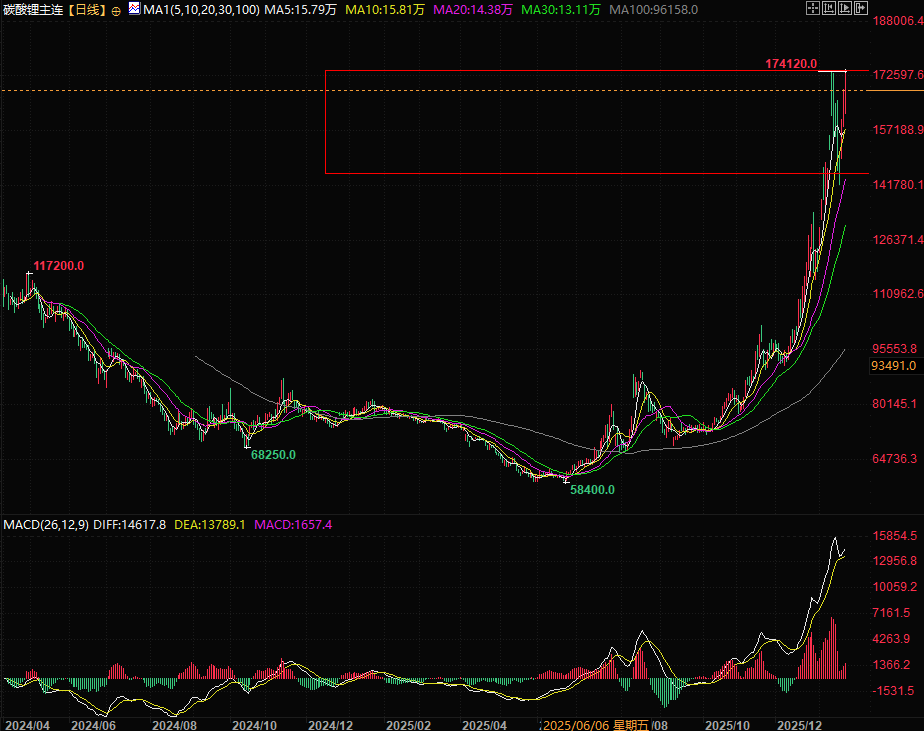
(Lithium carbonate futures daily chart, source: EasyForex)
At 21:44 Beijing time, lithium carbonate futures were quoted at 166,500 yuan/ton.
Market Turning Point: From Deep Oversupply to Tighter Supply and Demand, Prices Bottoming Out and Rebounding
2025 will be the most challenging year for the lithium carbonate market in recent years, with the dual pressures of severe oversupply and weaker-than-expected demand from electric vehicles leading to continued downward pressure on prices.
The price of 99.5% lithium carbonate in Asia hit a four-year low this year, with the Argus price assessed at only US$11,600 per ton on December 9, down about 80% from the peak at the end of 2022.
In the first half of the year, the resumption of production at lithium mica projects and the expansion of lithium extraction capacity from salt lakes further suppressed prices. At that time, the market generally believed that inventory was plentiful and failed to anticipate the potential for explosive growth in demand.
However, the market turning point gradually emerged in the second half of the year.
As high-cost production capacity is gradually cleared and industry inventory continues to decrease, lithium carbonate prices have begun to rebound. As of December 29, the price has increased by 56% from the beginning of the year of $10,798.54 per ton, closing at $16,882.63 per ton.
More importantly, structural changes on the demand side are accelerating the supply-demand reversal: China's major battery manufacturers continue to increase their operating rates, and the price of lithium carbonate futures on the Guangzhou Futures Exchange broke through the 100,000 yuan per ton mark in November, reaching a high point since the beginning of last year.
From the perspective of trading patterns, when market expectations of demand enter a structural growth phase, futures prices often become a leading indicator of spot market trends, and the current trend of rising prices linked to futures prices has begun to take shape.
Core Driver: The Explosive Growth of Energy Storage Ushers in a "Second Growth Curve" for Lithium Demand
If the demand for lithium carbonate previously relied mainly on electric vehicles, the energy storage sector will become the core engine driving demand growth in 2026, opening up a "second growth curve" for lithium demand.
Modular, commercially viable energy storage systems (ESS) with continuously increasing adoption rates are driving new demand for lithium carbonate, with growth rates far exceeding market expectations.
Explosive growth in energy storage installed capacity
According to Argus Consulting, the global installed capacity of energy storage systems will reach 273 gigawatt-hours in 2025 and is expected to increase to 359 gigawatt-hours in 2026. The Chinese market alone will contribute 182 gigawatt-hours of new demand, becoming the core engine of global lithium demand growth.
Overseas markets also performed strongly: in the UK, 34.5 gigawatts of battery storage projects have already secured priority grid connection, representing about one-third of its current total installed capacity; in Europe, driven by auction policies, annual installed capacity for energy storage is projected to increase from 10.1 gigawatts in 2023 to 17.6 gigawatts in 2030, representing a compound annual growth rate of over 8%.
Saudi Arabia has jumped to become the world’s third largest energy storage market in just a few months, completing the deployment of approximately 11 gigawatt-hours of projects in the first quarter of 2025 alone.
Technical and efficiency advantages of modular energy storage
Energy storage systems are rapidly transitioning to containerized modular deployment, with over 80% of them adopting lithium iron phosphate (LFP) technology, which can flexibly connect to substations, solar power plants, or peak-shaving power plants, significantly expanding their application boundaries.
This design successfully avoids the traditional grid access bottleneck—the project can be directly connected to the grid on the distribution side without waiting for the high-voltage transmission line upgrade cycle that can take several years, significantly shortening the implementation time.
In China, large-scale energy storage power stations can be put into operation in as little as 81 days from the start of construction, while the construction cycle for new power transmission corridors or gas-fired power plants can be as long as 5-7 years. This efficiency advantage, against the backdrop of grid congestion and high renewable energy curtailment rates, has directly driven the immediate demand for lithium carbonate.
The need for grid flexibility opens up long-term potential.
The demand for lithium in energy storage systems has shifted from simply "peak shaving and valley filling" to higher value-added grid ancillary services.
Batteries can provide key services such as frequency regulation, inertial support, and grid congestion relief. These services cannot be achieved with zero emissions and fast response by traditional peak-shaving power sources such as gas turbines, making them a core support for the stable operation of the power grid.
These high-value-added services can lock in stable revenue streams over many years, significantly improve the return on investment of energy storage projects, drive capital inflows, and thus create sustained growth momentum for lithium demand.
For example, the initial revenue of French energy storage projects mainly comes from ancillary services such as primary and secondary frequency regulation, with a clear charging model and strong pricing power; while the sharp rise in electricity market clearing prices further highlights the scarcity premium of fast-response assets such as batteries.
Key technologies: Lithium iron phosphate dominates, amplifying lithium demand intensity.
The structural choice of technological routes has become a key variable in amplifying the demand for lithium carbonate. Lithium iron phosphate (LFP) technology has become the dominant route for stationary energy storage and power batteries. Its lithium consumption intensity is significantly higher than that of high-nickel ternary batteries, which directly boosts the demand elasticity of lithium carbonate.
Data shows that China's total battery production reached 1.29 terawatt-hours from January to October 2025, a surge of 53% year-on-year, with lithium iron phosphate batteries accounting for as much as 79% of the production. In October, the domestic power battery installation volume was close to 170 gigawatt-hours, with lithium iron phosphate batteries accounting for nearly 80%, confirming its dual dominant position in the fields of energy storage and transportation electrification.
In terms of consumption intensity, lithium iron phosphate batteries consume 30%-50% more lithium per kilowatt-hour than high-nickel ternary batteries. The main reason is that their energy density is lower, and the number of cells needs to be increased to ensure cycle life.
This technological characteristic, against the backdrop of explosive growth in energy storage installations, has directly amplified the demand-pull effect on lithium carbonate, becoming a key technological logic driving up prices.
Iola Hughes of BenchmarkMineralIntelligence points out that lithium iron phosphate has become "the best technology choice for the vast majority of energy storage applications," and its industrialization process is unstoppable thanks to technological iteration and cost optimization.
Supply chain restructuring and strategic planning reinforce the logic of price increases.
Geopolitical competition and global policy orientation are reshaping the lithium carbonate value chain, further reinforcing the logic of rising prices. Key minerals have become a core agenda of US foreign policy, and Western economies are accelerating the localization of supply chains and regional collaboration.
China dominates key supply chains, while the United States has also included lithium in its list of critical minerals, promoting the construction of domestic mines and processing plants. For example, the ThackerPass lithium project, supported by the United States, has made breakthrough progress. The European Union has provided special financing to support companies such as Vulcan Energy Resources and provided a subsidy of 360 million euros to European Metals Holding. Canada has announced 6 billion Canadian dollars in funding through 26 investment programs to strengthen regional supply chains.
This “G7 coordinated action” has driven capital to concentrate in regions such as North America and Europe, but the new capacity release cycle is long and it is difficult to alleviate the supply and demand tension in the short term.
To stabilize prices and ensure supply chain security, Howard Klein, co-founder of RKEquity, advocated for the establishment of a strategic lithium reserve in the United States. This would create stable, large-scale basic demand to keep lithium carbonate prices within a range where companies can obtain reasonable returns.
This proposal has garnered widespread attention because the core pain point for the lithium industry is not insufficient demand, but rather the distortion of investment signals caused by extreme price fluctuations.
In addition, global policies are continuously strengthening the demand for energy storage: Europe is warning of the economic costs of curtailing renewable energy, forcing the grid to deploy battery backup power; China is vigorously promoting integrated wind, solar and energy storage projects. In June, solar and energy storage and integrated wind, solar and energy storage projects accounted for 80% of the newly installed generation-side energy storage capacity. The demand for energy storage driven by policies is entering a period of large-scale release.
Gerardo del Real, publisher of DigestPublishing, emphasized that regional cooperation between the United States, Canada, and potentially Mexico will significantly enhance supply security and reduce the risk of global supply chain disruptions.
North America has abundant lithium reserves, and regional collaboration can accelerate the implementation of production capacity. However, it is difficult to make up for the supply and demand gap caused by the surge in energy storage demand in the short term, which provides geopolitical support for the rise in lithium carbonate prices.
Summary and Technical Analysis:
This product was tracked a bit late, but overall, the lithium carbonate market in 2026 will present a pattern of "explosive growth in demand, limited increase in supply, and support from geopolitical policies." The trend of supply and demand rebalancing will be established, and the potential for price increases is expected to exceed most people's expectations.
On the demand side, energy storage and electric vehicles are driving global lithium carbonate demand growth, which is expected to far exceed supply growth. On the supply side, after the clearing of high-cost capacity, the release of new capacity will lag, making it difficult to quickly match demand growth. Technologically, lithium iron phosphate's dominant position is being consolidated, amplifying demand intensity. Geopolitically, supply chain restructuring and policy support are expected to further tighten supply. Under the combined effect of these multiple factors, lithium carbonate prices are expected to continue their rebound, becoming one of the most certain commodities to rise in 2026.
For investors, it is crucial to focus on key catalysts such as the progress of energy storage installations, the expansion of lithium iron phosphate production capacity, the localization of Western supply chains, and the implementation of strategic lithium reserve policies, in order to seize trading opportunities arising from supply and demand reversals.
At the same time, we must also be wary of potential variables such as the accelerated release of production capacity and the risk of technological substitution caused by the rapid rise in prices. JPMorgan is optimistic about the short-term trend of lithium prices, but remains cautious about the medium-term trend.
In the short term, the supply-demand gap driven by energy storage will remain the core contradiction in the market.
From a technical perspective, lithium carbonate futures contracts have reached the level required for a measured increase on both the daily and monthly charts. However, if the surge in energy storage and electricity demand cannot be disproven under the AI narrative, or if the data provides preliminary verification, then after the measured increase, the price of lithium carbonate may have the opportunity to continue to rise proportionally, similar to silver.
(Lithium carbonate futures daily chart, source: EasyForex)
At 21:44 Beijing time, lithium carbonate futures were quoted at 166,500 yuan/ton.
- Risk Warning and Disclaimer
- The market involves risk, and trading may not be suitable for all investors. This article is for reference only and does not constitute personal investment advice, nor does it take into account certain users’ specific investment objectives, financial situation, or other needs. Any investment decisions made based on this information are at your own risk.