Is the pound's upward momentum stalled? Hidden concerns lurk beneath the surface; tomorrow's news hinges on the central bank's stance.
2026-02-04 21:42:40
On Wednesday, February 4th, the British pound traded above 1.37 against the US dollar during the North American session, not far from the year-to-date high of 1.3867, but market sentiment had shifted from a sustained upward trend to cautious observation. While the price remained in relatively strong territory, upward momentum had clearly weakened, indicating strong selling pressure above. This rally was supported by unexpectedly positive UK economic data and driven by a temporary weakening of the US dollar. However, with the recent corrective rebound in the US dollar, the pound's further upside potential is being squeezed.
The market's focus is shifting from simple exchange rate fluctuations to the cross-verification of a series of key economic data and central bank policy moves. In particular, marginal improvements in a series of US economic indicators have fueled market expectations that the Federal Reserve will maintain higher interest rates for a longer period, providing support for the US dollar. In the UK, although the overall forward-looking economic index performed strongly, fueling speculation that the Bank of England might take a hawkish stance, overall inflation and employment data have not deviated significantly from expectations, limiting the room for policy adjustments. Therefore, whether the pound can maintain its strength increasingly depends on changes in the external environment.
After a correction in late January, the US dollar has recently rebounded, driven primarily by improving economic data. In particular, the latest manufacturing sentiment index released positive signals, suggesting that the US economy remains resilient. If subsequent data continues to strengthen, especially if interest rate-sensitive indicators exceed expectations, market bets on a Federal Reserve rate cut will be further reduced, providing stronger support for the dollar.
A more crucial test lies ahead—the originally scheduled non-farm payroll report, delayed due to the government shutdown, is expected to be released next week, along with US CPI inflation data. If both data points to a "hot" economy—meaning robust employment and a slow decline in inflation—the dollar is likely to confirm a trend rebound. However, if employment weakens and inflation cools, the market may again bet on the Federal Reserve shifting to easing measures sooner, effectively capping the dollar's upside potential. In short, the dollar's next move awaits the data's "verdict."
For the pound, the real test is about to begin – the Bank of England will announce its interest rate decision tomorrow. The market widely expects the benchmark interest rate to remain unchanged, with a likely 6-3 vote in favor of pausing rate hikes. This means the policy rate itself will not be a shock, but the real suspense lies in the details, especially the inflation forecasts and neutral interest rate assessment in the monetary policy report.
If the central bank lowers its future inflation forecasts or reduces its estimate of the neutral interest rate, the market is likely to interpret this as a signal of a more dovish policy stance, thus putting downward pressure on the pound. Conversely, if the forecast remains solid or even slightly hawkish, even without a rate hike, it could be seen as a "pause in hawkishness," giving the pound a breather. Furthermore, while changes in the wording of the policy statement are unlikely to drastically alter perceptions, at this sensitive juncture, any subtle adjustments can be amplified and interpreted.
From a technical chart perspective, the British pound against the US dollar previously surged to a high of 1.3867, but failed to hold and quickly retreated, indicating strong resistance above. The current price is in the middle range after the previous high pullback, a typical battleground between bulls and bears. Strong resistance lies around 1.3867; without strong fundamental catalysts, a breakout could be a false breakout. On the downside, the key level to watch is 1.3640, which has shown strong support during multiple pullbacks and is a crucial dividing line for determining whether the trend has reversed.
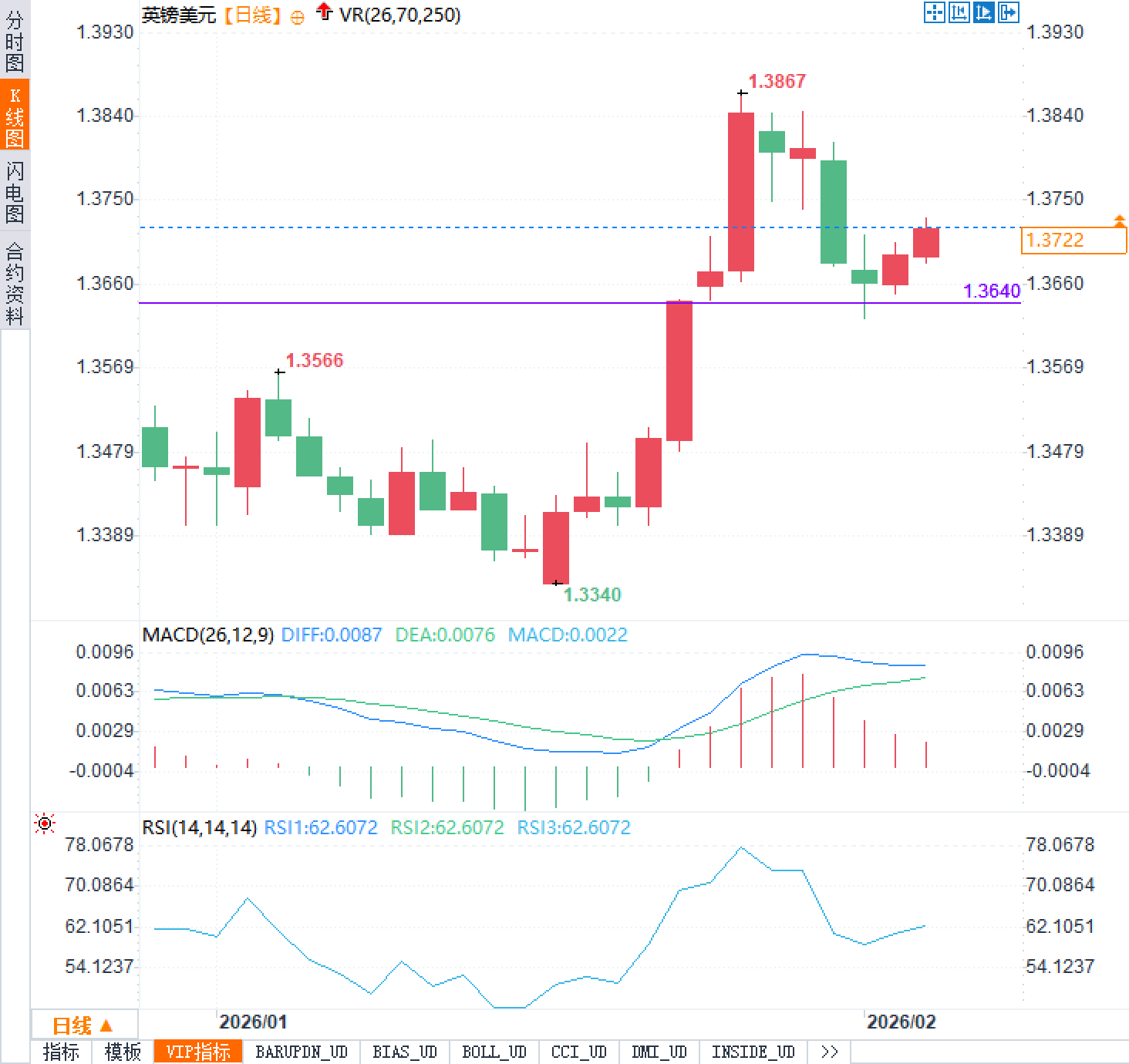
If 1.3640 is decisively broken, the market may further decline to the structural support zone near the previous low of 1.3340 in the short term, and market sentiment will likely turn pessimistic. Regarding momentum indicators, the RSI is currently at 62.6072, in a slightly bullish but not overheated range, indicating that the bulls still have the upper hand, but lack sufficient momentum to drive the trend forward. As for the MACD, the DIFF is 0.0087, the DEA is 0.0076, and the MACD histogram is 0.0022. Although these are still above the zero line, indicating an overall bullish trend, the histogram height is significantly lower than the previous high, reflecting a weakening upward momentum.
In summary, the GBP/USD pair is currently in a critical window driven by fundamentals. If US data continues to be strong, and the Bank of England releases dovish signals in its forecasts, the exchange rate may experience a deeper pullback and test the 1.3640 support level. Conversely, if US data falls short of expectations and the Bank of England remains restrained and does not shift towards easing, the pound still has the potential to challenge its previous highs again.
The market's focus is shifting from simple exchange rate fluctuations to the cross-verification of a series of key economic data and central bank policy moves. In particular, marginal improvements in a series of US economic indicators have fueled market expectations that the Federal Reserve will maintain higher interest rates for a longer period, providing support for the US dollar. In the UK, although the overall forward-looking economic index performed strongly, fueling speculation that the Bank of England might take a hawkish stance, overall inflation and employment data have not deviated significantly from expectations, limiting the room for policy adjustments. Therefore, whether the pound can maintain its strength increasingly depends on changes in the external environment.
The dollar's rebound is supported by fundamentals; data is the biggest variable.
After a correction in late January, the US dollar has recently rebounded, driven primarily by improving economic data. In particular, the latest manufacturing sentiment index released positive signals, suggesting that the US economy remains resilient. If subsequent data continues to strengthen, especially if interest rate-sensitive indicators exceed expectations, market bets on a Federal Reserve rate cut will be further reduced, providing stronger support for the dollar.
A more crucial test lies ahead—the originally scheduled non-farm payroll report, delayed due to the government shutdown, is expected to be released next week, along with US CPI inflation data. If both data points to a "hot" economy—meaning robust employment and a slow decline in inflation—the dollar is likely to confirm a trend rebound. However, if employment weakens and inflation cools, the market may again bet on the Federal Reserve shifting to easing measures sooner, effectively capping the dollar's upside potential. In short, the dollar's next move awaits the data's "verdict."
Will the Bank of England hold rates steady? The real focus is on the "cryptic messages" in the forecasts.
For the pound, the real test is about to begin – the Bank of England will announce its interest rate decision tomorrow. The market widely expects the benchmark interest rate to remain unchanged, with a likely 6-3 vote in favor of pausing rate hikes. This means the policy rate itself will not be a shock, but the real suspense lies in the details, especially the inflation forecasts and neutral interest rate assessment in the monetary policy report.
If the central bank lowers its future inflation forecasts or reduces its estimate of the neutral interest rate, the market is likely to interpret this as a signal of a more dovish policy stance, thus putting downward pressure on the pound. Conversely, if the forecast remains solid or even slightly hawkish, even without a rate hike, it could be seen as a "pause in hawkishness," giving the pound a breather. Furthermore, while changes in the wording of the policy statement are unlikely to drastically alter perceptions, at this sensitive juncture, any subtle adjustments can be amplified and interpreted.
Technical indicators are showing signs of weakness, and the market is entering a "critical moment."
From a technical chart perspective, the British pound against the US dollar previously surged to a high of 1.3867, but failed to hold and quickly retreated, indicating strong resistance above. The current price is in the middle range after the previous high pullback, a typical battleground between bulls and bears. Strong resistance lies around 1.3867; without strong fundamental catalysts, a breakout could be a false breakout. On the downside, the key level to watch is 1.3640, which has shown strong support during multiple pullbacks and is a crucial dividing line for determining whether the trend has reversed.
If 1.3640 is decisively broken, the market may further decline to the structural support zone near the previous low of 1.3340 in the short term, and market sentiment will likely turn pessimistic. Regarding momentum indicators, the RSI is currently at 62.6072, in a slightly bullish but not overheated range, indicating that the bulls still have the upper hand, but lack sufficient momentum to drive the trend forward. As for the MACD, the DIFF is 0.0087, the DEA is 0.0076, and the MACD histogram is 0.0022. Although these are still above the zero line, indicating an overall bullish trend, the histogram height is significantly lower than the previous high, reflecting a weakening upward momentum.
In summary, the GBP/USD pair is currently in a critical window driven by fundamentals. If US data continues to be strong, and the Bank of England releases dovish signals in its forecasts, the exchange rate may experience a deeper pullback and test the 1.3640 support level. Conversely, if US data falls short of expectations and the Bank of England remains restrained and does not shift towards easing, the pound still has the potential to challenge its previous highs again.
- Risk Warning and Disclaimer
- The market involves risk, and trading may not be suitable for all investors. This article is for reference only and does not constitute personal investment advice, nor does it take into account certain users’ specific investment objectives, financial situation, or other needs. Any investment decisions made based on this information are at your own risk.