Gold Trading Alert: Bulls and Bears Battle at the $5000 Level! Dollar Rebounds, Global Watch for These Three Potential Risks
2026-02-05 08:00:01
Wednesday (February 4th) saw a dramatic rollercoaster ride in the gold market. Spot gold initially surged over 3%, reaching a high of $5091.63 per ounce, before plummeting to a low of around $4853, exhibiting astonishing volatility within a single day. Ultimately, spot gold managed a modest 0.3% gain, closing at $4963.59. This dramatic turn of events, like a miniature theater, vividly illustrates the complex forces currently facing the gold market: on one hand, bargain hunting provides a rebound momentum; on the other hand, a stronger dollar exerts direct downward pressure, coupled with fluctuating safe-haven demand. The market oscillates wildly between euphoria and caution, with investors awaiting new directional guidance. Thursday
The recent pullback in gold prices was primarily driven by the strength of the US dollar. With the dollar index hovering near its highest level in over a week, dollar-denominated gold has become more expensive for investors holding other currencies, directly suppressing overseas demand. David Meger, Director of Metals Trading at High Ridge Futures, succinctly stated, "The dollar has indeed rebounded, and its strength is putting pressure on gold."
The strengthening of the US dollar is underpinned by the resilience shown in US service sector data. The Institute for Supply Management (ISM) report showed that the US non-manufacturing PMI remained stable at 53.8 in January, while rising input costs raised concerns about a potential rebound in service sector inflation. This subtle shift in economic data has temporarily provided support for the dollar, thus creating a "ceiling" effect on gold.
Meanwhile, the technical adjustment pressure within the market cannot be ignored. Gold prices climbed to unprecedented heights in a short period, accumulating substantial profits. Some investors chose to "take profits," naturally triggering a price pullback. As David Meger added, the market is still in a consolidation phase after reaching record highs, and this process is "not entirely over yet." This selling pressure driven by inherent profit-taking is a healthy correction that any asset may face after a rapid rise, but it also exacerbates short-term price volatility.
The gold market is currently at a crossroads, and its future trend will be closely intertwined with fierce competition around three core variables.
First and foremost is the US January non-farm payrolls report, due on February 11th. This report, delayed due to the government shutdown, has become the focus of global markets. The previously released ADP private sector employment data fell short of expectations, adding only 22,000 jobs, far below the forecast, casting a shadow over the labor market.
Standard Chartered's Steve Englander points out that the market is struggling to weigh whether the current stock market turmoil, led by tech stocks, is a typical example of risk aversion (which usually benefits the dollar) or a signal of deterioration in the core sectors of the US economy. The non-farm payroll data will be key to answering this question and reshaping expectations for the Fed's interest rate path. Any change in Fed policy expectations—whether an earlier or later rate cut is anticipated—will directly and forcefully impact gold prices through the dollar and real interest rates.
Secondly, the geopolitical situation presents a complex picture of "two extremes." On the one hand, there are signs of easing tensions. Russia and Ukraine held "productive" talks in Abu Dhabi under US mediation; although battlefield conflict continues, the diplomatic contact itself reduces the risk of a sudden escalation. On the other hand, new uncertainties are emerging. The US and Iran have agreed to hold talks in Oman on Friday, but fundamental differences remain on the negotiation agenda (the US demands discussions on missiles, while Iran only wants to discuss its nuclear program), casting uncertainty on the prospects of the negotiations and even regional stability. This delicate geopolitical balance causes the safe-haven demand for gold to fluctuate, sometimes weakening and sometimes supporting it, exhibiting an unstable, pulse-like characteristic.
Finally, long-term confidence and structural support from professional institutions remain robust. The latest survey shows that analysts have raised their 2026 gold price forecasts, with the median average reaching $4,746.50 per ounce—the highest annual forecast in the survey's more than a decade-long history. The logic supporting this optimistic outlook remains unchanged: high global geopolitical uncertainty, continued strong gold purchases by central banks (to diversify their foreign exchange reserves), concerns about the Federal Reserve's independence, doubts about the sustainability of the massive US debt, and the global trend of de-dollarization. As GoldCore CEO David Russell stated, we are entering an era where the institutions that have underpinned the global system for decades are undergoing severe testing. These deep-seated structural factors constitute the most solid foundation for a long-term bull market in gold.
In conclusion, the gold market is currently caught in a fierce tug-of-war between short-term adjustment pressures and long-term upward momentum. Wednesday's dramatic fluctuations may just be the beginning. In the coming week, the market will first be tested by the non-farm payroll data, which will significantly influence market pricing of the Federal Reserve's monetary policy, thus determining the short-term strength of the dollar and gold. Simultaneously, investors must act like radar, continuously scanning for any developments in the Ukraine and Middle East geopolitical negotiations; any unexpected breakthroughs or breakdowns could trigger a sharp reaction in gold prices.
In the short term, gold prices are likely to remain range-bound between $4,800 and $5,100 before making further moves. On one hand, if the US dollar continues to rebound and next week's non-farm payroll data is strong, gold may test the support level of $4,850-$4,900. On the other hand, if geopolitical risks escalate again or employment data weakens further, the probability of gold prices breaking through the $5,100 mark and even reaching higher levels is not low.
In the long term, as long as the global uncertainty landscape does not undergo a fundamental improvement, gold's status as the ultimate safe-haven asset and inflation hedge will remain largely unshaken. The 2026 average price forecast has been revised upwards to above $4,700, indicating that the market generally believes that even with periodic adjustments, the upward trend will still dominate throughout the year.
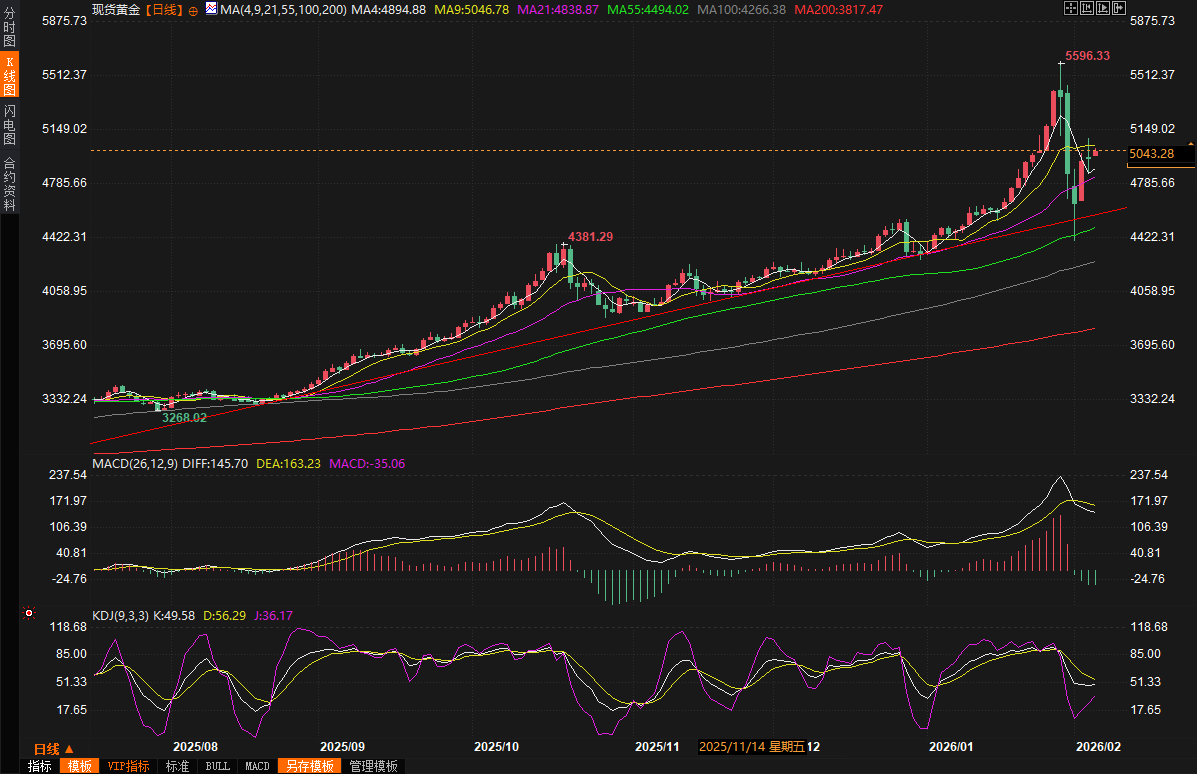
(Spot gold daily chart, source: FX678)
At 07:58 Beijing time, spot gold was trading at $5012.29 per ounce.
Pressures emerge: A double whammy of a strong dollar and profit-taking.
The recent pullback in gold prices was primarily driven by the strength of the US dollar. With the dollar index hovering near its highest level in over a week, dollar-denominated gold has become more expensive for investors holding other currencies, directly suppressing overseas demand. David Meger, Director of Metals Trading at High Ridge Futures, succinctly stated, "The dollar has indeed rebounded, and its strength is putting pressure on gold."
The strengthening of the US dollar is underpinned by the resilience shown in US service sector data. The Institute for Supply Management (ISM) report showed that the US non-manufacturing PMI remained stable at 53.8 in January, while rising input costs raised concerns about a potential rebound in service sector inflation. This subtle shift in economic data has temporarily provided support for the dollar, thus creating a "ceiling" effect on gold.
Meanwhile, the technical adjustment pressure within the market cannot be ignored. Gold prices climbed to unprecedented heights in a short period, accumulating substantial profits. Some investors chose to "take profits," naturally triggering a price pullback. As David Meger added, the market is still in a consolidation phase after reaching record highs, and this process is "not entirely over yet." This selling pressure driven by inherent profit-taking is a healthy correction that any asset may face after a rapid rise, but it also exacerbates short-term price volatility.
The focus of the game: Three key variables will determine the next move for gold.
The gold market is currently at a crossroads, and its future trend will be closely intertwined with fierce competition around three core variables.
First and foremost is the US January non-farm payrolls report, due on February 11th. This report, delayed due to the government shutdown, has become the focus of global markets. The previously released ADP private sector employment data fell short of expectations, adding only 22,000 jobs, far below the forecast, casting a shadow over the labor market.
Standard Chartered's Steve Englander points out that the market is struggling to weigh whether the current stock market turmoil, led by tech stocks, is a typical example of risk aversion (which usually benefits the dollar) or a signal of deterioration in the core sectors of the US economy. The non-farm payroll data will be key to answering this question and reshaping expectations for the Fed's interest rate path. Any change in Fed policy expectations—whether an earlier or later rate cut is anticipated—will directly and forcefully impact gold prices through the dollar and real interest rates.
Secondly, the geopolitical situation presents a complex picture of "two extremes." On the one hand, there are signs of easing tensions. Russia and Ukraine held "productive" talks in Abu Dhabi under US mediation; although battlefield conflict continues, the diplomatic contact itself reduces the risk of a sudden escalation. On the other hand, new uncertainties are emerging. The US and Iran have agreed to hold talks in Oman on Friday, but fundamental differences remain on the negotiation agenda (the US demands discussions on missiles, while Iran only wants to discuss its nuclear program), casting uncertainty on the prospects of the negotiations and even regional stability. This delicate geopolitical balance causes the safe-haven demand for gold to fluctuate, sometimes weakening and sometimes supporting it, exhibiting an unstable, pulse-like characteristic.
Finally, long-term confidence and structural support from professional institutions remain robust. The latest survey shows that analysts have raised their 2026 gold price forecasts, with the median average reaching $4,746.50 per ounce—the highest annual forecast in the survey's more than a decade-long history. The logic supporting this optimistic outlook remains unchanged: high global geopolitical uncertainty, continued strong gold purchases by central banks (to diversify their foreign exchange reserves), concerns about the Federal Reserve's independence, doubts about the sustainability of the massive US debt, and the global trend of de-dollarization. As GoldCore CEO David Russell stated, we are entering an era where the institutions that have underpinned the global system for decades are undergoing severe testing. These deep-seated structural factors constitute the most solid foundation for a long-term bull market in gold.
Looking ahead: Finding a balance between short-term fluctuations and long-term trends
In conclusion, the gold market is currently caught in a fierce tug-of-war between short-term adjustment pressures and long-term upward momentum. Wednesday's dramatic fluctuations may just be the beginning. In the coming week, the market will first be tested by the non-farm payroll data, which will significantly influence market pricing of the Federal Reserve's monetary policy, thus determining the short-term strength of the dollar and gold. Simultaneously, investors must act like radar, continuously scanning for any developments in the Ukraine and Middle East geopolitical negotiations; any unexpected breakthroughs or breakdowns could trigger a sharp reaction in gold prices.
In the short term, gold prices are likely to remain range-bound between $4,800 and $5,100 before making further moves. On one hand, if the US dollar continues to rebound and next week's non-farm payroll data is strong, gold may test the support level of $4,850-$4,900. On the other hand, if geopolitical risks escalate again or employment data weakens further, the probability of gold prices breaking through the $5,100 mark and even reaching higher levels is not low.
In the long term, as long as the global uncertainty landscape does not undergo a fundamental improvement, gold's status as the ultimate safe-haven asset and inflation hedge will remain largely unshaken. The 2026 average price forecast has been revised upwards to above $4,700, indicating that the market generally believes that even with periodic adjustments, the upward trend will still dominate throughout the year.
(Spot gold daily chart, source: FX678)
At 07:58 Beijing time, spot gold was trading at $5012.29 per ounce.
- Risk Warning and Disclaimer
- The market involves risk, and trading may not be suitable for all investors. This article is for reference only and does not constitute personal investment advice, nor does it take into account certain users’ specific investment objectives, financial situation, or other needs. Any investment decisions made based on this information are at your own risk.