The Fed's hawkish stance put downward pressure on the pound, which is now awaiting stabilization.
2026-02-05 13:58:27
The GBP/USD pair continued its decline during Thursday's Asian trading session, hovering around 1.3620. The main reason for the pound's weakness was the market's cautious stance regarding the Bank of England's interest rate decision.
The market widely expects the BOE Monetary Policy Committee (MPC) to keep interest rates unchanged in February, while the long-term fundamentals have not shown significant improvement after the committee narrowly lowered rates by 25 basis points by a 5-4 vote in December.
Investors adopted a cautious wait-and-see approach ahead of the decision, putting pressure on the pound. The dollar, on the other hand, remained strong, supported by expectations of Fed policy changes. The market widely anticipates a slower pace of Fed rate cuts, which is beneficial for the dollar.
Federal Reserve Governor Lisa Cook stated that she would not support further interest rate cuts until inflation has fallen significantly, emphasizing that her concerns about stagnant inflation outweigh her concerns about a weak labor market. This hawkish stance provided temporary support for the US dollar.
Furthermore, the market's positive support for the dollar came from the nomination of Kevin Warsh, a candidate for the next Federal Reserve chairman. Warsh's preference for maintaining a smaller balance sheet and his cautious approach to interest rate cuts are interpreted as a signal of a more prudent future monetary policy from the Fed.
Despite President Trump's statement that he would not have been nominated if Warsh supported interest rate hikes, and his emphasis that US interest rates were "too high" and that rate cuts were still possible, the overall hawkish logic still supports the dollar's temporary strength.
On the economic data front, ADP private sector employment increased by 22,000 in January, far below the market expectation of 48,000 and also lower than the previous value of 37,000 (revised to 41,000), indicating a slowdown in employment growth and providing important reference value for expectations of US dollar policy.
The ISM Services Index remained unchanged at 53.8, slightly higher than the expected 53.5, indicating that the expansion of the services sector continues, but economic growth is showing divergent characteristics. Under the combined pressure of a weakening pound and a temporarily stronger dollar, the GBP/USD exchange rate is expected to continue its downward trend in the short term, with the market anticipating continued volatility before the BoE interest rate decision.
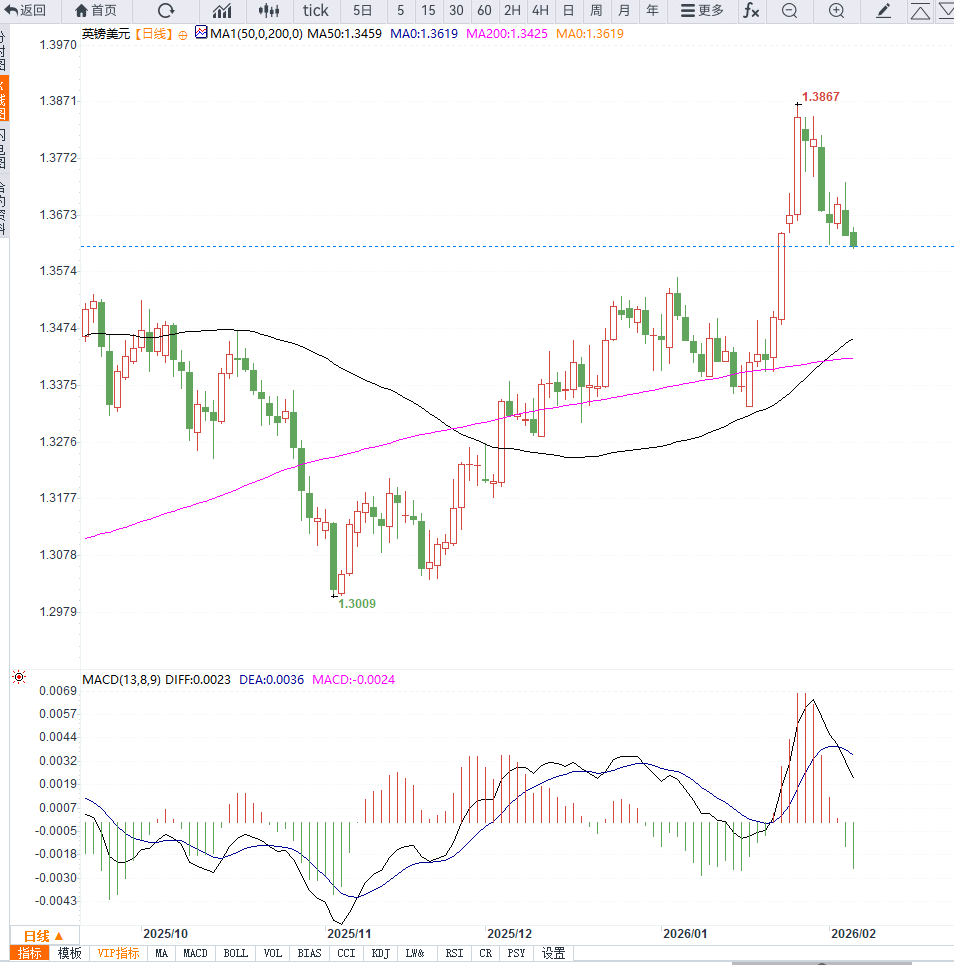
The daily chart shows that GBP/USD has been weak recently, testing support around 1.3620 for two consecutive days. Short-term moving averages are trending downwards, indicating waning bullish momentum. The price has consistently closed below the 20-day moving average, reflecting bearish dominance and significant short-term downward pressure.
In terms of momentum indicators, the RSI is close to the neutral-to-low range and has not yet reached oversold levels, indicating that there is still some room for a short-term pullback, but the risk of excessive decline is limited. The MACD indicator remains below the zero line, and the histogram is contracting, indicating that there is bearish momentum, but it may enter a consolidation phase in the short term.
Structurally, 1.3600 is a key short-term support level; a break below this area could open up further downside potential to around 1.3530. If the exchange rate rebounds and breaks above the 1.3660-1.3680 resistance zone, it is likely to return to a consolidation pattern. Overall, the GBP/USD daily chart suggests a short-term pullback and consolidation, but it remains influenced by a strong US dollar and BoE interest rate news, leading to increased short-term volatility.
Editor's Note:
The core of GBP/USD's short-term fluctuations lies in the interplay of a strong US dollar and pressure on the British pound. Ahead of the BOE interest rate decision, the pound lacks fundamental support, while the hawkish stance of the US dollar continues to provide upward momentum. Attention should be paid to the BOE interest rate announcement and subsequent statements from Federal Reserve officials, as these factors will determine whether the exchange rate continues its downward trend or experiences a rebound.
The market widely expects the BOE Monetary Policy Committee (MPC) to keep interest rates unchanged in February, while the long-term fundamentals have not shown significant improvement after the committee narrowly lowered rates by 25 basis points by a 5-4 vote in December.
Investors adopted a cautious wait-and-see approach ahead of the decision, putting pressure on the pound. The dollar, on the other hand, remained strong, supported by expectations of Fed policy changes. The market widely anticipates a slower pace of Fed rate cuts, which is beneficial for the dollar.
Federal Reserve Governor Lisa Cook stated that she would not support further interest rate cuts until inflation has fallen significantly, emphasizing that her concerns about stagnant inflation outweigh her concerns about a weak labor market. This hawkish stance provided temporary support for the US dollar.
Furthermore, the market's positive support for the dollar came from the nomination of Kevin Warsh, a candidate for the next Federal Reserve chairman. Warsh's preference for maintaining a smaller balance sheet and his cautious approach to interest rate cuts are interpreted as a signal of a more prudent future monetary policy from the Fed.
Despite President Trump's statement that he would not have been nominated if Warsh supported interest rate hikes, and his emphasis that US interest rates were "too high" and that rate cuts were still possible, the overall hawkish logic still supports the dollar's temporary strength.
On the economic data front, ADP private sector employment increased by 22,000 in January, far below the market expectation of 48,000 and also lower than the previous value of 37,000 (revised to 41,000), indicating a slowdown in employment growth and providing important reference value for expectations of US dollar policy.
The ISM Services Index remained unchanged at 53.8, slightly higher than the expected 53.5, indicating that the expansion of the services sector continues, but economic growth is showing divergent characteristics. Under the combined pressure of a weakening pound and a temporarily stronger dollar, the GBP/USD exchange rate is expected to continue its downward trend in the short term, with the market anticipating continued volatility before the BoE interest rate decision.
The daily chart shows that GBP/USD has been weak recently, testing support around 1.3620 for two consecutive days. Short-term moving averages are trending downwards, indicating waning bullish momentum. The price has consistently closed below the 20-day moving average, reflecting bearish dominance and significant short-term downward pressure.
In terms of momentum indicators, the RSI is close to the neutral-to-low range and has not yet reached oversold levels, indicating that there is still some room for a short-term pullback, but the risk of excessive decline is limited. The MACD indicator remains below the zero line, and the histogram is contracting, indicating that there is bearish momentum, but it may enter a consolidation phase in the short term.
Structurally, 1.3600 is a key short-term support level; a break below this area could open up further downside potential to around 1.3530. If the exchange rate rebounds and breaks above the 1.3660-1.3680 resistance zone, it is likely to return to a consolidation pattern. Overall, the GBP/USD daily chart suggests a short-term pullback and consolidation, but it remains influenced by a strong US dollar and BoE interest rate news, leading to increased short-term volatility.
Editor's Note:
The core of GBP/USD's short-term fluctuations lies in the interplay of a strong US dollar and pressure on the British pound. Ahead of the BOE interest rate decision, the pound lacks fundamental support, while the hawkish stance of the US dollar continues to provide upward momentum. Attention should be paid to the BOE interest rate announcement and subsequent statements from Federal Reserve officials, as these factors will determine whether the exchange rate continues its downward trend or experiences a rebound.
- Risk Warning and Disclaimer
- The market involves risk, and trading may not be suitable for all investors. This article is for reference only and does not constitute personal investment advice, nor does it take into account certain users’ specific investment objectives, financial situation, or other needs. Any investment decisions made based on this information are at your own risk.