Myth Shattered! Silver Plunged Over 16% at One Point, Speculative Frenzy and Market Warning
2026-02-05 14:53:36
The global precious metals market has recently witnessed a dramatic and shocking fluctuation in silver prices. On Thursday (February 5th), spot silver prices plummeted by as much as 16% to $73.25 per ounce, not only ending a brief two-day rebound and erasing all gains from the previous two trading days, but also highlighting the fragility of speculative forces in the market. This event has attracted widespread attention because silver had accumulated a gain of up to 146% in 2025 and continued to break historical records in January 2026, only to suffer a severe setback in the short term. This article will delve into the background, causes, and potential impact of this silver price decline to help readers understand the underlying logic behind this market turmoil.
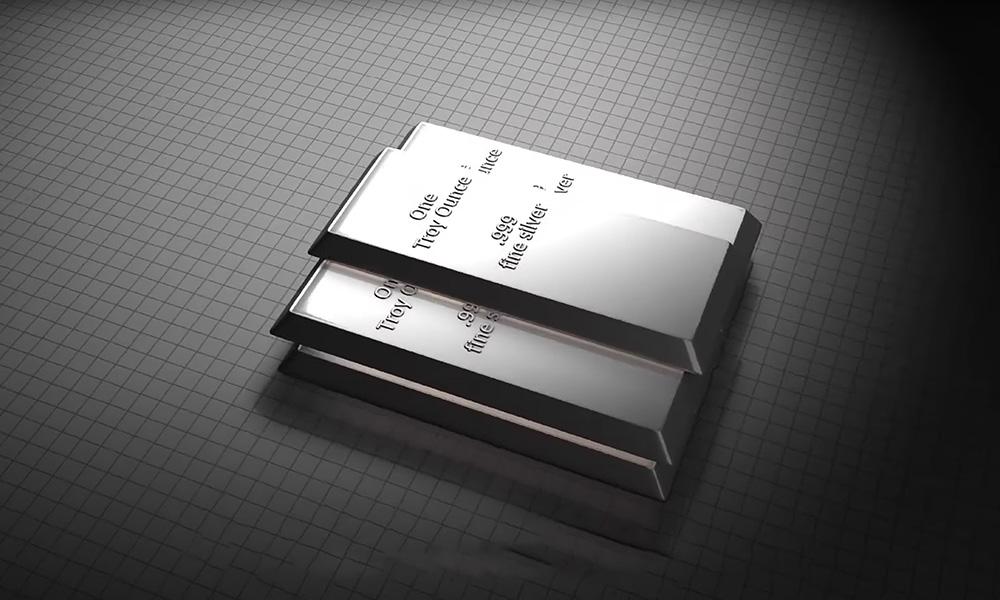
The decline in silver prices was swift and relentless. Spot silver is currently down about 11% at $78.12 per ounce, while COMEX silver is down more than 7.5% at $77.86 per ounce, after earlier in the session falling more than 16% and 13% respectively. This sharp correction is not an isolated event, but rather a release of long-accumulated pressure in the silver market.
Prior to this, silver had experienced a record-breaking rally, but suddenly collapsed last Friday (January 30th), plummeting by as much as 35% intraday. Looking back at the whole of 2025, silver prices have accumulated a gain of approximately 146%, and in January 2026, they surged by nearly 60%, demonstrating the market's fervent pursuit of silver. However, such rapid increases often foreshadow subsequent sharp corrections, as has been demonstrated by numerous commodity bubbles throughout history. As an asset with dual characteristics—supported by industrial demand yet susceptible to speculative sentiment—silver's price volatility is far higher than that of other precious metals such as gold.
The recent sharp fluctuations in silver prices were primarily due to excessive intervention by speculative funds, rather than a fundamental change in real demand. Analysts unanimously point out that the accumulation of leveraged positions, the amplifying effect of options trading, and the flow of speculative funds were the key factors driving price swings. These elements caused the market to deviate from fundamentals, resembling a leveraged game in the financial derivatives market.
In his analysis, Sunil Garg, managing director of Lighthouse Canton, a senior expert, emphasized that a large number of speculative positions have not been completely cleared, which means that the market may still face further reshuffling in the short term.
He further explained that the fundamental demand for silver remains solid, including its wide range of applications in industries such as solar energy, catalysts, and electronics, which form the basis of silver's long-term value as a strategic metal.
However, investors should remain cautious and wait for market forces to gradually "clear out" these leveraged positions before the speculative bubble bursts.
Furthermore, the increase in margin requirements by several global metal exchanges has also curbed speculative activity to some extent. For example, the CME Group quickly adjusted its margin requirements after a sharp sell-off last Friday, which effectively cooled down the overheated trading and further accelerated the withdrawal of speculative funds.
As prices fell, the chain reaction of trading mechanisms exacerbated market turmoil. Goldman Sachs described this process in detail in a report on Wednesday (February 4): As prices declined, traders' hedging strategies shifted from buying on dips to selling on rallies, triggering stop-loss mechanisms among investors, causing losses to be amplified at each level of the system.
In contrast, silver's pullback was far greater than gold's, primarily due to tighter liquidity conditions in the London market, which amplified price volatility. Goldman Sachs also pointed out from a time perspective that most of the sharp fluctuations occurred during the closure of China's futures market, indicating that Western funds, rather than Chinese speculative forces, were the main drivers of this position-building and closing. This characteristic of cross-border capital flows further highlights the interconnectedness of global financial markets.
Furthermore, the volatility in the silver market has drawn comparisons to the phenomenon of "meme stocks," such as the 2021 surge in GameStop's stock price, which was driven by an irrational exuberance fueled by a collective of retail investors on Reddit.
Market observers had previously warned that silver prices had deviated from sustainable levels and shifted to a “meme-based” trading pattern, reflecting how precious metals are attracting public attention and triggering momentum trading that goes beyond the volatility of traditional assets.
As Interactive Brokers chief strategist Steve Sosnick stated, this momentum trading even surpasses the historical extremes of many speculative assets.
During the same period, gold prices performed relatively moderately, with spot gold and futures prices only falling by more than 3% at one point, reaching $4,790 and $4,805 per ounce respectively, and currently recovering to around $4,915 and $4,935 respectively. This difference stems not only from gold's stronger safe-haven properties, but also from its better liquidity, making it less susceptible to short-term speculative shocks.
Silver's industrial properties make it more susceptible to economic cycles, but this also provides it with recovery potential. Overall, this event serves as a reminder to investors that while the precious metals market has long-term upside potential, short-term volatility risks cannot be ignored. Excessive leverage and speculative behavior often lead to a "boom-bust" cycle, while regulatory measures such as margin adjustments are crucial tools for maintaining market stability.
In conclusion, the sharp drop in silver prices is not only a natural result of market adjustments but also a warning of a bursting speculative bubble. Although fundamental demand remains strong, investors need to be wary of short-term risks and wait for the market to settle down. This event also serves as a wake-up call for global commodity markets: in the digital and globalized era, any asset can be driven irrationally by emotions. In the future, with economic recovery and the advancement of technological applications, silver may regain its upward momentum, but rational investment remains the best strategy for navigating volatility.
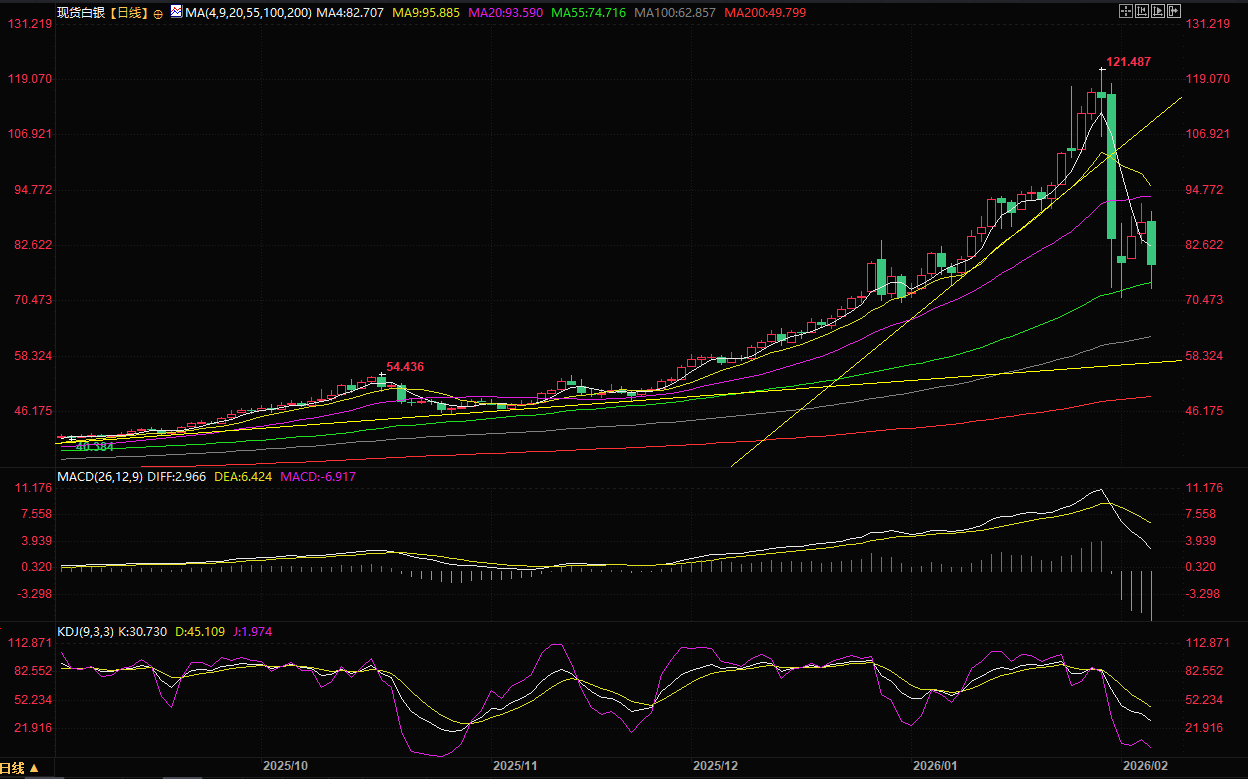
(Spot silver daily chart, source: EasyForex)
At 14:48 Beijing time, spot gold was trading at $78.11 per ounce.
Instantaneous performance and historical review of price crashes
The decline in silver prices was swift and relentless. Spot silver is currently down about 11% at $78.12 per ounce, while COMEX silver is down more than 7.5% at $77.86 per ounce, after earlier in the session falling more than 16% and 13% respectively. This sharp correction is not an isolated event, but rather a release of long-accumulated pressure in the silver market.
Prior to this, silver had experienced a record-breaking rally, but suddenly collapsed last Friday (January 30th), plummeting by as much as 35% intraday. Looking back at the whole of 2025, silver prices have accumulated a gain of approximately 146%, and in January 2026, they surged by nearly 60%, demonstrating the market's fervent pursuit of silver. However, such rapid increases often foreshadow subsequent sharp corrections, as has been demonstrated by numerous commodity bubbles throughout history. As an asset with dual characteristics—supported by industrial demand yet susceptible to speculative sentiment—silver's price volatility is far higher than that of other precious metals such as gold.
Analysis of the root causes of speculative volatility
The recent sharp fluctuations in silver prices were primarily due to excessive intervention by speculative funds, rather than a fundamental change in real demand. Analysts unanimously point out that the accumulation of leveraged positions, the amplifying effect of options trading, and the flow of speculative funds were the key factors driving price swings. These elements caused the market to deviate from fundamentals, resembling a leveraged game in the financial derivatives market.
In his analysis, Sunil Garg, managing director of Lighthouse Canton, a senior expert, emphasized that a large number of speculative positions have not been completely cleared, which means that the market may still face further reshuffling in the short term.
He further explained that the fundamental demand for silver remains solid, including its wide range of applications in industries such as solar energy, catalysts, and electronics, which form the basis of silver's long-term value as a strategic metal.
However, investors should remain cautious and wait for market forces to gradually "clear out" these leveraged positions before the speculative bubble bursts.
Furthermore, the increase in margin requirements by several global metal exchanges has also curbed speculative activity to some extent. For example, the CME Group quickly adjusted its margin requirements after a sharp sell-off last Friday, which effectively cooled down the overheated trading and further accelerated the withdrawal of speculative funds.
The amplifying effect of market mechanisms and external factors
As prices fell, the chain reaction of trading mechanisms exacerbated market turmoil. Goldman Sachs described this process in detail in a report on Wednesday (February 4): As prices declined, traders' hedging strategies shifted from buying on dips to selling on rallies, triggering stop-loss mechanisms among investors, causing losses to be amplified at each level of the system.
In contrast, silver's pullback was far greater than gold's, primarily due to tighter liquidity conditions in the London market, which amplified price volatility. Goldman Sachs also pointed out from a time perspective that most of the sharp fluctuations occurred during the closure of China's futures market, indicating that Western funds, rather than Chinese speculative forces, were the main drivers of this position-building and closing. This characteristic of cross-border capital flows further highlights the interconnectedness of global financial markets.
Furthermore, the volatility in the silver market has drawn comparisons to the phenomenon of "meme stocks," such as the 2021 surge in GameStop's stock price, which was driven by an irrational exuberance fueled by a collective of retail investors on Reddit.
Market observers had previously warned that silver prices had deviated from sustainable levels and shifted to a “meme-based” trading pattern, reflecting how precious metals are attracting public attention and triggering momentum trading that goes beyond the volatility of traditional assets.
As Interactive Brokers chief strategist Steve Sosnick stated, this momentum trading even surpasses the historical extremes of many speculative assets.
Comparison with the gold market and overall impact
During the same period, gold prices performed relatively moderately, with spot gold and futures prices only falling by more than 3% at one point, reaching $4,790 and $4,805 per ounce respectively, and currently recovering to around $4,915 and $4,935 respectively. This difference stems not only from gold's stronger safe-haven properties, but also from its better liquidity, making it less susceptible to short-term speculative shocks.
Silver's industrial properties make it more susceptible to economic cycles, but this also provides it with recovery potential. Overall, this event serves as a reminder to investors that while the precious metals market has long-term upside potential, short-term volatility risks cannot be ignored. Excessive leverage and speculative behavior often lead to a "boom-bust" cycle, while regulatory measures such as margin adjustments are crucial tools for maintaining market stability.
In conclusion, the sharp drop in silver prices is not only a natural result of market adjustments but also a warning of a bursting speculative bubble. Although fundamental demand remains strong, investors need to be wary of short-term risks and wait for the market to settle down. This event also serves as a wake-up call for global commodity markets: in the digital and globalized era, any asset can be driven irrationally by emotions. In the future, with economic recovery and the advancement of technological applications, silver may regain its upward momentum, but rational investment remains the best strategy for navigating volatility.
(Spot silver daily chart, source: EasyForex)
At 14:48 Beijing time, spot gold was trading at $78.11 per ounce.
- Risk Warning and Disclaimer
- The market involves risk, and trading may not be suitable for all investors. This article is for reference only and does not constitute personal investment advice, nor does it take into account certain users’ specific investment objectives, financial situation, or other needs. Any investment decisions made based on this information are at your own risk.