Crude oil trading alert: With geopolitical risk premiums declining and commodity price volatility increasing, oil prices have returned to range-bound trading.
2026-02-06 09:46:41
The crude oil market saw its first pullback in three days after a series of gains. During Friday's Asian trading session, it traded around $62.77 per barrel. With Iran confirming it would begin negotiations with the United States, market concerns about a potential military conflict in the Middle East leading to disruptions in oil supply have eased significantly, gradually diminishing the previously accumulated geopolitical risk premium.
Market research indicates that some funds chose to take profits after key geopolitical news became clearer, putting downward pressure on oil prices. Iranian Foreign Minister Abbas Araqchi confirmed via social media that US-Iran talks will be held in Oman on Friday.
This news was seen as a significant signal reducing the probability of short-term conflict, directly suppressing oil prices. Meanwhile, the latest weak US private sector employment data reignited market concerns about a slowdown in economic growth, casting doubt on the outlook for crude oil demand and further widening the decline in oil prices.

However, oil prices did not experience a one-sided downward trend. Previously, Saudi Arabia lowered the official selling price of its main crude oil products for Asian buyers to a multi-year low, but the actual reduction was less than the industry had generally expected.
The market generally believes that this move is more of a response to the temporary easing of supply than a pessimistic assessment of the demand outlook, thus limiting the decline in oil prices to some extent.
Shell CEO Wael Sawan stated, "There is indeed a certain degree of oversupply in the market right now, but this is balanced by the high level of uncertainty brought about by geopolitical challenges. This uncertainty and volatility itself constitute a price premium."
In addition, traders are still monitoring the latest developments in Ukraine. Ukrainian President Zelenskyy pointed out that Russia's attacks on energy infrastructure will affect the negotiation process and called for more support from the United States. This uncertainty continues to have a potential impact on the crude oil market at the sentiment level.
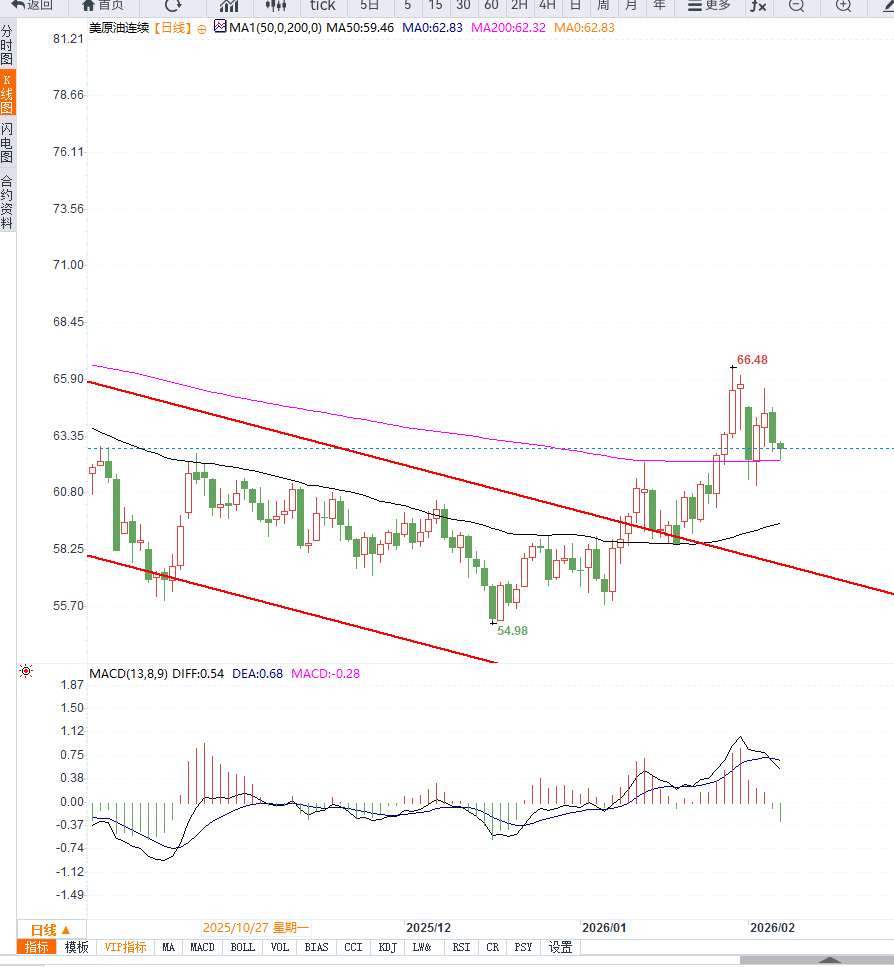
From a daily chart perspective, WTI crude oil rebounded rapidly but then encountered resistance at a key resistance level and fell back, indicating that the upward momentum is weakening and the overall price is still trading within a medium-term consolidation range.
The price failed to hold above the $64.80-$65.00 resistance zone, which is both the upper edge of the previous trading range and a key area of high trading volume during this rebound. The failed breakout has strengthened the pressure for a short-term pullback.
As short-term moving averages flattened out from their upward trend, and daily momentum indicators retreated from their highs, signs of profit-taking by bulls gradually emerged. On the downside, the $62.00-$62.30 level forms the first key support zone; a break below this level could lead to a further decline to test the important daily support zone of $60.50-$61.00.
This area also corresponds to the lower edge of the previous consolidation range, and is expected to attract some medium-term capital inflows. Overall, WTI is more likely to fluctuate repeatedly within the $62-$65 range in the short term, exhibiting high volatility but lacking a clear directional breakout.
Editor's Note:
The crude oil market is currently in a phase of interplay between multiple forces. On the one hand, the confirmation of the US-Iran negotiations has weakened the short-term geopolitical risk premium; on the other hand, demand concerns triggered by macroeconomic data are rising, putting real pressure on oil prices.
With no significant tightening on the supply side and cautious signals on the demand side, oil prices are more likely to remain range-bound in the short term. The key to future price movements will depend on whether geopolitical tensions escalate again and whether global economic data can provide clearer guidance for the demand outlook.
Market research indicates that some funds chose to take profits after key geopolitical news became clearer, putting downward pressure on oil prices. Iranian Foreign Minister Abbas Araqchi confirmed via social media that US-Iran talks will be held in Oman on Friday.
This news was seen as a significant signal reducing the probability of short-term conflict, directly suppressing oil prices. Meanwhile, the latest weak US private sector employment data reignited market concerns about a slowdown in economic growth, casting doubt on the outlook for crude oil demand and further widening the decline in oil prices.
However, oil prices did not experience a one-sided downward trend. Previously, Saudi Arabia lowered the official selling price of its main crude oil products for Asian buyers to a multi-year low, but the actual reduction was less than the industry had generally expected.
The market generally believes that this move is more of a response to the temporary easing of supply than a pessimistic assessment of the demand outlook, thus limiting the decline in oil prices to some extent.
Shell CEO Wael Sawan stated, "There is indeed a certain degree of oversupply in the market right now, but this is balanced by the high level of uncertainty brought about by geopolitical challenges. This uncertainty and volatility itself constitute a price premium."
In addition, traders are still monitoring the latest developments in Ukraine. Ukrainian President Zelenskyy pointed out that Russia's attacks on energy infrastructure will affect the negotiation process and called for more support from the United States. This uncertainty continues to have a potential impact on the crude oil market at the sentiment level.
From a daily chart perspective, WTI crude oil rebounded rapidly but then encountered resistance at a key resistance level and fell back, indicating that the upward momentum is weakening and the overall price is still trading within a medium-term consolidation range.
The price failed to hold above the $64.80-$65.00 resistance zone, which is both the upper edge of the previous trading range and a key area of high trading volume during this rebound. The failed breakout has strengthened the pressure for a short-term pullback.
As short-term moving averages flattened out from their upward trend, and daily momentum indicators retreated from their highs, signs of profit-taking by bulls gradually emerged. On the downside, the $62.00-$62.30 level forms the first key support zone; a break below this level could lead to a further decline to test the important daily support zone of $60.50-$61.00.
This area also corresponds to the lower edge of the previous consolidation range, and is expected to attract some medium-term capital inflows. Overall, WTI is more likely to fluctuate repeatedly within the $62-$65 range in the short term, exhibiting high volatility but lacking a clear directional breakout.
Editor's Note:
The crude oil market is currently in a phase of interplay between multiple forces. On the one hand, the confirmation of the US-Iran negotiations has weakened the short-term geopolitical risk premium; on the other hand, demand concerns triggered by macroeconomic data are rising, putting real pressure on oil prices.
With no significant tightening on the supply side and cautious signals on the demand side, oil prices are more likely to remain range-bound in the short term. The key to future price movements will depend on whether geopolitical tensions escalate again and whether global economic data can provide clearer guidance for the demand outlook.
- Risk Warning and Disclaimer
- The market involves risk, and trading may not be suitable for all investors. This article is for reference only and does not constitute personal investment advice, nor does it take into account certain users’ specific investment objectives, financial situation, or other needs. Any investment decisions made based on this information are at your own risk.