Dovish signals from the Bank of England strengthened expectations of an interest rate cut, and a stronger dollar pushed the pound to a two-week low against the dollar.
2026-02-06 10:04:17
The pound continued its decline against the dollar in Asian trading on Friday, falling for the third consecutive session and briefly hitting a two-week low.
Previously, the dovish signals from the Bank of England's meeting triggered a repricing of the monetary policy outlook in the market, while the US dollar continued to strengthen, supported by safe-haven demand and interest rate expectations, jointly pushing the exchange rate down.
Regarding the US dollar, news of Kevin Warsh's nomination as the next Federal Reserve Chairman has sparked speculation that future monetary policy will lean towards a less dovish stance. Against the backdrop of increased market volatility, the US dollar's attractiveness as the world's primary reserve currency has risen.
The dollar index rose to its highest level since late January, becoming a significant factor suppressing the pound against the dollar. In contrast, the pound was clearly weighed down by the Bank of England's policy stance.
The Bank of England's Monetary Policy Committee voted 5-4 at its February meeting to keep interest rates unchanged, indicating growing internal disagreement on the policy outlook. At the same time, the central bank explicitly hinted in its policy statement that there is room for future rate cuts if inflation continues to slow.
Bank of England Governor Andrew Bailey stated at the post-meeting press conference that inflation may reach the target level sooner than previously expected. This statement quickly triggered a market reaction, with traders beginning to price in a cumulative 50 basis point rate cut by the Bank of England this year, further diminishing the pound's appeal.
Although the market also expects the Federal Reserve to have room for further rate cuts in 2026, the US dollar is more resilient in the short term, supported by interest rate differentials and safe-haven demand, which strengthens the downward logic of the pound against the dollar from a fundamental perspective.
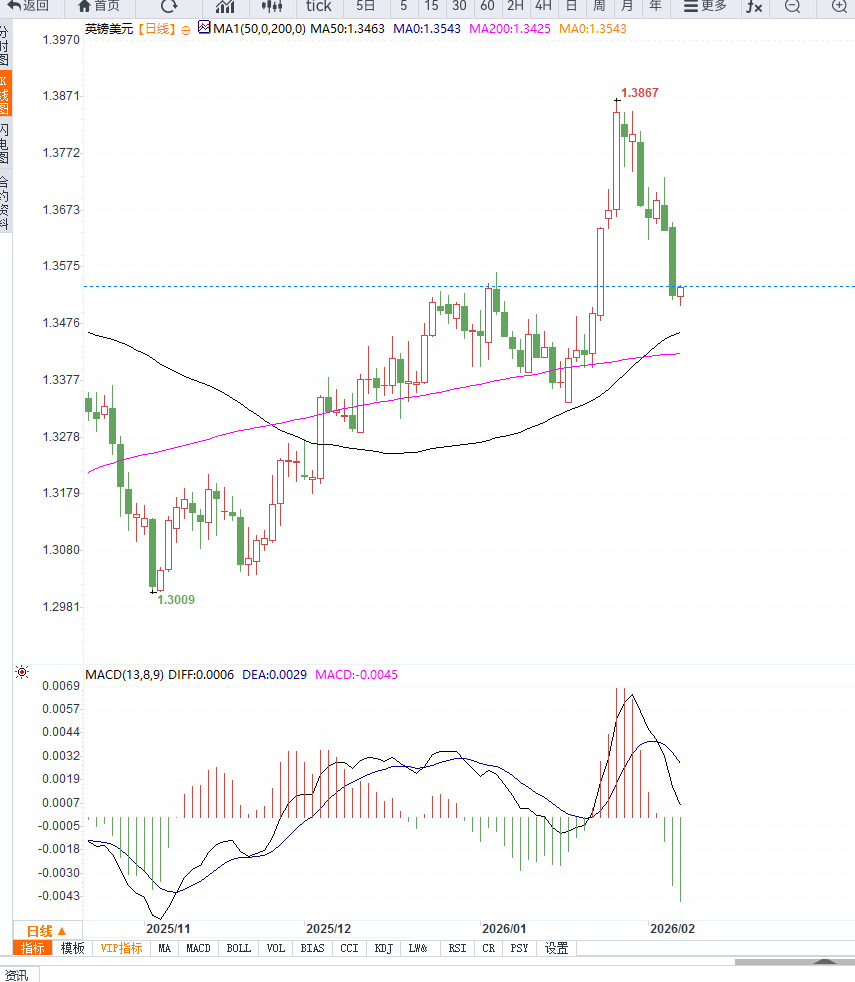
From a daily chart perspective, the British pound against the US dollar broke below its previous consolidation range following the Bank of England's decision, further confirming the downward trend. The exchange rate has effectively broken below short-term moving average support, and the moving average system is beginning to diverge downwards, indicating that bearish momentum is strengthening.
The current level of 1.3500 is a key psychological barrier. If it is broken on the daily chart, the 1.3420-1.3450 range below this level will become the next important support area. If it continues to fall below this level, a retest of the 1.3350 level cannot be ruled out.
On the upside, 1.3600 forms the first significant resistance level, which also corresponds to the lower edge of the previous consolidation range. Stronger resistance lies around 1.3700; only a retest of this area could alleviate the current weak structure. Overall, given the bearish fundamentals and weakening technical patterns, the GBP/USD pair still faces further downward pressure in the short term.
Editor's Note:
This pullback in the pound was not driven by a single event, but rather by the combined effect of a rapid shift in Bank of England policy expectations and a temporary strength in the US dollar. The market has clearly priced in a potential interest rate cut in the UK this year, putting relative pressure on the pound among major currencies.
In the absence of new positive factors, the pound is more likely to maintain a weak trend against the dollar in the short term. The key to its future direction will still depend on whether UK inflation data continues to decline and whether the dollar's strength can be sustained.
Previously, the dovish signals from the Bank of England's meeting triggered a repricing of the monetary policy outlook in the market, while the US dollar continued to strengthen, supported by safe-haven demand and interest rate expectations, jointly pushing the exchange rate down.
Regarding the US dollar, news of Kevin Warsh's nomination as the next Federal Reserve Chairman has sparked speculation that future monetary policy will lean towards a less dovish stance. Against the backdrop of increased market volatility, the US dollar's attractiveness as the world's primary reserve currency has risen.
The dollar index rose to its highest level since late January, becoming a significant factor suppressing the pound against the dollar. In contrast, the pound was clearly weighed down by the Bank of England's policy stance.
The Bank of England's Monetary Policy Committee voted 5-4 at its February meeting to keep interest rates unchanged, indicating growing internal disagreement on the policy outlook. At the same time, the central bank explicitly hinted in its policy statement that there is room for future rate cuts if inflation continues to slow.
Bank of England Governor Andrew Bailey stated at the post-meeting press conference that inflation may reach the target level sooner than previously expected. This statement quickly triggered a market reaction, with traders beginning to price in a cumulative 50 basis point rate cut by the Bank of England this year, further diminishing the pound's appeal.
Although the market also expects the Federal Reserve to have room for further rate cuts in 2026, the US dollar is more resilient in the short term, supported by interest rate differentials and safe-haven demand, which strengthens the downward logic of the pound against the dollar from a fundamental perspective.
From a daily chart perspective, the British pound against the US dollar broke below its previous consolidation range following the Bank of England's decision, further confirming the downward trend. The exchange rate has effectively broken below short-term moving average support, and the moving average system is beginning to diverge downwards, indicating that bearish momentum is strengthening.
The current level of 1.3500 is a key psychological barrier. If it is broken on the daily chart, the 1.3420-1.3450 range below this level will become the next important support area. If it continues to fall below this level, a retest of the 1.3350 level cannot be ruled out.
On the upside, 1.3600 forms the first significant resistance level, which also corresponds to the lower edge of the previous consolidation range. Stronger resistance lies around 1.3700; only a retest of this area could alleviate the current weak structure. Overall, given the bearish fundamentals and weakening technical patterns, the GBP/USD pair still faces further downward pressure in the short term.
Editor's Note:
This pullback in the pound was not driven by a single event, but rather by the combined effect of a rapid shift in Bank of England policy expectations and a temporary strength in the US dollar. The market has clearly priced in a potential interest rate cut in the UK this year, putting relative pressure on the pound among major currencies.
In the absence of new positive factors, the pound is more likely to maintain a weak trend against the dollar in the short term. The key to its future direction will still depend on whether UK inflation data continues to decline and whether the dollar's strength can be sustained.
- Risk Warning and Disclaimer
- The market involves risk, and trading may not be suitable for all investors. This article is for reference only and does not constitute personal investment advice, nor does it take into account certain users’ specific investment objectives, financial situation, or other needs. Any investment decisions made based on this information are at your own risk.