Nuclear arms control "cornerstone" collapses! The last US-Russia treaty expires, fueling demand for gold as a safe haven.
2026-02-06 11:02:15
On Thursday (February 5), the last major nuclear arms control treaty between the United States and Russia expired after US President Donald Trump rejected Russia's offer to voluntarily extend the restrictions for another year. This move dismantled a cornerstone of the post-Cold War security system and prompted arms control advocates to warn of an accelerating global arms race.
This event fueled lingering global risk concerns, with safe-haven demand attracting funds to buy gold on dips. Spot gold rebounded after hitting a low during Friday's Asian session, currently trading around $4,825 per ounce, up about 1.3% on the day. Earlier in the session, it had fallen as much as 2.5% to $4,670 per ounce, before bargain hunting helped the price recover its losses.
Trump rejected the idea of extending the New START Treaty, writing on social media: "Instead of extending the New START Treaty... let's get nuclear experts working on a new, improved, and modernized treaty that can last a long time."
Opponents within the United States argue that the treaty limited the country's ability to respond to nuclear threats. However, the treaty's expiration now leaves the world's two largest nuclear powers without verifiable restrictions on their nuclear arsenals for the first time in decades.
The deadlock occurred after Russian President Vladimir Putin proposed that the two countries continue to abide by the terms of the 2010 agreement to deploy 1,550 nuclear warheads on 700 delivery systems, including missiles, aircraft, and submarines, for a period of one year.
The New START Treaty, the final pillar of a series of arms control agreements that began more than 50 years ago, allows for a five-year extension, which was agreed upon by Putin and former US President Joe Biden in 2021.
Trump called the New START Treaty a "terrible deal" and claimed it was "grossly violated." This appears to refer to Putin's 2023 decision to suspend on-site inspections, a key step in the process. Putin defended the suspension by citing U.S. support for Ukraine against Russia.
Despite the treaty's collapse, both sides expressed a willingness to engage in dialogue . Kremlin spokesman Dmitry Peskov stated that Russia remains prepared for dialogue if Washington responds constructively. Similarly, White House spokeswoman Carolyn Levitt confirmed that the United States will continue talks with Russia.
Security analysts warn that without a new treaty to replace the New START Treaty, the world will enter a more dangerous and unpredictable phase . The treaty's verification mechanism provides crucial trust and transparency between the two nuclear adversaries.
Without these safeguards, both the United States and Russia might be forced to act based on worst-case scenarios, thus creating an incentive to expand their arsenals. Key concerns include:
The risk of misjudgment is higher during a crisis;
The loss of transparency and predictability is the foundation of strategic stability;
This has increased the pressure to expand nuclear capabilities.
Reports indicate that Abu Dhabi held negotiations in the 24 hours leading up to the agreement's expiration, but failed to reach an agreement. It is reportedly unclear whether any formal agreement to temporarily comply with the treaty's terms will be reached.
However, the talks were not a complete failure. U.S. European Command announced on Thursday that the U.S. and Russia reached an agreement in Abu Dhabi to resume high-level military dialogue. Furthermore, Ukrainian President Volodymyr Zelensky indicated that U.S.-backed peace talks with Russia would continue following a round of talks in the city.
In Moscow, the Russian Foreign Ministry announced that the treaty was no longer applicable, leaving both sides with options for their next steps. While warning of its readiness to take "decisive military-technical countermeasures," the ministry also expressed its willingness to engage in diplomatic negotiations. This warning appears to be aimed at the possibility that the United States might expand its nuclear deployments by reversing measures taken to comply with the New START Treaty.
In 2023, a bipartisan U.S. commission recommended that the United States prepare for war and consider redeploying some or all of its stockpiled warheads.
Ukraine condemned the treaty's expiration, describing the event as a result of Russia's attempt to "dismantle the global security architecture" and "another tool of nuclear blackmail."
Strategic nuclear weapons are long-range systems designed to strike an adversary's homeland in a full-scale war. Without an agreement, experts estimate that Russia and the United States could deploy hundreds of additional warheads within just a few years.
As Karim Haggag, director of the Stockholm International Peace Research Institute, pointed out: "Transparency and predictability are the more intangible benefits of arms control and the basis of deterrence and strategic stability."
The collapse of the New START Treaty has had a profound and multi-layered impact on gold. It is not merely an event that brings short-term price increases, but a strategic turning point that could potentially alter the global security paradigm and thus reshape the long-term value of gold.
In the short term, gold, as the most direct safe-haven asset, received strong buying support. In the medium to long term, the new era of global strategic uncertainty ushered in by this event endows gold with a stronger "strategic insurance" attribute and a more enduring bullish narrative.
With global security barriers being dismantled, gold's safe-haven appeal will shine even brighter. The market needs to recognize that the pricing logic for gold is shifting partly from "economic and financial cycles" to "geopolitical and security cycles."
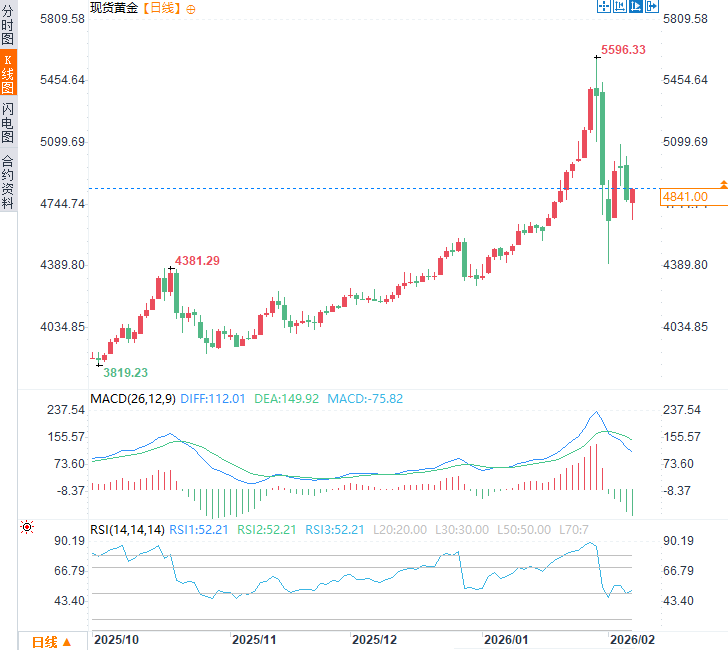
(Spot gold daily chart, source: FX678)
At 11:02 Beijing time, spot gold was trading at $4,825.74 per ounce.
This event fueled lingering global risk concerns, with safe-haven demand attracting funds to buy gold on dips. Spot gold rebounded after hitting a low during Friday's Asian session, currently trading around $4,825 per ounce, up about 1.3% on the day. Earlier in the session, it had fallen as much as 2.5% to $4,670 per ounce, before bargain hunting helped the price recover its losses.
Trump rejected the idea of extending the New START Treaty, writing on social media: "Instead of extending the New START Treaty... let's get nuclear experts working on a new, improved, and modernized treaty that can last a long time."
Opponents within the United States argue that the treaty limited the country's ability to respond to nuclear threats. However, the treaty's expiration now leaves the world's two largest nuclear powers without verifiable restrictions on their nuclear arsenals for the first time in decades.
Russia's last-minute offer was rejected.
The deadlock occurred after Russian President Vladimir Putin proposed that the two countries continue to abide by the terms of the 2010 agreement to deploy 1,550 nuclear warheads on 700 delivery systems, including missiles, aircraft, and submarines, for a period of one year.
The New START Treaty, the final pillar of a series of arms control agreements that began more than 50 years ago, allows for a five-year extension, which was agreed upon by Putin and former US President Joe Biden in 2021.
Trump called the New START Treaty a "terrible deal" and claimed it was "grossly violated." This appears to refer to Putin's 2023 decision to suspend on-site inspections, a key step in the process. Putin defended the suspension by citing U.S. support for Ukraine against Russia.
Despite the treaty's collapse, both sides expressed a willingness to engage in dialogue . Kremlin spokesman Dmitry Peskov stated that Russia remains prepared for dialogue if Washington responds constructively. Similarly, White House spokeswoman Carolyn Levitt confirmed that the United States will continue talks with Russia.
Global security has entered a new era fraught with uncertainty.
Security analysts warn that without a new treaty to replace the New START Treaty, the world will enter a more dangerous and unpredictable phase . The treaty's verification mechanism provides crucial trust and transparency between the two nuclear adversaries.
Without these safeguards, both the United States and Russia might be forced to act based on worst-case scenarios, thus creating an incentive to expand their arsenals. Key concerns include:
The risk of misjudgment is higher during a crisis;
The loss of transparency and predictability is the foundation of strategic stability;
This has increased the pressure to expand nuclear capabilities.
Diplomatic channels between the US and Russia remain open.
Reports indicate that Abu Dhabi held negotiations in the 24 hours leading up to the agreement's expiration, but failed to reach an agreement. It is reportedly unclear whether any formal agreement to temporarily comply with the treaty's terms will be reached.
However, the talks were not a complete failure. U.S. European Command announced on Thursday that the U.S. and Russia reached an agreement in Abu Dhabi to resume high-level military dialogue. Furthermore, Ukrainian President Volodymyr Zelensky indicated that U.S.-backed peace talks with Russia would continue following a round of talks in the city.
In Moscow, the Russian Foreign Ministry announced that the treaty was no longer applicable, leaving both sides with options for their next steps. While warning of its readiness to take "decisive military-technical countermeasures," the ministry also expressed its willingness to engage in diplomatic negotiations. This warning appears to be aimed at the possibility that the United States might expand its nuclear deployments by reversing measures taken to comply with the New START Treaty.
In 2023, a bipartisan U.S. commission recommended that the United States prepare for war and consider redeploying some or all of its stockpiled warheads.
Ukraine condemned the treaty's expiration, describing the event as a result of Russia's attempt to "dismantle the global security architecture" and "another tool of nuclear blackmail."
Strategic nuclear weapons are long-range systems designed to strike an adversary's homeland in a full-scale war. Without an agreement, experts estimate that Russia and the United States could deploy hundreds of additional warheads within just a few years.
As Karim Haggag, director of the Stockholm International Peace Research Institute, pointed out: "Transparency and predictability are the more intangible benefits of arms control and the basis of deterrence and strategic stability."
Geopolitical risks are surging, leading to a sharp increase in demand for gold as a safe haven.
The collapse of the New START Treaty has had a profound and multi-layered impact on gold. It is not merely an event that brings short-term price increases, but a strategic turning point that could potentially alter the global security paradigm and thus reshape the long-term value of gold.
In the short term, gold, as the most direct safe-haven asset, received strong buying support. In the medium to long term, the new era of global strategic uncertainty ushered in by this event endows gold with a stronger "strategic insurance" attribute and a more enduring bullish narrative.
With global security barriers being dismantled, gold's safe-haven appeal will shine even brighter. The market needs to recognize that the pricing logic for gold is shifting partly from "economic and financial cycles" to "geopolitical and security cycles."
(Spot gold daily chart, source: FX678)
At 11:02 Beijing time, spot gold was trading at $4,825.74 per ounce.
- Risk Warning and Disclaimer
- The market involves risk, and trading may not be suitable for all investors. This article is for reference only and does not constitute personal investment advice, nor does it take into account certain users’ specific investment objectives, financial situation, or other needs. Any investment decisions made based on this information are at your own risk.