The rebound in oil prices supported the Canadian dollar, while the USD/CAD pair consolidated at high levels awaiting a directional move.
2026-02-06 13:26:59
The US dollar remained relatively stable against the Canadian dollar in Asian trading on Friday, trading around 1.3700, after earlier giving back some of its intraday gains. The pullback mainly reflected temporary support for the Canadian dollar, benefiting from the rebound in oil prices from their lows.
Specifically, WTI crude oil prices rebounded to around $63.50 per barrel, providing support for the Canadian dollar, which is highly correlated with commodities. However, the upside potential for oil prices remains somewhat limited.
With the US and Iran confirming that they will hold talks in Oman, market concerns about a sharp escalation of the situation in the Middle East in the short term have eased, and some of the risk premium previously accumulated in crude oil prices has been given back.
From the perspective of the US dollar, the downside potential for the USD/CAD pair is also limited. The US dollar index remains near a two-week high, reflecting market expectations of a more cautious pace of interest rate cuts by the Federal Reserve.
Recent emphasis by Federal Reserve officials on not easing policy prematurely until the downward trend in inflation becomes clearer has provided sentiment support for the US dollar. Furthermore, the market is also assessing the potential impact of Kevin Warsh's nomination as Federal Reserve Chairman.
It is seen as inclined to maintain a smaller balance sheet and take a relatively restrained stance on interest rate cuts. This expectation has eased market concerns about the independence of monetary policy and helped stabilize the dollar's performance.
However, a series of weak US labor market data released this week indicate that the job market is gradually cooling. This has led to renewed bets on interest rate cuts this year, with widespread expectations that the Federal Reserve may implement two rate cuts this year, the first possibly in June, followed by a possible policy adjustment in September.
This expectation has limited the upside potential of the US dollar to some extent, and has also made the USD/CAD pair lack the momentum for a clear directional breakout.
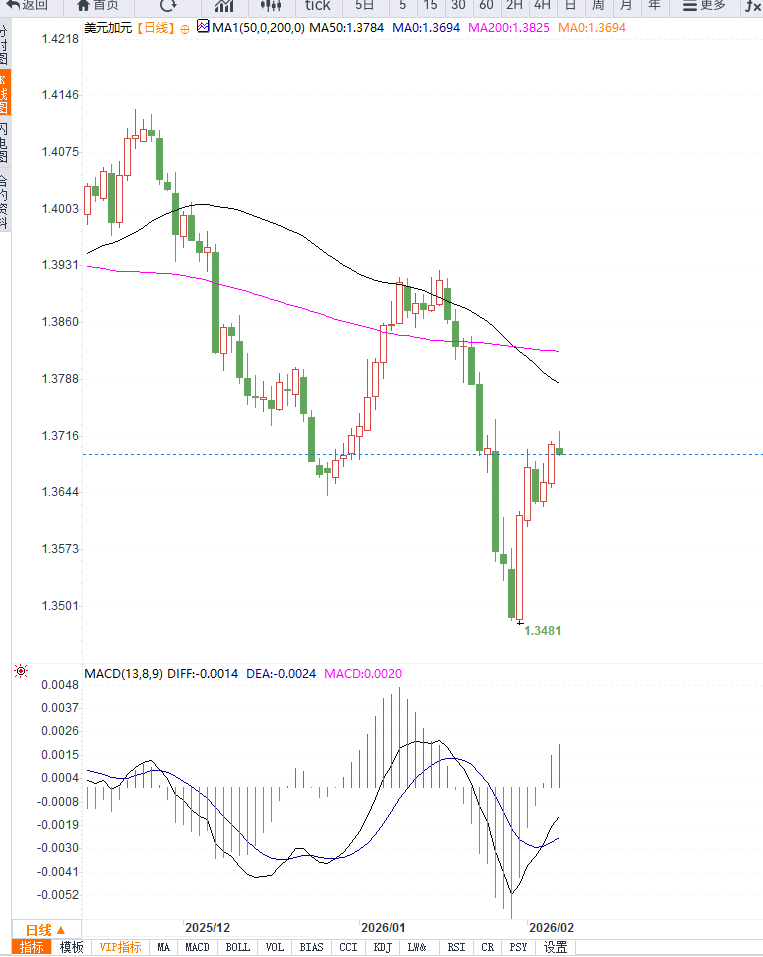
From a daily chart perspective, the USD/CAD pair has entered a consolidation phase after its previous rebound, remaining within a medium-term upward-biased range. The pair is fluctuating around 1.3700, indicating a temporary balance between bullish and bearish forces.
On the upside, the 1.3750-1.3780 area constitutes a significant resistance level. If oil prices weaken again or the US dollar strengthens again, the exchange rate is expected to test this area; further resistance lies around 1.3850.
On the downside, 1.3650 forms the first support level. A break below this level could see the exchange rate fall back to test the 1.3580-1.3600 range, which also corresponds to the previous consolidation platform. Overall, influenced by the interplay of oil price fluctuations and the strength of the US dollar, the USD/CAD pair is more likely to remain within the 1.3600-1.3800 range in the short term, exhibiting high-level fluctuations.
Editor's Note:
The current USD/CAD exchange rate movement is essentially a result of the tug-of-war between oil prices and expectations regarding US policy. The rebound in oil prices has provided temporary support for the Canadian dollar, but its sustainability remains uncertain given the easing of geopolitical risk premiums.
Meanwhile, the Federal Reserve's cautious stance on interest rate cuts makes it difficult for the dollar to weaken significantly. Until new macroeconomic data or oil price trend signals emerge, the USD/CAD pair is more likely to maintain a high-level consolidation pattern, with a directional breakout still awaiting clearer catalysts.
Specifically, WTI crude oil prices rebounded to around $63.50 per barrel, providing support for the Canadian dollar, which is highly correlated with commodities. However, the upside potential for oil prices remains somewhat limited.
With the US and Iran confirming that they will hold talks in Oman, market concerns about a sharp escalation of the situation in the Middle East in the short term have eased, and some of the risk premium previously accumulated in crude oil prices has been given back.
From the perspective of the US dollar, the downside potential for the USD/CAD pair is also limited. The US dollar index remains near a two-week high, reflecting market expectations of a more cautious pace of interest rate cuts by the Federal Reserve.
Recent emphasis by Federal Reserve officials on not easing policy prematurely until the downward trend in inflation becomes clearer has provided sentiment support for the US dollar. Furthermore, the market is also assessing the potential impact of Kevin Warsh's nomination as Federal Reserve Chairman.
It is seen as inclined to maintain a smaller balance sheet and take a relatively restrained stance on interest rate cuts. This expectation has eased market concerns about the independence of monetary policy and helped stabilize the dollar's performance.
However, a series of weak US labor market data released this week indicate that the job market is gradually cooling. This has led to renewed bets on interest rate cuts this year, with widespread expectations that the Federal Reserve may implement two rate cuts this year, the first possibly in June, followed by a possible policy adjustment in September.
This expectation has limited the upside potential of the US dollar to some extent, and has also made the USD/CAD pair lack the momentum for a clear directional breakout.
From a daily chart perspective, the USD/CAD pair has entered a consolidation phase after its previous rebound, remaining within a medium-term upward-biased range. The pair is fluctuating around 1.3700, indicating a temporary balance between bullish and bearish forces.
On the upside, the 1.3750-1.3780 area constitutes a significant resistance level. If oil prices weaken again or the US dollar strengthens again, the exchange rate is expected to test this area; further resistance lies around 1.3850.
On the downside, 1.3650 forms the first support level. A break below this level could see the exchange rate fall back to test the 1.3580-1.3600 range, which also corresponds to the previous consolidation platform. Overall, influenced by the interplay of oil price fluctuations and the strength of the US dollar, the USD/CAD pair is more likely to remain within the 1.3600-1.3800 range in the short term, exhibiting high-level fluctuations.
Editor's Note:
The current USD/CAD exchange rate movement is essentially a result of the tug-of-war between oil prices and expectations regarding US policy. The rebound in oil prices has provided temporary support for the Canadian dollar, but its sustainability remains uncertain given the easing of geopolitical risk premiums.
Meanwhile, the Federal Reserve's cautious stance on interest rate cuts makes it difficult for the dollar to weaken significantly. Until new macroeconomic data or oil price trend signals emerge, the USD/CAD pair is more likely to maintain a high-level consolidation pattern, with a directional breakout still awaiting clearer catalysts.
- Risk Warning and Disclaimer
- The market involves risk, and trading may not be suitable for all investors. This article is for reference only and does not constitute personal investment advice, nor does it take into account certain users’ specific investment objectives, financial situation, or other needs. Any investment decisions made based on this information are at your own risk.