The situation in Iran supported supply premiums, leading to a slight increase in crude oil prices.
2026-02-10 23:39:44
On Tuesday (February 10), during the US trading session, West Texas Intermediate (WTI) crude oil futures rebounded slightly from their early morning weakness. The market action suggests that traders are closely monitoring the risk of supply disruptions, but are cautious about entering the market due to concerns about oversupply and the possibility of a diplomatic breakthrough in US-Iran negotiations.
As of 23:29 Beijing time, March WTI crude oil futures were trading at $64.47 per barrel, up 0.17%.

The United States issues navigation guidance for vessels in the Strait of Hormuz.
Bullish traders were buoyed by news of U.S. guidance for vessels transiting the Strait of Hormuz. Oil prices had already risen 1% in the previous session, and buying interest continued in the market today. The U.S. Maritime Administration reportedly advised commercial vessels to stay as far away from Iranian territorial waters as possible and to verbally refuse any requests to board by the Iranian military.
Oil prices traded in a narrow range, indicating that investors are assessing whether the warning is a harbinger of an impending US military strike or merely a friendly reminder to commercial vessels. The Strait of Hormuz is of crucial importance, as 20% of global oil consumption is transported through it. If the US were to strike Iran, the market fears that shipping through the strait would be forced to halt, directly impacting global crude oil supplies.
However, the market generally believes that as long as the US and Iran continue negotiations, a military conflict is unlikely. Last Friday, an Iranian official stated that the negotiations were "progressing smoothly," but there has been no further news regarding the follow-up negotiations.
Supply disruption premium supports oil prices
Overall, numerous uncertainties continue to support the market, supply disruption premiums persist, but there are currently no sufficient signals to indicate that military action is imminent.
"The market remains focused on tensions between Iran and the United States, but oil prices may start to fall unless there are concrete signs of supply disruptions," said Tamas Varga, an oil analyst at brokerage PVM.
IG analyst Tony Sikamore said, "Despite the cautiously optimistic atmosphere at the talks in Oman, the moderate risk premium remains low due to ongoing uncertainties such as the potential escalation of tensions in the Strait of Hormuz, tightening of sanctions, or supply disruptions."
Technical Analysis: The upward trend remains intact; pay attention to the trendline support.
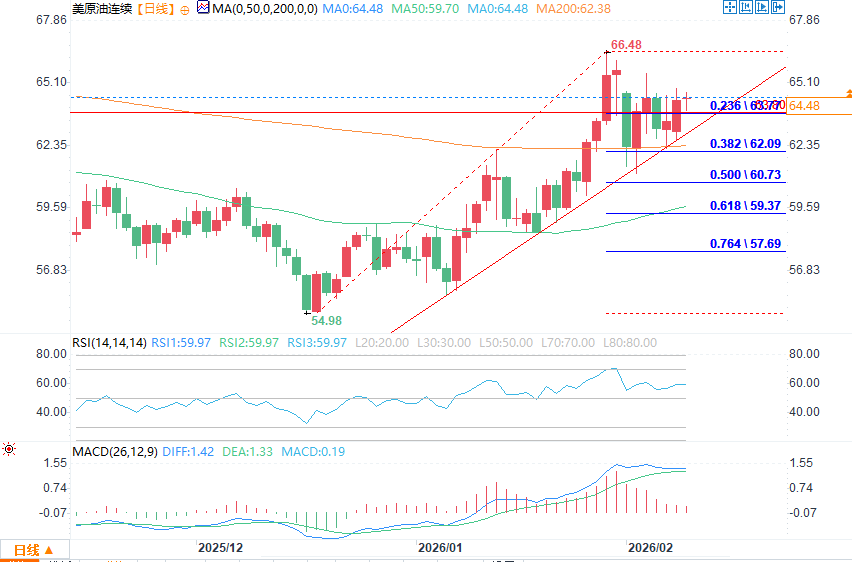
(WTI crude oil daily chart source: FX678)
Judging from the three major indicators—trend lines, oscillators, and moving averages—the current oil price trend remains upward.
Today, oil prices are trading above the $63.96 trendline and have held above the key pivot level of $63.80. A break below the trendline would be the first sign of weakness in oil prices; a break below the lows of $62.20 and the minor swing lows of $61.12 would shift the momentum downwards. However, as long as the 200-day moving average at $62.38 and the 50-day moving average at $59.70 provide support, the long-term trend remains supported. Furthermore, the retracement levels within the $60.73–$59.37 range also provide support.
It is recommended to continue to monitor oil price trends and changes in moving averages. The 50-day moving average has begun to rise gradually. If it crosses above the 200-day moving average, oil prices are expected to rise sharply.
As of 23:29 Beijing time, March WTI crude oil futures were trading at $64.47 per barrel, up 0.17%.
The United States issues navigation guidance for vessels in the Strait of Hormuz.
Bullish traders were buoyed by news of U.S. guidance for vessels transiting the Strait of Hormuz. Oil prices had already risen 1% in the previous session, and buying interest continued in the market today. The U.S. Maritime Administration reportedly advised commercial vessels to stay as far away from Iranian territorial waters as possible and to verbally refuse any requests to board by the Iranian military.
Oil prices traded in a narrow range, indicating that investors are assessing whether the warning is a harbinger of an impending US military strike or merely a friendly reminder to commercial vessels. The Strait of Hormuz is of crucial importance, as 20% of global oil consumption is transported through it. If the US were to strike Iran, the market fears that shipping through the strait would be forced to halt, directly impacting global crude oil supplies.
However, the market generally believes that as long as the US and Iran continue negotiations, a military conflict is unlikely. Last Friday, an Iranian official stated that the negotiations were "progressing smoothly," but there has been no further news regarding the follow-up negotiations.
Supply disruption premium supports oil prices
Overall, numerous uncertainties continue to support the market, supply disruption premiums persist, but there are currently no sufficient signals to indicate that military action is imminent.
"The market remains focused on tensions between Iran and the United States, but oil prices may start to fall unless there are concrete signs of supply disruptions," said Tamas Varga, an oil analyst at brokerage PVM.
IG analyst Tony Sikamore said, "Despite the cautiously optimistic atmosphere at the talks in Oman, the moderate risk premium remains low due to ongoing uncertainties such as the potential escalation of tensions in the Strait of Hormuz, tightening of sanctions, or supply disruptions."
Technical Analysis: The upward trend remains intact; pay attention to the trendline support.
(WTI crude oil daily chart source: FX678)
Judging from the three major indicators—trend lines, oscillators, and moving averages—the current oil price trend remains upward.
Today, oil prices are trading above the $63.96 trendline and have held above the key pivot level of $63.80. A break below the trendline would be the first sign of weakness in oil prices; a break below the lows of $62.20 and the minor swing lows of $61.12 would shift the momentum downwards. However, as long as the 200-day moving average at $62.38 and the 50-day moving average at $59.70 provide support, the long-term trend remains supported. Furthermore, the retracement levels within the $60.73–$59.37 range also provide support.
It is recommended to continue to monitor oil price trends and changes in moving averages. The 50-day moving average has begun to rise gradually. If it crosses above the 200-day moving average, oil prices are expected to rise sharply.
- Risk Warning and Disclaimer
- The market involves risk, and trading may not be suitable for all investors. This article is for reference only and does not constitute personal investment advice, nor does it take into account certain users’ specific investment objectives, financial situation, or other needs. Any investment decisions made based on this information are at your own risk.