Sluggish US retail sales exacerbate expectations of interest rate cuts, putting short-term downward pressure on the US dollar index (DXY).
2026-02-11 13:32:22
The US dollar index (DXY) remained weak and volatile during Wednesday's Asian trading session, hovering near 96.65. The market remained largely on the sidelines, with the US January non-farm payroll report and CPI inflation data being key factors determining the dollar's short-term direction.
Investors remained cautious ahead of the data release, resulting in narrowing short-term volatility. US retail sales data for December was weak, with total retail sales remaining at $735 billion, a year-on-year increase of 2.4%, lower than the previous month's 3.3% and market expectations of 0.4%.
This result reinforced market expectations for further interest rate cuts by the Federal Reserve, putting pressure on the dollar. Analysts pointed out that although US economic growth has slowed somewhat, it is still maintaining a moderate expansion overall, meaning that the Federal Reserve is likely to take limited easing measures rather than large-scale stimulus policies.
 Furthermore, recent pressure from US President Trump on the Federal Reserve, and questions raised by officials regarding the central bank's independence, have increased market expectations of downward pressure on the dollar. The dollar index's failure to break through the 97 level in the short term reflects continued market caution regarding risk events.
Improved risk appetite in global markets reduced demand for the safe-haven US dollar and enhanced short-term volatility. The market is focused on today's non-farm payroll data: if job growth exceeds expectations or the unemployment rate declines, it will strengthen expectations of a Fed tightening policy, and the DXY may rebound to the 96.90-97.20 resistance level in the short term.
If the non-farm payroll data is weak, it could further increase market bets on interest rate cuts, putting pressure on the US dollar, and the DXY could test the support area of 96.40 or 96.20. Short-term volatility is expected to increase significantly after the release of the non-farm payroll data.
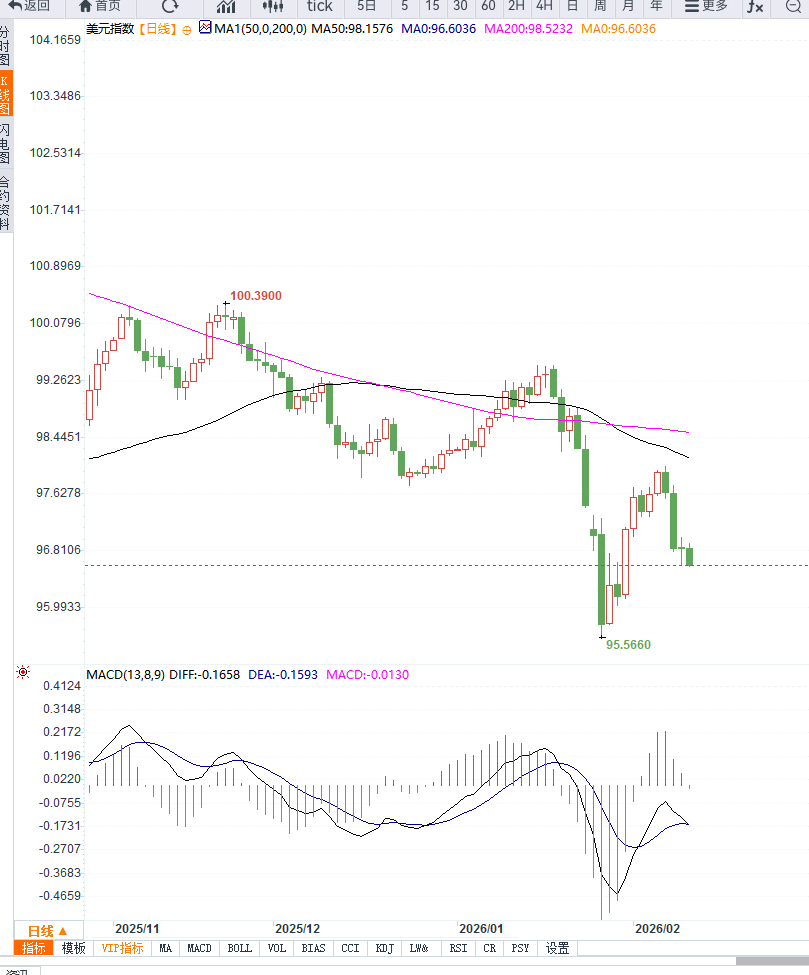
From the daily chart, the DXY is currently consolidating around 96.65, showing short-term weakness. The daily moving average system shows that the 5-day moving average is exerting downward pressure on the price, the 10-day moving average is providing short-term support, and the 20-day moving average forms a medium-term defense line at 96.40.
The price action has seen a series of small bearish candlesticks and doji patterns, reflecting a temporary balance between bullish and bearish forces, but overall downward pressure is evident. The MACD indicator shows that the red histogram bars are gradually shortening, and the DIFF line is slightly below the DEA line, indicating weak short-term momentum, but no clear reversal signal has yet appeared.
The KDJ indicator shows the K and D lines intersecting in the low to mid-range, while the J line is slightly declining, suggesting that short-term fluctuations or a slight pullback may continue. Combining the daily candlestick pattern with moving averages and indicators, the short-term bullish trend remains, but significant resistance above indicates strong market caution.
Technical analysis indicates that the DXY is under short-term pressure, but the support below is solid. The key point to watch is how well it holds up during pullbacks. If the non-farm payroll data is weak, it may trigger a further test of support; if the data is strong, it may lead to a rebound to the 96.90-97.20 resistance zone.
Editor's Note:
The US dollar index has been under short-term pressure recently, mainly due to weak US retail sales and market expectations of interest rate cuts. Fundamentals indicate a slowdown in US economic growth, but this has not yet triggered significant easing, making a significant rebound in the dollar unlikely in the short term.
The key focus should be on the short-term impact of tonight's non-farm payroll report and CPI data on the US dollar, which will determine the oscillation pattern of the DXY within the 96.40-97.20 range.
Investors remained cautious ahead of the data release, resulting in narrowing short-term volatility. US retail sales data for December was weak, with total retail sales remaining at $735 billion, a year-on-year increase of 2.4%, lower than the previous month's 3.3% and market expectations of 0.4%.
This result reinforced market expectations for further interest rate cuts by the Federal Reserve, putting pressure on the dollar. Analysts pointed out that although US economic growth has slowed somewhat, it is still maintaining a moderate expansion overall, meaning that the Federal Reserve is likely to take limited easing measures rather than large-scale stimulus policies.
Furthermore, recent pressure from US President Trump on the Federal Reserve, and questions raised by officials regarding the central bank's independence, have increased market expectations of downward pressure on the dollar. The dollar index's failure to break through the 97 level in the short term reflects continued market caution regarding risk events.Improved risk appetite in global markets reduced demand for the safe-haven US dollar and enhanced short-term volatility. The market is focused on today's non-farm payroll data: if job growth exceeds expectations or the unemployment rate declines, it will strengthen expectations of a Fed tightening policy, and the DXY may rebound to the 96.90-97.20 resistance level in the short term.
If the non-farm payroll data is weak, it could further increase market bets on interest rate cuts, putting pressure on the US dollar, and the DXY could test the support area of 96.40 or 96.20. Short-term volatility is expected to increase significantly after the release of the non-farm payroll data.
From the daily chart, the DXY is currently consolidating around 96.65, showing short-term weakness. The daily moving average system shows that the 5-day moving average is exerting downward pressure on the price, the 10-day moving average is providing short-term support, and the 20-day moving average forms a medium-term defense line at 96.40.
The price action has seen a series of small bearish candlesticks and doji patterns, reflecting a temporary balance between bullish and bearish forces, but overall downward pressure is evident. The MACD indicator shows that the red histogram bars are gradually shortening, and the DIFF line is slightly below the DEA line, indicating weak short-term momentum, but no clear reversal signal has yet appeared.
The KDJ indicator shows the K and D lines intersecting in the low to mid-range, while the J line is slightly declining, suggesting that short-term fluctuations or a slight pullback may continue. Combining the daily candlestick pattern with moving averages and indicators, the short-term bullish trend remains, but significant resistance above indicates strong market caution.
Technical analysis indicates that the DXY is under short-term pressure, but the support below is solid. The key point to watch is how well it holds up during pullbacks. If the non-farm payroll data is weak, it may trigger a further test of support; if the data is strong, it may lead to a rebound to the 96.90-97.20 resistance zone.
Editor's Note:
The US dollar index has been under short-term pressure recently, mainly due to weak US retail sales and market expectations of interest rate cuts. Fundamentals indicate a slowdown in US economic growth, but this has not yet triggered significant easing, making a significant rebound in the dollar unlikely in the short term.
The key focus should be on the short-term impact of tonight's non-farm payroll report and CPI data on the US dollar, which will determine the oscillation pattern of the DXY within the 96.40-97.20 range.
- Risk Warning and Disclaimer
- The market involves risk, and trading may not be suitable for all investors. This article is for reference only and does not constitute personal investment advice, nor does it take into account certain users’ specific investment objectives, financial situation, or other needs. Any investment decisions made based on this information are at your own risk.