Gold Trading Alert: Gold Prices Rise 1.2% Despite Non-Farm Payrolls; Bullish Window Opens Ahead of CPI Release?
2026-02-12 08:13:23
On Wednesday (February 11), spot gold prices surged to around $5,118 per ounce, ultimately closing with a gain of over 1% at around $5,083 per ounce. US gold futures for April delivery also rose 1.3%, settling at $5,098.50 per ounce. This surge was particularly noteworthy because it occurred against the backdrop of exceptionally strong US non-farm payroll data for January—130,000 new jobs were added, far exceeding market expectations of 70,000, and the unemployment rate fell from 4.4% to 4.3%. Normally, such data would reinforce expectations that the Federal Reserve will maintain high interest rates, putting significant downward pressure on gold. However, gold prices rebounded quickly after a brief pullback, demonstrating the extreme resilience of the bulls. On Thursday (February 12) in early Asian trading, spot gold weakened slightly, currently trading around $5,055 per ounce, down about 0.5%.
The unexpected resilience of the US labor market did briefly shake market confidence in the Federal Reserve's interest rate cut path. Accelerated job growth, a declining unemployment rate, and improved average hourly wages all seem to offer the Fed more room to remain on hold. Statements from Kansas City Fed President Schmid and Cleveland Fed President Hammarck both emphasized that the current economy is strong enough that monetary policy should not be eased prematurely, even suggesting that hoping for a significant increase in productivity to solve inflation is premature.
However, this hawkish rhetoric hasn't truly shaken the core logic of gold buyers. Independent metals trader Tai Wong astutely pointed out: "A strong jobs report won't shake the psychology behind gold buying, which is seen as long-term and fundamentally based." While gold prices experienced two consecutive days of sharp declines after Trump nominated Kevin Warsh as the next Federal Reserve Chairman, they quickly stabilized and reached new highs, with a year-to-date gain exceeding 17%, continuing last year's record-breaking rally. This indicates that market demand for gold has entered a new normal of "holding regardless of short-term data fluctuations."
The US dollar index rebounded slightly after the release of employment data, but the overall gains were limited, ultimately rising only 0.1%. This indicates that even though expectations for interest rate cuts have weakened in the short term (the CME FedWatch tool shows a significant drop in the probability of a rate cut in March, and the probability of a rate cut in June has also fallen from over 75% to about 60%), the market consensus that there will still be around 50 basis points of rate cuts throughout the year has not completely collapsed. More importantly, the dollar's rebound failed to sustainably suppress risk assets, with the stock market rising in tandem. This shows that the current market environment is closer to the expectation of a "soft landing for the economy + moderate interest rate cuts" rather than a hard landing or stagflation, which is precisely the most comfortable range for gold as an asset allocation.
The fundamental driving force behind this round of gold price increases goes far beyond monetary policy maneuvering. Escalating geopolitical risks, particularly news of the US Department of Defense's plans to deploy a second carrier strike group to the Middle East and the Iranian Foreign Minister's remarks on the possibility of a peace nuclear agreement, serve as reminders to the market that the great power rivalry is far from over and local conflicts could escalate at any time. This has continuously strengthened gold's appeal as the ultimate safe-haven asset.
The question of who will succeed the Federal Reserve chairman has also cast a long-term shadow of uncertainty over the market. While there is a high probability that Powell will maintain interest rates for the remainder of his term, if Kevin Warsh takes over in June, he is seen by the market as relatively hawkish but also at risk of overly accommodative policies, leading to divergence among investors regarding the future direction of monetary policy. Dovish voices, such as Fed Governor Milan, continue to emphasize that even with strong employment data, factors such as supply-side reforms and slowing housing inflation still support further rate cuts. This divergence in policy expectations has actually strengthened gold's "insurance" attribute—regardless of whether the market ultimately takes a hawkish or dovish stance, gold provides a hedging value.
Meanwhile, the trend of global central banks continuously increasing their gold holdings has never ceased. De-dollarization and reserve diversification have become long-term strategies for many central banks, providing a steady stream of physical demand support for gold prices. Coupled with investors' growing concerns about the sustainability of US debt and the narrative of "withdrawing from US assets" circulating among some funds, gold has become an indispensable part of the portfolios of many institutions and individuals.
The market's primary focus right now is undoubtedly the upcoming US January CPI report. This data will directly impact the market's assessment of the inflation path. If the CPI shows easing inflationary pressures, it will strengthen expectations of a June rate cut, which would be beneficial for gold. Conversely, if inflation exceeds expectations again, it may temporarily suppress gold prices, but given strong fundamental support, the downside is expected to be limited.
From a technical perspective, after a significant correction at the end of January, gold prices have formed a clear pattern of rising lows and simultaneously higher highs. The $5100 level was briefly breached, and the short-term resistance level is seen in the $5150-$5200 range. Looking at a longer-term perspective, many institutions have significantly raised their full-year 2026 price targets: some predict that prices could approach $6000 or even higher by the end of the year, reflecting a strong consensus on a structural bull market for gold.
The gold market in 2026 is demonstrating that traditional macroeconomic logic can sometimes be overshadowed by deeper structural changes. Strong employment data, hawkish Fed statements, and a slight rebound in the US dollar—factors that once put pressure on gold prices—can now only cause temporary disturbances but cannot reverse the main bullish trend.
When multiple forces such as safe-haven demand, geopolitical risks, the wave of de-dollarization, central bank gold purchases, and debt concerns resonate simultaneously, gold is no longer simply an "inflation hedge" or an "interest rate sensitive asset," but rather a core anchor in the era of global asset reallocation.
Today's trading session will also see the release of US initial jobless claims for the week ending February 7 and US existing home sales in January at an annualized rate. Investors should pay attention to these figures.
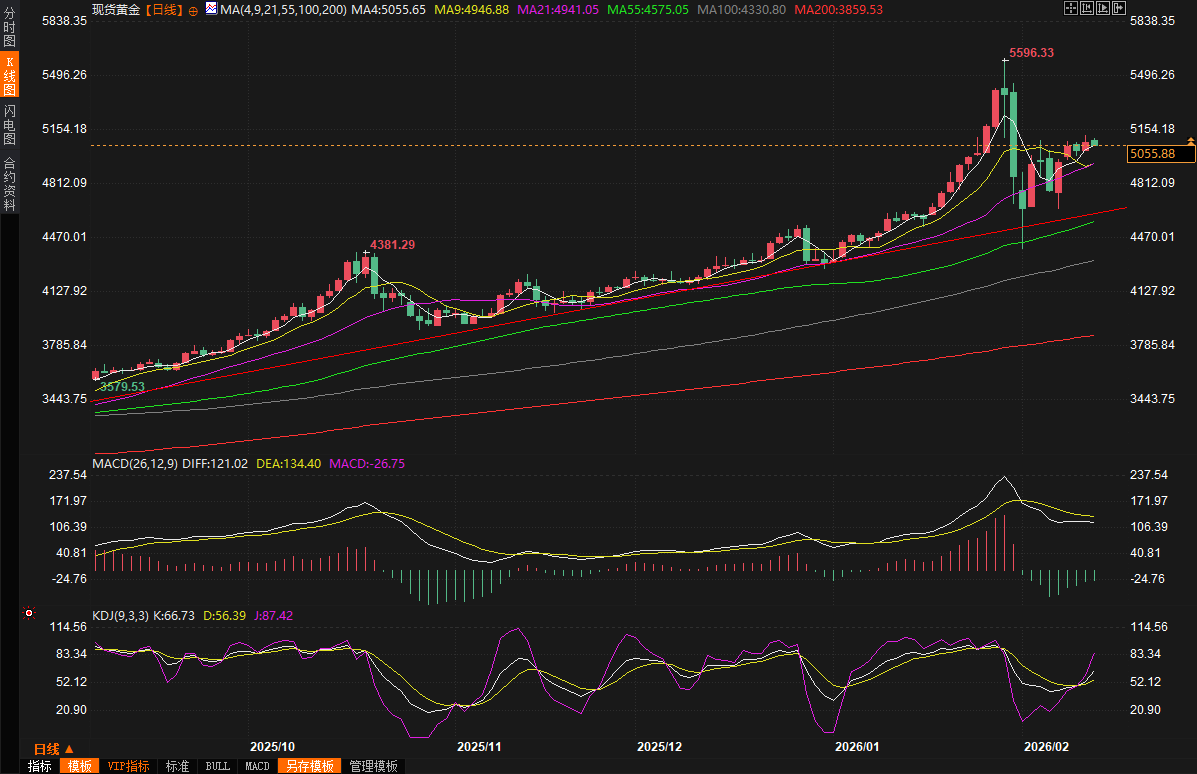
At 08:10 Beijing time, spot gold was trading at $5055.88 per ounce.
Why did strong non-farm payroll data fail to extinguish gold's rally?
The unexpected resilience of the US labor market did briefly shake market confidence in the Federal Reserve's interest rate cut path. Accelerated job growth, a declining unemployment rate, and improved average hourly wages all seem to offer the Fed more room to remain on hold. Statements from Kansas City Fed President Schmid and Cleveland Fed President Hammarck both emphasized that the current economy is strong enough that monetary policy should not be eased prematurely, even suggesting that hoping for a significant increase in productivity to solve inflation is premature.
However, this hawkish rhetoric hasn't truly shaken the core logic of gold buyers. Independent metals trader Tai Wong astutely pointed out: "A strong jobs report won't shake the psychology behind gold buying, which is seen as long-term and fundamentally based." While gold prices experienced two consecutive days of sharp declines after Trump nominated Kevin Warsh as the next Federal Reserve Chairman, they quickly stabilized and reached new highs, with a year-to-date gain exceeding 17%, continuing last year's record-breaking rally. This indicates that market demand for gold has entered a new normal of "holding regardless of short-term data fluctuations."
The US dollar index rebounded slightly after the release of employment data, but the overall gains were limited, ultimately rising only 0.1%. This indicates that even though expectations for interest rate cuts have weakened in the short term (the CME FedWatch tool shows a significant drop in the probability of a rate cut in March, and the probability of a rate cut in June has also fallen from over 75% to about 60%), the market consensus that there will still be around 50 basis points of rate cuts throughout the year has not completely collapsed. More importantly, the dollar's rebound failed to sustainably suppress risk assets, with the stock market rising in tandem. This shows that the current market environment is closer to the expectation of a "soft landing for the economy + moderate interest rate cuts" rather than a hard landing or stagflation, which is precisely the most comfortable range for gold as an asset allocation.
Geopolitical factors and uncertainty surrounding the Federal Reserve's personnel appointments form the most solid foundation for gold.
The fundamental driving force behind this round of gold price increases goes far beyond monetary policy maneuvering. Escalating geopolitical risks, particularly news of the US Department of Defense's plans to deploy a second carrier strike group to the Middle East and the Iranian Foreign Minister's remarks on the possibility of a peace nuclear agreement, serve as reminders to the market that the great power rivalry is far from over and local conflicts could escalate at any time. This has continuously strengthened gold's appeal as the ultimate safe-haven asset.
The question of who will succeed the Federal Reserve chairman has also cast a long-term shadow of uncertainty over the market. While there is a high probability that Powell will maintain interest rates for the remainder of his term, if Kevin Warsh takes over in June, he is seen by the market as relatively hawkish but also at risk of overly accommodative policies, leading to divergence among investors regarding the future direction of monetary policy. Dovish voices, such as Fed Governor Milan, continue to emphasize that even with strong employment data, factors such as supply-side reforms and slowing housing inflation still support further rate cuts. This divergence in policy expectations has actually strengthened gold's "insurance" attribute—regardless of whether the market ultimately takes a hawkish or dovish stance, gold provides a hedging value.
Meanwhile, the trend of global central banks continuously increasing their gold holdings has never ceased. De-dollarization and reserve diversification have become long-term strategies for many central banks, providing a steady stream of physical demand support for gold prices. Coupled with investors' growing concerns about the sustainability of US debt and the narrative of "withdrawing from US assets" circulating among some funds, gold has become an indispensable part of the portfolios of many institutions and individuals.
Friday's CPI Data and Future Trend Outlook
The market's primary focus right now is undoubtedly the upcoming US January CPI report. This data will directly impact the market's assessment of the inflation path. If the CPI shows easing inflationary pressures, it will strengthen expectations of a June rate cut, which would be beneficial for gold. Conversely, if inflation exceeds expectations again, it may temporarily suppress gold prices, but given strong fundamental support, the downside is expected to be limited.
From a technical perspective, after a significant correction at the end of January, gold prices have formed a clear pattern of rising lows and simultaneously higher highs. The $5100 level was briefly breached, and the short-term resistance level is seen in the $5150-$5200 range. Looking at a longer-term perspective, many institutions have significantly raised their full-year 2026 price targets: some predict that prices could approach $6000 or even higher by the end of the year, reflecting a strong consensus on a structural bull market for gold.
Conclusion: Gold has entered a new phase where "buying at the high point is also reasonable."
The gold market in 2026 is demonstrating that traditional macroeconomic logic can sometimes be overshadowed by deeper structural changes. Strong employment data, hawkish Fed statements, and a slight rebound in the US dollar—factors that once put pressure on gold prices—can now only cause temporary disturbances but cannot reverse the main bullish trend.
When multiple forces such as safe-haven demand, geopolitical risks, the wave of de-dollarization, central bank gold purchases, and debt concerns resonate simultaneously, gold is no longer simply an "inflation hedge" or an "interest rate sensitive asset," but rather a core anchor in the era of global asset reallocation.
Today's trading session will also see the release of US initial jobless claims for the week ending February 7 and US existing home sales in January at an annualized rate. Investors should pay attention to these figures.
At 08:10 Beijing time, spot gold was trading at $5055.88 per ounce.
- Risk Warning and Disclaimer
- The market involves risk, and trading may not be suitable for all investors. This article is for reference only and does not constitute personal investment advice, nor does it take into account certain users’ specific investment objectives, financial situation, or other needs. Any investment decisions made based on this information are at your own risk.