Trump's aircraft carriers, Iran's bargaining chips, and safe-haven gold waiting for a conflict they "cannot win"?
2026-02-13 09:49:59
The prospect of a potential U.S. attack on Iran in 2026 is causing volatility in oil prices, but analysts say such a strike would require a much larger military commitment and more complex deployment than the U.S. currently has.
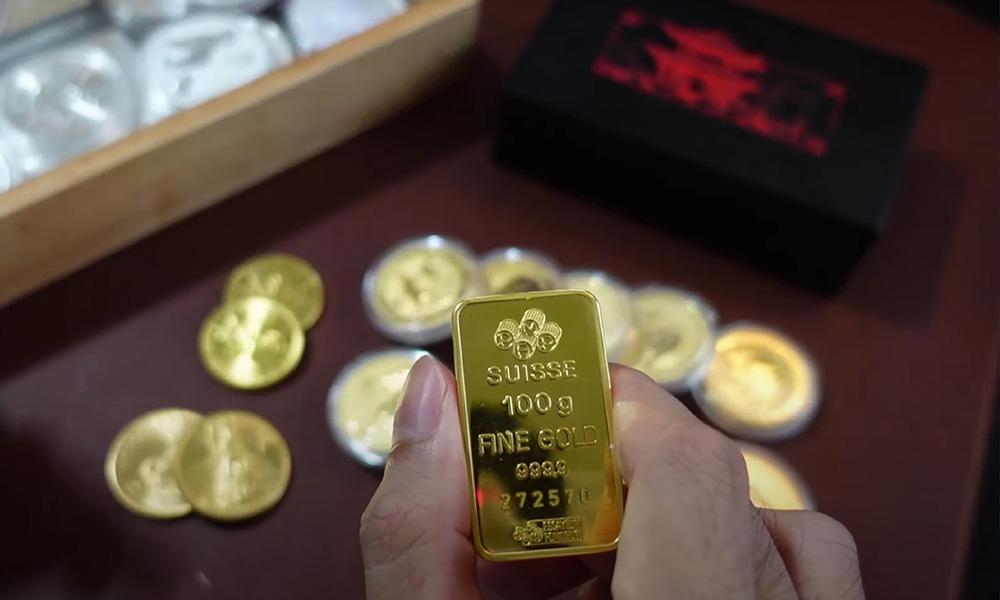
On Friday (February 13) during the Asian session, spot gold fluctuated and strengthened, currently trading around $4,980 per ounce, with a daily increase of about 1.2%.
Tensions remain high, with the US and Iran deadlocked despite talks in Oman last week. Last month, US President Donald Trump intensified pressure on the Iranian regime, citing its brutal crackdown on anti-government protesters across the country.
Trump said this week that he is still considering sending a second aircraft carrier to the Middle East, even if Washington and Tehran are prepared to resume negotiations. On Tuesday, he threatened Iran with “very harsh” measures if it does not agree to U.S. demands—ranging from halting nuclear enrichment activities to reducing its ballistic missile program.
The United States deployed the USS Abraham Lincoln carrier strike group to the Middle East in January, bringing the number of guided-missile destroyers in the region to six. However, analysts believe this is still insufficient to overthrow the Iranian regime. Implementing the "very harsh" threat would mean plunging into a protracted conflict in a region Trump has already treated with caution .
"The United States has insufficient military presence in the region to support a major, long-term military operation in Iran, which is necessary to achieve any major military objective," said Alireza Ahmadi, executive researcher at the Geneva Centre for Security Policy Studies.
Trump has also intensified pressure on the Islamic Republic of Iran, imposing financial strain on an economy already crippled by sanctions. Just last month, he threatened to impose tariffs on any country that purchases goods or services from Iran.
However, it remains unclear how things will develop next. Ali Waez, director of the Iran project at the International Crisis Group, said, "President Trump is known for being unpredictable," but added that Trump also understands that "the Iran issue is not a simple, easy military option to resolve."
Michael Rubin, a former Pentagon official and senior fellow at the American Enterprise Institute, said, "The cost of not attacking Iran would be enormous." He added that if Trump does not take action, "his political legacy will be: a president who gave Iran nuclear weapons."
Bob McNally, president of Rapidan Energy Group, said, "The president is in a bind, he doesn't have many options, and this is a very dangerous moment." McNally added that Iran's ballistic missile program means "we have to take drastic measures because Iran is quite powerful."
Trump said last week that Iran's Supreme Leader Ayatollah Khamenei should be "very concerned".
But analysts warn that the operation against Iran's leadership will not be as simple as the capture of Venezuelan President Nicolás Maduro.
Alireza Ahmadi said, "The Iranian government is not Venezuela." He also stated that even if the United States ousted Khamenei, "a successor would be elected immediately, and the military would effectively control the country for the foreseeable future."
Power in Iran is highly concentrated in the hands of Khamenei. Although there is a presidential office, Khamenei makes all political, military, and foreign policy decisions for the Islamic Republic. For the past three decades, Khamenei has held supreme power with the support of the Islamic Revolutionary Guard Corps, which not only assists in implementing the regime's policies but also plays a key role in foreign policy.
Rubin stated that even if the United States were to remove Khamenei and install a regime official to replace him, the fate of the Revolutionary Guard would remain an "unresolved question."
Waez stated, "The United States cannot achieve regime change solely through air power without deploying any ground troops (whether U.S. or Iranian opposition forces). It can only transform the regime into another form—perhaps worse, or turn Iran into yet another failed state."
Ahmadi believes that regime change in Iran "would require at least the level of military commitment required for the Iraq War, which Trump is unlikely to support." Between 2003 and 2011, 4,500 U.S. military personnel were killed in Iraq.
The White House declared that Iran's nuclear facilities had been "destroyed" after launching strikes against three major Iranian nuclear sites in 2025. Iran quickly repaired the damage to its ballistic missile bases, but analysis suggests that it only made "limited repairs" to the major nuclear facilities targeted by the United States.
Iran has long maintained that it has no plans to develop nuclear weapons. With Washington and Tehran resuming negotiations, Iran has proposed limiting uranium enrichment to a low level. Since the collapse of the Iran nuclear deal in 2018, the United States has consistently opposed any uranium enrichment activities by Iran.
While the United States has vowed to strike Iran if it restarts its nuclear and missile programs, it remains unclear whether these facilities will again become targets. "Both options could lead to a disproportionate retaliation from Iran, potentially escalating the confrontation into a regional war," said Vaez.
Iran has vowed to retaliate against U.S. military bases in the region if Washington launches an attack.
Ahmadi stated, "Iran is betting that the United States does not have enough interceptor missiles and the THAAD anti-missile system to protect its vast military camps and facilities throughout the Middle East, nor can it protect Israel."
The United States maintains approximately 40,000 military personnel in the Middle East. It has bases in the Arabian Gulf, including the U.S. Naval Central Command in Bahrain, Al Udeid Air Base in Qatar—which was attacked by Iran in the summer of 2025—and Al Dhafra Air Base south of Abu Dhabi.
Waez stated, "Iran will undoubtedly attack U.S. military bases and naval assets in Iraq, Syria, and the Gulf region, and is also very likely to attack Israel, with its remaining proxy forces possibly joining in."
Ahmadi added, "Iran appears to be preparing for a military confrontation that could last for weeks or even months. There seems to be a sense among the Iranian leadership that the United States has overestimated its capabilities and that a large-scale war may be needed to correct this miscalculation."
The escalating tensions between the US and Iran in early 2026 provided a clear upward driver for gold. Despite the Trump administration's strong military threats, reports generally point to a core conclusion: the US lacks the military capability to quickly resolve the Iranian issue, and any substantial strike would be costly and have unpredictable consequences. This "risky, low-chance" situation is precisely the most typical favorable environment for gold .
Under this logic, the rise in gold prices is not simply driven by sentiment, but rather a rational pricing of a "high-risk, unsolvable, and protracted" geopolitical environment. As long as the US-Iran standoff remains in a state of "no agreement reached, no victory in a war, and no way to back down," safe-haven buying of gold will have structural support .
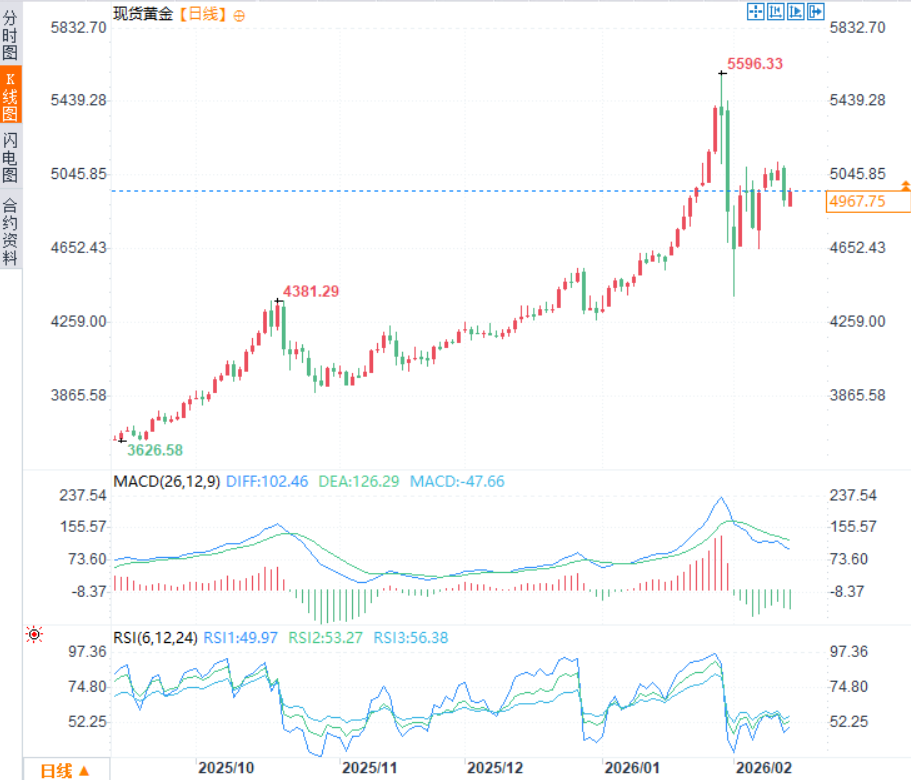
(Spot gold daily chart, source: FX678)
At 9:49 AM Beijing time, spot gold was trading at $4,986.88 per ounce.
On Friday (February 13) during the Asian session, spot gold fluctuated and strengthened, currently trading around $4,980 per ounce, with a daily increase of about 1.2%.
Tensions remain high, with the US and Iran deadlocked despite talks in Oman last week. Last month, US President Donald Trump intensified pressure on the Iranian regime, citing its brutal crackdown on anti-government protesters across the country.
Trump said this week that he is still considering sending a second aircraft carrier to the Middle East, even if Washington and Tehran are prepared to resume negotiations. On Tuesday, he threatened Iran with “very harsh” measures if it does not agree to U.S. demands—ranging from halting nuclear enrichment activities to reducing its ballistic missile program.
The United States deployed the USS Abraham Lincoln carrier strike group to the Middle East in January, bringing the number of guided-missile destroyers in the region to six. However, analysts believe this is still insufficient to overthrow the Iranian regime. Implementing the "very harsh" threat would mean plunging into a protracted conflict in a region Trump has already treated with caution .
"The United States has insufficient military presence in the region to support a major, long-term military operation in Iran, which is necessary to achieve any major military objective," said Alireza Ahmadi, executive researcher at the Geneva Centre for Security Policy Studies.
Trump has also intensified pressure on the Islamic Republic of Iran, imposing financial strain on an economy already crippled by sanctions. Just last month, he threatened to impose tariffs on any country that purchases goods or services from Iran.
However, it remains unclear how things will develop next. Ali Waez, director of the Iran project at the International Crisis Group, said, "President Trump is known for being unpredictable," but added that Trump also understands that "the Iran issue is not a simple, easy military option to resolve."
Will the United States attack Iran again?
Michael Rubin, a former Pentagon official and senior fellow at the American Enterprise Institute, said, "The cost of not attacking Iran would be enormous." He added that if Trump does not take action, "his political legacy will be: a president who gave Iran nuclear weapons."
Bob McNally, president of Rapidan Energy Group, said, "The president is in a bind, he doesn't have many options, and this is a very dangerous moment." McNally added that Iran's ballistic missile program means "we have to take drastic measures because Iran is quite powerful."
What options does Trump have?
Trump said last week that Iran's Supreme Leader Ayatollah Khamenei should be "very concerned".
But analysts warn that the operation against Iran's leadership will not be as simple as the capture of Venezuelan President Nicolás Maduro.
Alireza Ahmadi said, "The Iranian government is not Venezuela." He also stated that even if the United States ousted Khamenei, "a successor would be elected immediately, and the military would effectively control the country for the foreseeable future."
Power in Iran is highly concentrated in the hands of Khamenei. Although there is a presidential office, Khamenei makes all political, military, and foreign policy decisions for the Islamic Republic. For the past three decades, Khamenei has held supreme power with the support of the Islamic Revolutionary Guard Corps, which not only assists in implementing the regime's policies but also plays a key role in foreign policy.
Rubin stated that even if the United States were to remove Khamenei and install a regime official to replace him, the fate of the Revolutionary Guard would remain an "unresolved question."
Waez stated, "The United States cannot achieve regime change solely through air power without deploying any ground troops (whether U.S. or Iranian opposition forces). It can only transform the regime into another form—perhaps worse, or turn Iran into yet another failed state."
Ahmadi believes that regime change in Iran "would require at least the level of military commitment required for the Iraq War, which Trump is unlikely to support." Between 2003 and 2011, 4,500 U.S. military personnel were killed in Iraq.
The White House declared that Iran's nuclear facilities had been "destroyed" after launching strikes against three major Iranian nuclear sites in 2025. Iran quickly repaired the damage to its ballistic missile bases, but analysis suggests that it only made "limited repairs" to the major nuclear facilities targeted by the United States.
Iran has long maintained that it has no plans to develop nuclear weapons. With Washington and Tehran resuming negotiations, Iran has proposed limiting uranium enrichment to a low level. Since the collapse of the Iran nuclear deal in 2018, the United States has consistently opposed any uranium enrichment activities by Iran.
While the United States has vowed to strike Iran if it restarts its nuclear and missile programs, it remains unclear whether these facilities will again become targets. "Both options could lead to a disproportionate retaliation from Iran, potentially escalating the confrontation into a regional war," said Vaez.
Potential Iranian retaliation
Iran has vowed to retaliate against U.S. military bases in the region if Washington launches an attack.
Ahmadi stated, "Iran is betting that the United States does not have enough interceptor missiles and the THAAD anti-missile system to protect its vast military camps and facilities throughout the Middle East, nor can it protect Israel."
The United States maintains approximately 40,000 military personnel in the Middle East. It has bases in the Arabian Gulf, including the U.S. Naval Central Command in Bahrain, Al Udeid Air Base in Qatar—which was attacked by Iran in the summer of 2025—and Al Dhafra Air Base south of Abu Dhabi.
Waez stated, "Iran will undoubtedly attack U.S. military bases and naval assets in Iraq, Syria, and the Gulf region, and is also very likely to attack Israel, with its remaining proxy forces possibly joining in."
Ahmadi added, "Iran appears to be preparing for a military confrontation that could last for weeks or even months. There seems to be a sense among the Iranian leadership that the United States has overestimated its capabilities and that a large-scale war may be needed to correct this miscalculation."
Geopolitical Risks and Gold's Safe-Haven Logic: Gold Price Support from the US-Iran Standoff
The escalating tensions between the US and Iran in early 2026 provided a clear upward driver for gold. Despite the Trump administration's strong military threats, reports generally point to a core conclusion: the US lacks the military capability to quickly resolve the Iranian issue, and any substantial strike would be costly and have unpredictable consequences. This "risky, low-chance" situation is precisely the most typical favorable environment for gold .
Under this logic, the rise in gold prices is not simply driven by sentiment, but rather a rational pricing of a "high-risk, unsolvable, and protracted" geopolitical environment. As long as the US-Iran standoff remains in a state of "no agreement reached, no victory in a war, and no way to back down," safe-haven buying of gold will have structural support .
(Spot gold daily chart, source: FX678)
At 9:49 AM Beijing time, spot gold was trading at $4,986.88 per ounce.
- Risk Warning and Disclaimer
- The market involves risk, and trading may not be suitable for all investors. This article is for reference only and does not constitute personal investment advice, nor does it take into account certain users’ specific investment objectives, financial situation, or other needs. Any investment decisions made based on this information are at your own risk.