The euro traded in a range against the dollar, while the dollar rose significantly against the yen.
2026-02-17 00:08:54
On Monday (February 16), during the US trading session, the global foreign exchange market was affected by the double holiday closure, resulting in a generally quiet trading atmosphere. The US dollar index remained stable with low volatility. Specifically, the US market was closed for Presidents' Day, with trading suspended and volume significantly reduced, resulting in relatively dormant buying and selling pressure on the dollar. Meanwhile, the Chinese mainland and Hong Kong markets were closed for the entire Lunar New Year Golden Week, further weakening market activity during the Asian trading session and leading to continued low trading volume in the Asia-Pacific region. Given this holiday-driven downturn, and considering recent global monetary policy trends and economic data from major economies, this article will focus on analyzing the Euro/US Dollar and US Dollar/Japanese Yen pairs, two of the most closely watched currency pairs, to provide guidance for market trading.

EUR/USD: Neutral to neutral, limited volatility, awaiting key data guidance.
On Monday morning, the euro traded in a range against the US dollar, fluctuating around the key level of 1.1850 without showing a clear one-sided trend. From a price perspective, the 1.1850 level had previously served as a significant resistance level for the euro against the dollar, but it was successfully broken in recent market battles. Now, this level has become a potential support level, and the current exchange rate is testing its effectiveness. By the close of trading on Monday evening, the euro was trading around 1.1864 against the dollar, down slightly by 0.04% from the previous trading day. The daily trading range narrowed to 1.1849 to 1.1875, a fluctuation of less than 30 basis points, highlighting the cautious trading and strong wait-and-see sentiment among both bulls and bears during the holiday period.
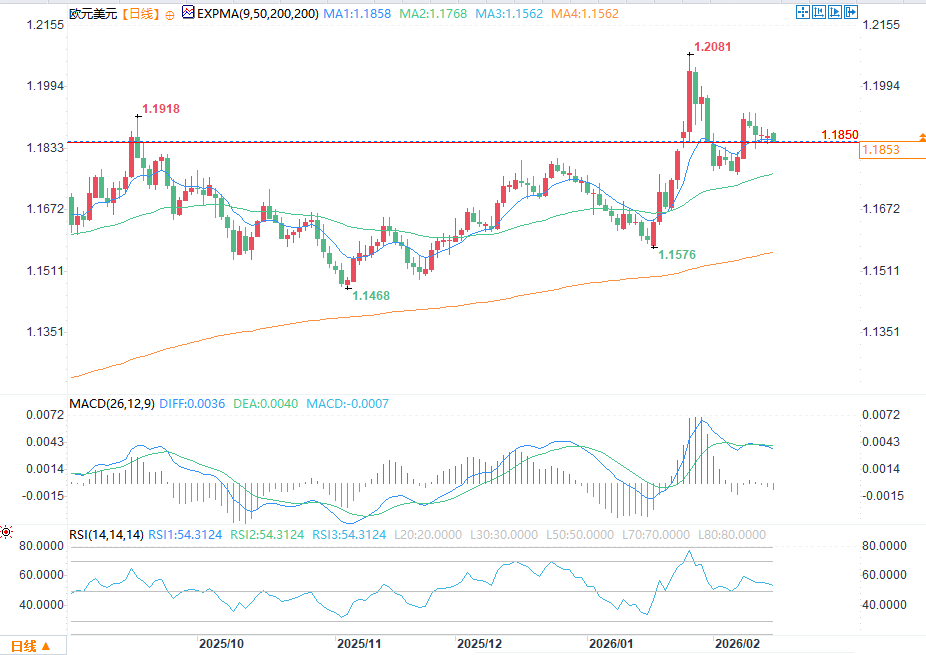
(Euro/USD daily chart source: FX678)
In the short term, the volatility of the euro against the US dollar is expected to remain low, primarily due to the lack of significant US economic data recently, leaving the market without a clear trading logic. Specifically, the Federal Open Market Committee (FOMC) will release its latest meeting minutes on Wednesday evening. These minutes will be a key factor influencing the dollar's performance in the short term, and consequently, the euro's volatility against the dollar. The market will focus on the Fed members' discussions regarding the future path of interest rate cuts, the pace of quantitative tightening (QT) adjustments, and the internal disagreements among members on monetary policy stances. These details will directly reflect the Fed's policy inclinations, thus affecting market sentiment towards the dollar. Following the release of the minutes, the US will release its weekly initial jobless claims on Thursday, and on Friday, both the US and Europe will simultaneously release their Purchasing Managers' Indices (PMIs), including the manufacturing and services PMIs. These data will directly reflect the economic recovery momentum of the US and European economies and are expected to be a key catalyst in breaking the current narrow trading range of the currency pair and driving it towards more targeted volatility.
From a technical perspective, the euro/dollar exchange rate is currently maintaining a slight upward bias overall, but remains in a neutral consolidation phase in the short term, without a clear one-sided trend. Looking at key technical indicators, the 50-day exponential moving average (EMA) is currently near the 1.18 level. This moving average serves as a crucial short-term support/resistance level. If the euro/dollar exchange rate breaks below this support level, it will indicate a shift in short-term market sentiment towards pessimism, potentially leading to a temporary strengthening of the dollar. Conversely, if the exchange rate successfully breaks through the high point of last Wednesday's range (approximately 1.1925 USD), it will further confirm the euro's upward trend, potentially leading to a challenge of the 1.20 level, and market bullish sentiment will subsequently increase.
USD/JPY: The yen weakened due to weak economic data, while the dollar held near a key resistance level.
Unlike the narrow trading range of the euro against the dollar, the dollar/yen exchange rate showed a clear upward trend on Monday, rising 0.34% in the morning session and further expanding to 0.50% in the evening, trading around 153.46. The weakening yen was the core driver of the pair's rise, and the direct reason for the yen's weakness was a series of weak economic data recently released by Japan. Specifically, data showed that Japan's GDP grew by only 0.1% year-on-year in the fourth quarter of 2025, significantly lower than the market's previous expectation of 0.4%. The revised third-quarter GDP figure showed a contraction of 0.7%, highlighting the continued lack of momentum and sluggish growth in the Japanese economic recovery. In addition, Japan's industrial output data for December also showed a significant decline, with the slowdown in industrial production further confirming the weakness of Japan's real economy. These weak economic data have significantly reinforced market expectations that the Bank of Japan's policy normalization process will slow down. The market generally believes that against the backdrop of a sluggish economic recovery, the Bank of Japan will not tighten monetary policy rashly in the short term and will most likely maintain its current accommodative stance. With the interest rate differential between the US dollar and the yen continuing to exist and showing no signs of narrowing, the yen will continue to face downward pressure, which also provides support for the upward movement of the US dollar against the yen.
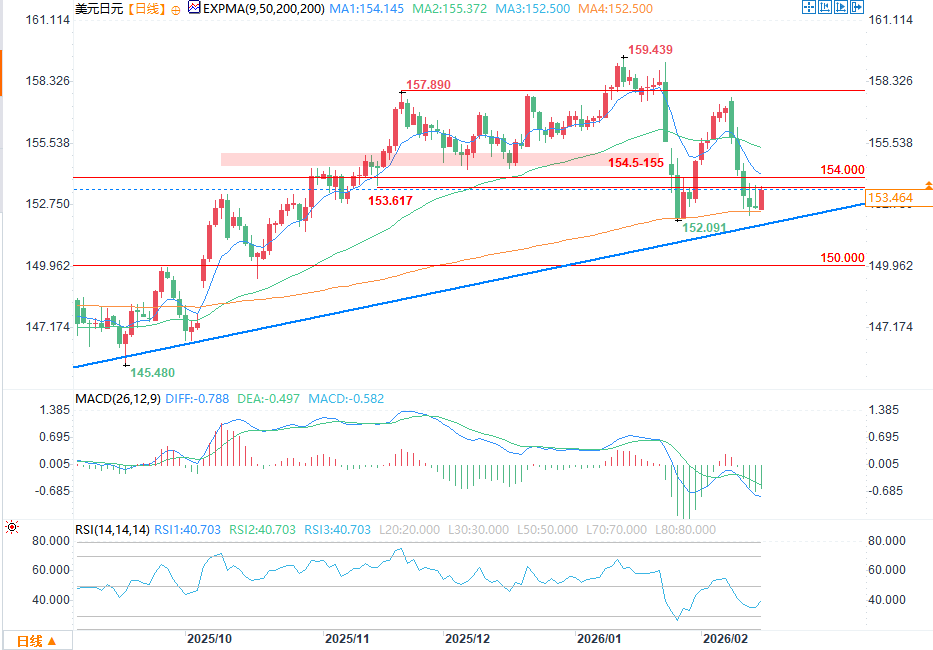
(USD/JPY daily chart source: FX678)
From a technical perspective, the USD/JPY pair remains near a key resistance level, facing a significant test in the short term. On Monday morning, the USD/JPY exchange rate remained below Thursday's high (approximately 153.75 yen), failing to break through effectively. The daily trading range was between 152.64 and 153.41, with bulls and bears battling it out below this key resistance level. Looking ahead, the 154 yen level will be a crucial resistance point for USD/JPY. A successful break and hold above this level would break the current consolidation pattern and open up further upside potential. On the support side, the 200-day exponential moving average (EMA) will be a key short-term support level. A pullback to this level could find buying support, alleviating downward pressure. It's important to note that the absence of the Chinese market this week due to the Lunar New Year holiday further increases uncertainty in the foreign exchange market. With the US market also closed on Monday, trading volume and fund flows during the European trading session may be crucial factors in determining whether USD/JPY can break through short-term resistance and initiate a directional move.
Overall, the global foreign exchange market this week will be characterized by a combination of "light holiday trading and key data guidance." Before the release of major economic data from Europe and the US later this week, as well as the FOMC meeting minutes, the US dollar is likely to continue its consolidation and stabilization. As a result, both the EUR/USD and USD/JPY currency pairs will maintain narrow trading ranges. Market traders will remain cautious and hesitant, delaying large-scale position building until clearer signals emerge regarding the monetary policy direction and economic recovery momentum of major global economies. Only then will they gradually determine their trading direction and drive a clear unidirectional trend in the currency pairs.
EUR/USD: Neutral to neutral, limited volatility, awaiting key data guidance.
On Monday morning, the euro traded in a range against the US dollar, fluctuating around the key level of 1.1850 without showing a clear one-sided trend. From a price perspective, the 1.1850 level had previously served as a significant resistance level for the euro against the dollar, but it was successfully broken in recent market battles. Now, this level has become a potential support level, and the current exchange rate is testing its effectiveness. By the close of trading on Monday evening, the euro was trading around 1.1864 against the dollar, down slightly by 0.04% from the previous trading day. The daily trading range narrowed to 1.1849 to 1.1875, a fluctuation of less than 30 basis points, highlighting the cautious trading and strong wait-and-see sentiment among both bulls and bears during the holiday period.
(Euro/USD daily chart source: FX678)
In the short term, the volatility of the euro against the US dollar is expected to remain low, primarily due to the lack of significant US economic data recently, leaving the market without a clear trading logic. Specifically, the Federal Open Market Committee (FOMC) will release its latest meeting minutes on Wednesday evening. These minutes will be a key factor influencing the dollar's performance in the short term, and consequently, the euro's volatility against the dollar. The market will focus on the Fed members' discussions regarding the future path of interest rate cuts, the pace of quantitative tightening (QT) adjustments, and the internal disagreements among members on monetary policy stances. These details will directly reflect the Fed's policy inclinations, thus affecting market sentiment towards the dollar. Following the release of the minutes, the US will release its weekly initial jobless claims on Thursday, and on Friday, both the US and Europe will simultaneously release their Purchasing Managers' Indices (PMIs), including the manufacturing and services PMIs. These data will directly reflect the economic recovery momentum of the US and European economies and are expected to be a key catalyst in breaking the current narrow trading range of the currency pair and driving it towards more targeted volatility.
From a technical perspective, the euro/dollar exchange rate is currently maintaining a slight upward bias overall, but remains in a neutral consolidation phase in the short term, without a clear one-sided trend. Looking at key technical indicators, the 50-day exponential moving average (EMA) is currently near the 1.18 level. This moving average serves as a crucial short-term support/resistance level. If the euro/dollar exchange rate breaks below this support level, it will indicate a shift in short-term market sentiment towards pessimism, potentially leading to a temporary strengthening of the dollar. Conversely, if the exchange rate successfully breaks through the high point of last Wednesday's range (approximately 1.1925 USD), it will further confirm the euro's upward trend, potentially leading to a challenge of the 1.20 level, and market bullish sentiment will subsequently increase.
USD/JPY: The yen weakened due to weak economic data, while the dollar held near a key resistance level.
Unlike the narrow trading range of the euro against the dollar, the dollar/yen exchange rate showed a clear upward trend on Monday, rising 0.34% in the morning session and further expanding to 0.50% in the evening, trading around 153.46. The weakening yen was the core driver of the pair's rise, and the direct reason for the yen's weakness was a series of weak economic data recently released by Japan. Specifically, data showed that Japan's GDP grew by only 0.1% year-on-year in the fourth quarter of 2025, significantly lower than the market's previous expectation of 0.4%. The revised third-quarter GDP figure showed a contraction of 0.7%, highlighting the continued lack of momentum and sluggish growth in the Japanese economic recovery. In addition, Japan's industrial output data for December also showed a significant decline, with the slowdown in industrial production further confirming the weakness of Japan's real economy. These weak economic data have significantly reinforced market expectations that the Bank of Japan's policy normalization process will slow down. The market generally believes that against the backdrop of a sluggish economic recovery, the Bank of Japan will not tighten monetary policy rashly in the short term and will most likely maintain its current accommodative stance. With the interest rate differential between the US dollar and the yen continuing to exist and showing no signs of narrowing, the yen will continue to face downward pressure, which also provides support for the upward movement of the US dollar against the yen.
(USD/JPY daily chart source: FX678)
From a technical perspective, the USD/JPY pair remains near a key resistance level, facing a significant test in the short term. On Monday morning, the USD/JPY exchange rate remained below Thursday's high (approximately 153.75 yen), failing to break through effectively. The daily trading range was between 152.64 and 153.41, with bulls and bears battling it out below this key resistance level. Looking ahead, the 154 yen level will be a crucial resistance point for USD/JPY. A successful break and hold above this level would break the current consolidation pattern and open up further upside potential. On the support side, the 200-day exponential moving average (EMA) will be a key short-term support level. A pullback to this level could find buying support, alleviating downward pressure. It's important to note that the absence of the Chinese market this week due to the Lunar New Year holiday further increases uncertainty in the foreign exchange market. With the US market also closed on Monday, trading volume and fund flows during the European trading session may be crucial factors in determining whether USD/JPY can break through short-term resistance and initiate a directional move.
Overall, the global foreign exchange market this week will be characterized by a combination of "light holiday trading and key data guidance." Before the release of major economic data from Europe and the US later this week, as well as the FOMC meeting minutes, the US dollar is likely to continue its consolidation and stabilization. As a result, both the EUR/USD and USD/JPY currency pairs will maintain narrow trading ranges. Market traders will remain cautious and hesitant, delaying large-scale position building until clearer signals emerge regarding the monetary policy direction and economic recovery momentum of major global economies. Only then will they gradually determine their trading direction and drive a clear unidirectional trend in the currency pairs.
- Risk Warning and Disclaimer
- The market involves risk, and trading may not be suitable for all investors. This article is for reference only and does not constitute personal investment advice, nor does it take into account certain users’ specific investment objectives, financial situation, or other needs. Any investment decisions made based on this information are at your own risk.