Crude oil trading alert: Easing geopolitical tensions pressured oil prices lower again, with prices awaiting stabilization at the lower end of the trading range.
2026-02-18 09:04:48
US crude oil prices fell slightly during Asian trading hours on Wednesday, trading near the lower end of the $62 range, with the latest news surrounding the nuclear negotiations between Iran and the United States becoming the focus of the energy market.
The Iranian Foreign Minister stated that both sides have reached a general consensus on a set of "guiding principles" and will proceed with the drafting of a potential agreement text based on these principles. Oman also confirmed that the negotiations have made "tangible progress."

This news quickly changed market expectations. If an agreement is ultimately reached in the negotiations, it means that some sanctions against Iran's oil industry may be lifted, thereby increasing global crude oil supply.
Against the backdrop of relatively moderate global demand growth, marginal improvements in supply expectations have been enough to trigger significant oil price volatility. As a result, international oil prices fell rapidly. WTI crude oil briefly dipped below $62 yesterday.
The geopolitical risk premium previously priced in by the market has been significantly reversed. However, the prospects for negotiations are not without obstacles. Iran's Supreme Leader has sent a strong signal, emphasizing that the missile and weapons issue is a matter of national sovereignty and should not be a condition attached to negotiations.
Iran has also warned that an agreement is "not imminent," and that the process will become significantly more difficult once the text is drafted. Furthermore, military deployments in the Persian Gulf region continue to intensify.
Diplomatic developments and military maneuvering are intertwined, causing markets to fluctuate between optimism and caution. Overall, oil prices currently reflect expectations of "potential supply increases" rather than actual changes in exports.
Uncertainty remains on the supply side until the agreement is actually implemented.
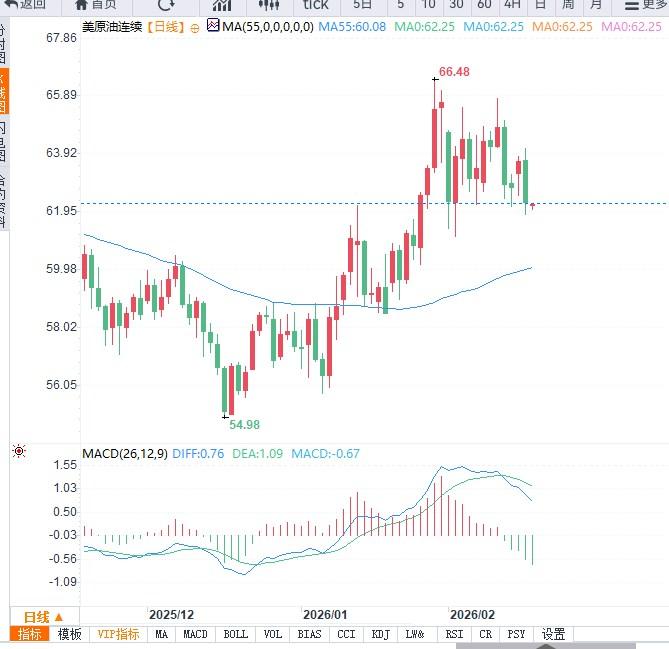
From a daily chart perspective, WTI crude oil encountered resistance and fell back after rebounding above $64, forming a potential double top pattern. Currently, the price is approaching the $62 mark and trading near the 20-day moving average, indicating a significant weakening of short-term momentum.
The MACD indicator has formed a death cross above the zero line, and the momentum bars continue to shorten, indicating that the upward momentum is weakening; the RSI has fallen from above 60 to around 50, reflecting that the bullish force is weakening but has not yet entered the oversold zone.
Key support levels to watch are the $60.80–$61.00 range. A decisive break below this area on the daily chart would confirm a short-term top, potentially leading to further declines towards $59.50 or even the psychological level of $58.
On the upside, $62.80 forms the first short-term resistance. Only if it can regain and stabilize above $63.50 can the short-term downward pressure be alleviated and the $64.50 area be retested.
The overall technical structure indicates that oil prices have shifted from a previously volatile but slightly bullish pattern to a volatile but slightly bearish one, with the direction of the price movement approaching a key support area.
Editor's Note:
The recent decline in oil prices is essentially a rapid correction of risk premiums. The market had already priced in the expectation of a possible resumption of Iranian supply, but negotiations are still in the principle stage, and there is still a long way to go before sanctions are truly lifted.
In the short term, oil price trends will heavily depend on two main factors: whether the US-Iran negotiations progress smoothly to the text stage; and whether there is a new escalation of military tensions in the Middle East.
With uncertainty remaining, oil prices are likely to maintain a highly volatile and volatile pattern. If negotiations continue to release positive signals, WTI may test the $60 mark; if the situation fluctuates, the geopolitical premium may quickly return.
The Iranian Foreign Minister stated that both sides have reached a general consensus on a set of "guiding principles" and will proceed with the drafting of a potential agreement text based on these principles. Oman also confirmed that the negotiations have made "tangible progress."
This news quickly changed market expectations. If an agreement is ultimately reached in the negotiations, it means that some sanctions against Iran's oil industry may be lifted, thereby increasing global crude oil supply.
Against the backdrop of relatively moderate global demand growth, marginal improvements in supply expectations have been enough to trigger significant oil price volatility. As a result, international oil prices fell rapidly. WTI crude oil briefly dipped below $62 yesterday.
The geopolitical risk premium previously priced in by the market has been significantly reversed. However, the prospects for negotiations are not without obstacles. Iran's Supreme Leader has sent a strong signal, emphasizing that the missile and weapons issue is a matter of national sovereignty and should not be a condition attached to negotiations.
Iran has also warned that an agreement is "not imminent," and that the process will become significantly more difficult once the text is drafted. Furthermore, military deployments in the Persian Gulf region continue to intensify.
Diplomatic developments and military maneuvering are intertwined, causing markets to fluctuate between optimism and caution. Overall, oil prices currently reflect expectations of "potential supply increases" rather than actual changes in exports.
Uncertainty remains on the supply side until the agreement is actually implemented.
From a daily chart perspective, WTI crude oil encountered resistance and fell back after rebounding above $64, forming a potential double top pattern. Currently, the price is approaching the $62 mark and trading near the 20-day moving average, indicating a significant weakening of short-term momentum.
The MACD indicator has formed a death cross above the zero line, and the momentum bars continue to shorten, indicating that the upward momentum is weakening; the RSI has fallen from above 60 to around 50, reflecting that the bullish force is weakening but has not yet entered the oversold zone.
Key support levels to watch are the $60.80–$61.00 range. A decisive break below this area on the daily chart would confirm a short-term top, potentially leading to further declines towards $59.50 or even the psychological level of $58.
On the upside, $62.80 forms the first short-term resistance. Only if it can regain and stabilize above $63.50 can the short-term downward pressure be alleviated and the $64.50 area be retested.
The overall technical structure indicates that oil prices have shifted from a previously volatile but slightly bullish pattern to a volatile but slightly bearish one, with the direction of the price movement approaching a key support area.
Editor's Note:
The recent decline in oil prices is essentially a rapid correction of risk premiums. The market had already priced in the expectation of a possible resumption of Iranian supply, but negotiations are still in the principle stage, and there is still a long way to go before sanctions are truly lifted.
In the short term, oil price trends will heavily depend on two main factors: whether the US-Iran negotiations progress smoothly to the text stage; and whether there is a new escalation of military tensions in the Middle East.
With uncertainty remaining, oil prices are likely to maintain a highly volatile and volatile pattern. If negotiations continue to release positive signals, WTI may test the $60 mark; if the situation fluctuates, the geopolitical premium may quickly return.
- Risk Warning and Disclaimer
- The market involves risk, and trading may not be suitable for all investors. This article is for reference only and does not constitute personal investment advice, nor does it take into account certain users’ specific investment objectives, financial situation, or other needs. Any investment decisions made based on this information are at your own risk.