Reports of progress in Iran negotiations and no escalation of military exercises weighed on oil prices, causing them to plummet over 2% to a two-week low.
2026-02-18 09:24:10
On Tuesday (February 17), the US and Iran held a new round of nuclear talks in Geneva. Although no agreement was reached, limited consensus was achieved. Coupled with the market viewing the military exercises as a controlled military posture rather than a prelude to a blockade, US crude oil prices fell by more than 2% on Tuesday, briefly touching a two-week low of $61.87 per barrel. During Wednesday's Asian trading session, US crude oil prices fluctuated narrowly around $62.25 per barrel. Trading agencies assessed that the event caused only minor delays, but geopolitical risks will continue to make oil prices highly sensitive to the progress of the negotiations.
On Tuesday, Iranian state media reported that the Islamic Revolutionary Guard Corps (IRGC) imposed temporary traffic restrictions in parts of the Strait of Hormuz due to "security concerns." The strait is a vital global oil shipping route, and the operation was part of the IRGC's "Smart Control of the Strait of Hormuz" military exercise, which included live-fire drills. Some firing zones overlapped with international shipping lanes in the strait, requiring merchant ships to give way within hours.
The Strait of Hormuz connects the Persian Gulf and the Gulf of Oman, serving as a major waterway for Middle Eastern crude oil shipments to Asian, European, and North American markets. According to K statistics, the strait is projected to handle approximately 13 million barrels of crude oil per day by 2025, accounting for about 31% of global seaborne crude oil traffic. Any sustained disruption could significantly drive up international oil prices.
At the same time, the United States and Iran held a new round of indirect talks in Geneva, Switzerland, focusing on the long-standing dispute over Iran's nuclear program. Iranian Foreign Minister Araqchi stated after the meeting that both sides had reached a certain understanding on the "guiding principles" of the negotiations, but emphasized that a final agreement was still a long way off and much more work was needed. The market generally believes that the progress of these negotiations will have a decisive impact on the direction of geopolitical risk premiums.
Signs of progress in US-Iran negotiations dampened demand for commodities. US crude oil prices fell more than 2% on Tuesday, hitting a two-week low of $61.87 per barrel. On Wednesday in Asian trading, US crude oil prices fluctuated narrowly around $62.25 per barrel.
Analysts believe the market views this closure as a limited, controlled military gesture, rather than a prelude to a full-scale blockade.
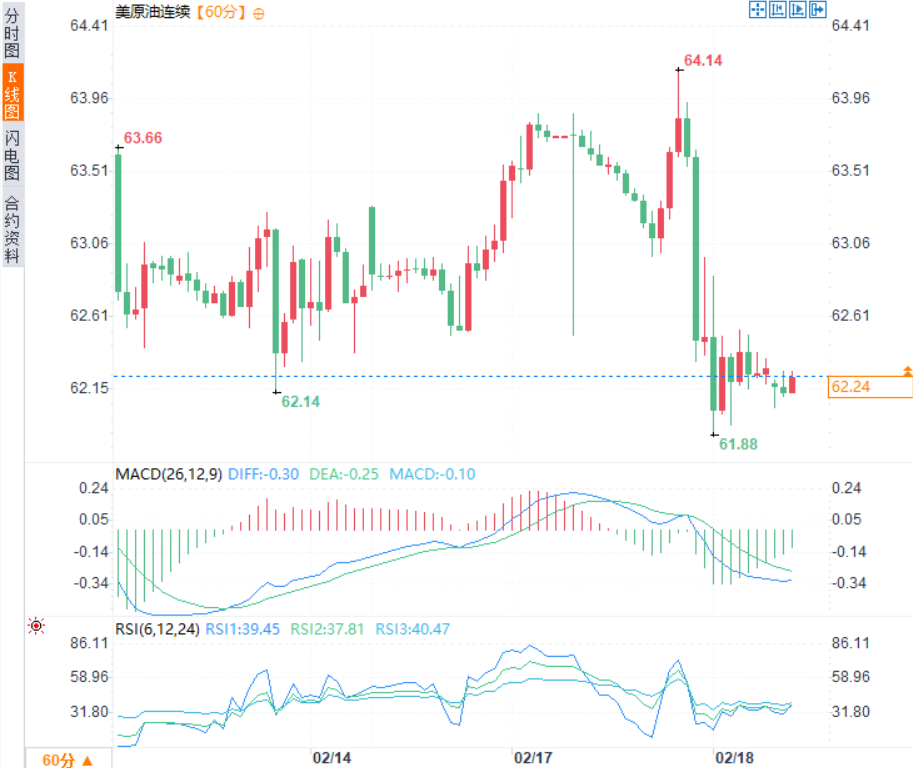
(US crude oil hourly chart, source: FX678)
Jakob Larsen, Chief Safety and Security Officer at BIMCO, the global shipowners' association, pointed out that the temporary restrictions are expected to cause only "minor delays and inconveniences" for vessels entering the Persian Gulf, and will not lead to large-scale shipping disruptions. Given the current regional tensions, commercial vessels are generally expected to comply with Iran's requests for evasive action.
This incident demonstrates that Iran retains the option of "flexing its muscles" during nuclear negotiations: maintaining deterrence through limited actions while avoiding triggering full-scale confrontation and escalation of sanctions. In the short term, the oil market remains highly sensitive to the progress of the Geneva negotiations. If a breakthrough is achieved, the geopolitical risk premium is expected to decline further; conversely, similar military exercises or localized disruptions could again increase oil price volatility.
As one of the most vulnerable nodes in the global energy system, any disturbance in the Strait of Hormuz will continue to affect the nerves of international energy security.
At 9:23 Beijing time, US crude oil futures were trading at $62.25 per barrel.
Event Summary: Revolutionary Guard Exercise Leads to Temporary Closure
On Tuesday, Iranian state media reported that the Islamic Revolutionary Guard Corps (IRGC) imposed temporary traffic restrictions in parts of the Strait of Hormuz due to "security concerns." The strait is a vital global oil shipping route, and the operation was part of the IRGC's "Smart Control of the Strait of Hormuz" military exercise, which included live-fire drills. Some firing zones overlapped with international shipping lanes in the strait, requiring merchant ships to give way within hours.
Key Data from the Strait of Hormuz, the Global Energy Lifeline
The Strait of Hormuz connects the Persian Gulf and the Gulf of Oman, serving as a major waterway for Middle Eastern crude oil shipments to Asian, European, and North American markets. According to K statistics, the strait is projected to handle approximately 13 million barrels of crude oil per day by 2025, accounting for about 31% of global seaborne crude oil traffic. Any sustained disruption could significantly drive up international oil prices.
US-Iran Geneva nuclear talks: Limited consensus, but prospects remain unclear
At the same time, the United States and Iran held a new round of indirect talks in Geneva, Switzerland, focusing on the long-standing dispute over Iran's nuclear program. Iranian Foreign Minister Araqchi stated after the meeting that both sides had reached a certain understanding on the "guiding principles" of the negotiations, but emphasized that a final agreement was still a long way off and much more work was needed. The market generally believes that the progress of these negotiations will have a decisive impact on the direction of geopolitical risk premiums.
Progress in US-Iran negotiations triggers market reaction: Oil prices plummet.
Signs of progress in US-Iran negotiations dampened demand for commodities. US crude oil prices fell more than 2% on Tuesday, hitting a two-week low of $61.87 per barrel. On Wednesday in Asian trading, US crude oil prices fluctuated narrowly around $62.25 per barrel.
Analysts believe the market views this closure as a limited, controlled military gesture, rather than a prelude to a full-scale blockade.
(US crude oil hourly chart, source: FX678)
Shipping impact assessment: Temporary disturbance rather than systemic shock
Jakob Larsen, Chief Safety and Security Officer at BIMCO, the global shipowners' association, pointed out that the temporary restrictions are expected to cause only "minor delays and inconveniences" for vessels entering the Persian Gulf, and will not lead to large-scale shipping disruptions. Given the current regional tensions, commercial vessels are generally expected to comply with Iran's requests for evasive action.
Outlook and Risk Warning
This incident demonstrates that Iran retains the option of "flexing its muscles" during nuclear negotiations: maintaining deterrence through limited actions while avoiding triggering full-scale confrontation and escalation of sanctions. In the short term, the oil market remains highly sensitive to the progress of the Geneva negotiations. If a breakthrough is achieved, the geopolitical risk premium is expected to decline further; conversely, similar military exercises or localized disruptions could again increase oil price volatility.
As one of the most vulnerable nodes in the global energy system, any disturbance in the Strait of Hormuz will continue to affect the nerves of international energy security.
At 9:23 Beijing time, US crude oil futures were trading at $62.25 per barrel.
- Risk Warning and Disclaimer
- The market involves risk, and trading may not be suitable for all investors. This article is for reference only and does not constitute personal investment advice, nor does it take into account certain users’ specific investment objectives, financial situation, or other needs. Any investment decisions made based on this information are at your own risk.