Crude oil trading alert: A sharp rise in geopolitical risks has pushed oil prices back to the upper limit of their trading range, and further upward acceleration is possible in the short term.
2026-02-19 08:58:14
International oil prices surged overnight, coming within a hair's breadth of the year's highest closing price; the gains continued in Asian trading on Thursday, trading around $65.07. Brent crude returned above $70, breaking through the key psychological level for the first time in over two weeks.
The energy sector rose in tandem, indicating a temporary recovery in market risk appetite. The core driver of rising oil prices was escalating geopolitical tensions.

The United States may take military action sooner than previously expected. If a conflict breaks out, Iran may block the Strait of Hormuz, a vital global oil shipping route, thereby disrupting global supply chains.
The strait carries a significant portion of the world's seaborne crude oil exports; any disruption would quickly trigger market priced in the risk of supply disruption. Furthermore, reports suggest that potential military action could last for weeks, rather than the previous short-term precision strikes against Venezuela.
This means that if a conflict occurs, its impact could be far-reaching and last for a longer period, significantly increasing market risk premiums. However, uncertainties remain at the diplomatic level.
Iran has stated that it has reached a general consensus on some "guiding principles" regarding the nuclear issue and plans to continue negotiations over the next two weeks. If a breakthrough is achieved in the negotiations, sanctioned crude oil supplies could re-enter the market, thereby easing current tensions.
Meanwhile, while progress in Russia-Ukraine negotiations has been limited, a subsequent easing of tensions could release additional energy supplies. Therefore, the current rise in oil prices reflects more of a pre-emptive pricing of the "worst-case scenario" than an immediate tightening of supply and demand fundamentals.
The market is in a highly sensitive phase, and changes in news will directly dominate short-term trends.
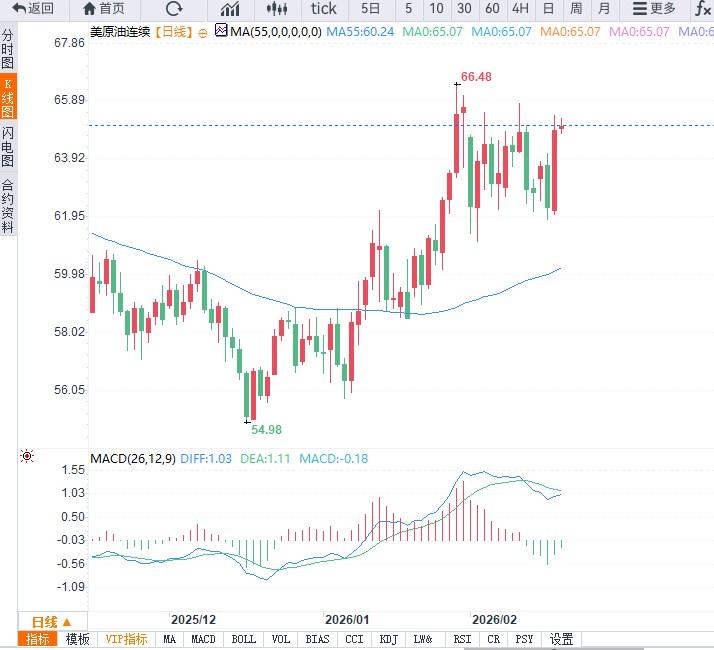
From the daily chart, WTI crude oil previously formed a bottom structure around $60, and then rebounded strongly.
This strong bullish candlestick effectively broke through the resistance zone of 63.50-64.00 and approached the previous high, indicating a significant increase in bullish momentum.
In terms of moving averages, the price has climbed back above the 20-day and 50-day moving averages, with short-term moving averages turning upwards, forming initial signs of a bullish alignment. If it can maintain its position above $64, it may challenge the $66-$67 range.
In terms of momentum indicators, the daily RSI has risen rapidly above 60, but has not yet entered the overbought zone, indicating that there is still room for the upward momentum to continue; the MACD has formed a golden cross above the zero axis, and the momentum bars are expanding, strengthening the bullish signal.
However, it should be noted that the current rise is largely driven by geopolitical risks, and once the risk premium falls, the technical outlook may see a rapid pullback.
If the price falls below $63 again, this breakout may turn into a "false breakout," with support levels to watch at $61.50 and the psychological level of $60.
The daily chart shows that US crude oil has completed a phase breakout and turned into a bullish pattern. As long as it remains above $63, the bullish structure remains dominant; if geopolitical tensions escalate further, the upside potential could extend to $66 or even higher.
Editor's Note:
The essence of this round of oil price increases is a rapid reassessment of risk premiums, rather than a sudden change in the supply and demand pattern. The potential risks in the Strait of Hormuz provide strong upward potential for the market, but diplomatic negotiations have not yet ended, and the possibility of a return to normal supply levels remains.
Technical and fundamental factors are converging, leading to a bullish short-term trend. However, in event-driven markets, volatility is often high and directional shifts are rapid. Close attention should be paid to geopolitical developments and negotiation progress.
The energy sector rose in tandem, indicating a temporary recovery in market risk appetite. The core driver of rising oil prices was escalating geopolitical tensions.
The United States may take military action sooner than previously expected. If a conflict breaks out, Iran may block the Strait of Hormuz, a vital global oil shipping route, thereby disrupting global supply chains.
The strait carries a significant portion of the world's seaborne crude oil exports; any disruption would quickly trigger market priced in the risk of supply disruption. Furthermore, reports suggest that potential military action could last for weeks, rather than the previous short-term precision strikes against Venezuela.
This means that if a conflict occurs, its impact could be far-reaching and last for a longer period, significantly increasing market risk premiums. However, uncertainties remain at the diplomatic level.
Iran has stated that it has reached a general consensus on some "guiding principles" regarding the nuclear issue and plans to continue negotiations over the next two weeks. If a breakthrough is achieved in the negotiations, sanctioned crude oil supplies could re-enter the market, thereby easing current tensions.
Meanwhile, while progress in Russia-Ukraine negotiations has been limited, a subsequent easing of tensions could release additional energy supplies. Therefore, the current rise in oil prices reflects more of a pre-emptive pricing of the "worst-case scenario" than an immediate tightening of supply and demand fundamentals.
The market is in a highly sensitive phase, and changes in news will directly dominate short-term trends.
From the daily chart, WTI crude oil previously formed a bottom structure around $60, and then rebounded strongly.
This strong bullish candlestick effectively broke through the resistance zone of 63.50-64.00 and approached the previous high, indicating a significant increase in bullish momentum.
In terms of moving averages, the price has climbed back above the 20-day and 50-day moving averages, with short-term moving averages turning upwards, forming initial signs of a bullish alignment. If it can maintain its position above $64, it may challenge the $66-$67 range.
In terms of momentum indicators, the daily RSI has risen rapidly above 60, but has not yet entered the overbought zone, indicating that there is still room for the upward momentum to continue; the MACD has formed a golden cross above the zero axis, and the momentum bars are expanding, strengthening the bullish signal.
However, it should be noted that the current rise is largely driven by geopolitical risks, and once the risk premium falls, the technical outlook may see a rapid pullback.
If the price falls below $63 again, this breakout may turn into a "false breakout," with support levels to watch at $61.50 and the psychological level of $60.
The daily chart shows that US crude oil has completed a phase breakout and turned into a bullish pattern. As long as it remains above $63, the bullish structure remains dominant; if geopolitical tensions escalate further, the upside potential could extend to $66 or even higher.
Editor's Note:
The essence of this round of oil price increases is a rapid reassessment of risk premiums, rather than a sudden change in the supply and demand pattern. The potential risks in the Strait of Hormuz provide strong upward potential for the market, but diplomatic negotiations have not yet ended, and the possibility of a return to normal supply levels remains.
Technical and fundamental factors are converging, leading to a bullish short-term trend. However, in event-driven markets, volatility is often high and directional shifts are rapid. Close attention should be paid to geopolitical developments and negotiation progress.
- Risk Warning and Disclaimer
- The market involves risk, and trading may not be suitable for all investors. This article is for reference only and does not constitute personal investment advice, nor does it take into account certain users’ specific investment objectives, financial situation, or other needs. Any investment decisions made based on this information are at your own risk.