February 23 Financial Breakfast: Trump raises tariffs to 15%, driving up gold prices and lowering oil prices as risk aversion increases.
2026-02-23 07:18:50
On Monday (February 23, Beijing time) in early Asian trading, spot gold rose, trading around $5,140 per ounce. This followed the announcement over the weekend that Trump would raise global tariffs on many countries from the existing 10% to a fully legal and legally validated 15%, leading to a resurgence of risk aversion in the market. Simultaneously, US crude oil opened nearly 1% lower, trading around $65.90 per barrel.

U.S. stocks closed higher on Friday, led by gains in heavyweight stocks such as Alphabet (Google's parent company) and Amazon. This followed a 6-3 vote by the U.S. Supreme Court to reject President Trump's global tariffs imposed under the Federal Emergency Management Act. Trump called the ruling a "disgrace" and announced that he would instead impose a 10% tariff on the entire globe within 150 days, pursuant to Section 122 of the Trade Act of 1974.
Investors were relieved that tariffs did not escalate further, and shares of companies affected by tariffs, such as Hasbro and Wayfair, rose between 0.5% and 2.3%. The S&P 500 rose 0.69%, the Nasdaq rose 0.90%, and the Dow Jones Industrial Average rose 0.47%. Due to previous tariff policies, the U.S. may face the risk of tariff refunds exceeding $175 billion.
On the economic data front, US economic growth slowed more than expected in the fourth quarter, while inflation rebounded somewhat in December. The market believes there is a slightly higher than 50% probability that the Federal Reserve will cut interest rates before June. Investors are closely watching Nvidia's quarterly results next Wednesday to assess the future momentum of the artificial intelligence sector.
Gold prices climbed more than 1% on Friday, surpassing the $5,070 mark. The rise was primarily driven by two factors: a sharp slowdown in US fourth-quarter GDP growth to 1.4%, far below expectations; and increased market uncertainty following Trump's announcement of a new 150-day round of 10% global tariffs.
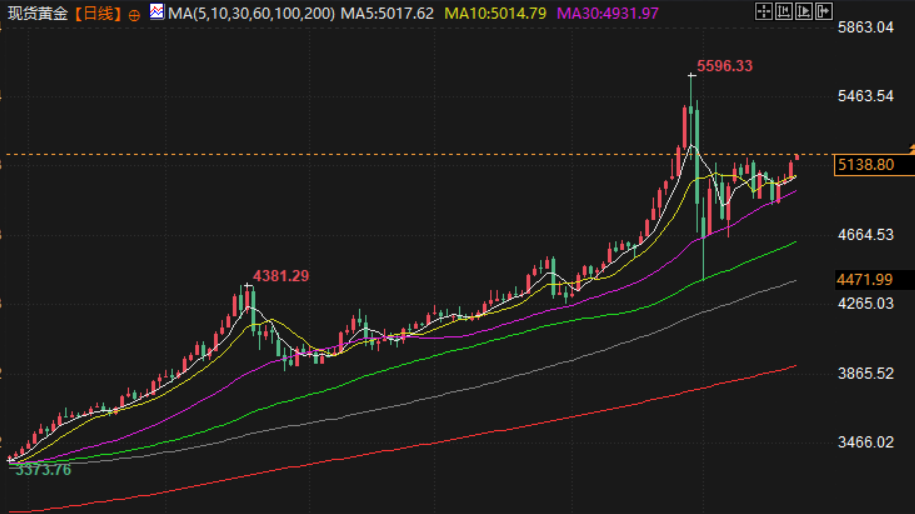
Spot gold rose 1.5% to $5,071.48 per ounce; U.S. gold futures rose 1.7% to $5,080.90 per ounce. U.S. fourth-quarter GDP annualized quarterly growth slowed to 1.4% (expected 3.0%); December PCE inflation rose 0.4% month-on-month (expected 0.3%).
The Supreme Court rejected Trump's previous interpretation of the IEEPA tariffs, but Trump immediately announced new global tariff measures.
In a social media post, Trump stated that, based on a full, thorough, and complete review of the U.S. Supreme Court's ruling on tariffs on the 20th, he hereby declares that, as President of the United States, he will immediately raise the 10% global tariffs imposed on many countries to a fully legal and legally tested 15%. Many of these countries have been "exploiting" the United States for decades without any punishment (until I took office!). In the coming months, the Trump administration will identify and enact new legal tariffs that will continue the extraordinary process of making America great again.
Independent metals trader Tai Wong said that political uncertainty will not deter gold bulls.
Traders still expect the Federal Reserve to cut interest rates twice this year, with the first cut in June. Silver surged 5.8% to $82.92; platinum rose 4.5%; and palladium gained 4%.
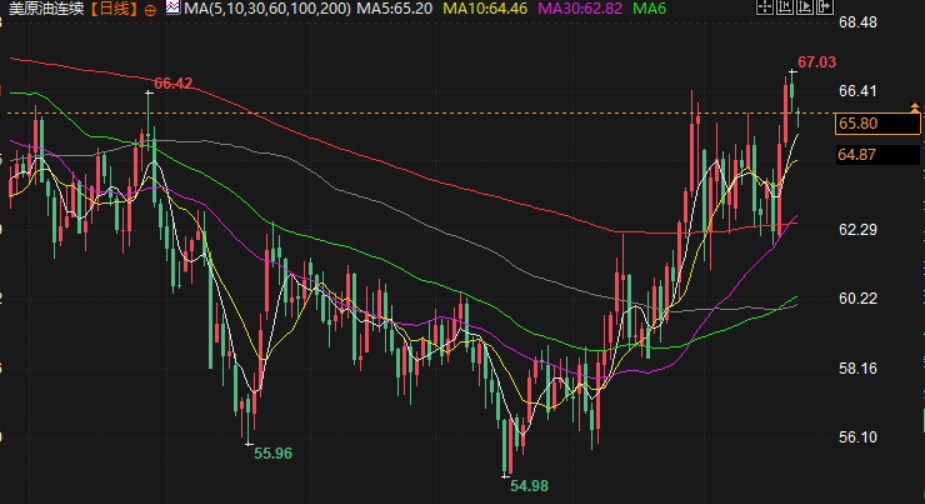
Brent crude futures closed slightly higher on Friday after short covering emerged in late trading, influenced by escalating tensions between Iran and the United States. Brent crude futures settled at $71.76 per barrel, up 0.14%; WTI crude futures settled at $66.39 per barrel, down 0.06%. Both benchmark crudes saw cumulative gains exceeding 5% last week.
Markets are closely watching the latest developments in the US-Iran situation. US President Trump warned last week that Iran would face " dire consequences" if a deal was not reached to stop it from developing nuclear weapons, sparking investor concerns about military action.
Phil Flynn, senior analyst at Price Futures Group, said the market is caught in a conflicting mindset between anticipating developments in the US-Iran situation and denying the possibility of an attack. He also pointed out that while the US Supreme Court ruled that Trump's invocation of the national emergency law to impose tariffs was unconstitutional, the oil market reacted tepidly, with the market generally expecting the tariff issue to be resolved through other means.
Saxo Bank analysis shows that traders and investors have recently increased their holdings of Brent crude oil call options, betting on rising oil prices.
The dollar fell in volatile trading on Friday, ending a four-day winning streak, after the U.S. Supreme Court overturned President Trump's massive tariff measures imposed under the national emergency law.
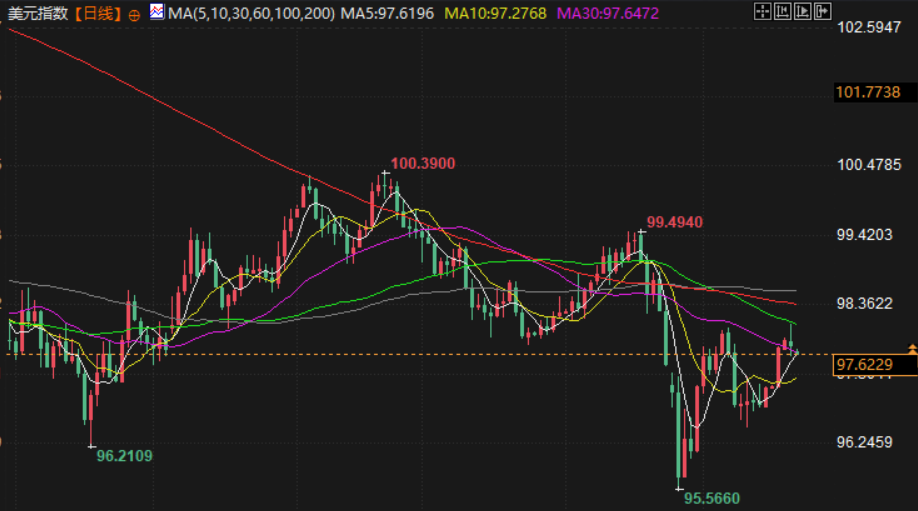
In a 6-3 decision authored by conservative Chief Justice John Roberts, the lower court's ruling was upheld, finding that Trump's actions, which invoked the 1977 law, exceeded his authority.
The dollar had previously strengthened due to mixed US economic data – inflation readings were higher than expected while economic growth was far below expectations.
Data from the U.S. Department of Commerce shows that the country's GDP grew at an annualized rate of only 1.4% last quarter, far below economists' forecasts of 3%. However, analysts point out that the government shutdown negatively impacted the data.
"The dollar was strong for most of last week, except for now, so I think the 'sell-off of U.S. assets' trade is a bit premature," said Erik Bregar, Director of FX and Precious Metals Risk Management at Silver Gold Bull in Toronto. "We need to see how Trump responds, how Treasury Secretary Bessant responds, and how the government responds. There have been rumors that they have other ways to implement tariffs."
In a briefing following the ruling, Trump stated that he would issue the order under Section 122 of the Trade Act of 1974, imposing a 10% global tariff for 150 days to replace some emergency tariff measures that had been overturned by the U.S. Supreme Court. Trump said these tariffs would be added on top of existing tariffs. On Saturday, he further raised the 10% global tariff to a fully legal and legally validated 15%.
According to the U.S. Commerce Department, the Personal Consumption Expenditures (PCE) price index rose 0.4% month-over-month in December, excluding volatile food and energy components, exceeding the expected 0.3% increase. The unrevised November figure was 0.2%. Year-over-year, the December increase was 3%, compared to 2.8% in November.
The euro rose 0.06% against the dollar to $1.1779. The dollar rose nearly 1% last week, marking its biggest weekly gain since November.
A business survey shows that economic activity in the eurozone grew faster than expected this month, with manufacturing returning to growth for the first time since October last year, but the dominant services sector underperformed slightly.
The court ruling did not address the issue of the government refunding the abolished tariffs, a matter Trump said could take years of litigation to resolve.
In a report, Wells Fargo analysts noted that the ruling had a "slightly negative impact on the dollar, but not enough to change the current fundamental landscape that favors tactical long dollar strategies."
Economic data and tariff rulings released last Friday slightly dampened market expectations for a near-term interest rate cut by the Federal Reserve. The CME FedWatch tool showed that market expectations for a rate cut of at least 25 basis points at the Fed's June meeting fell to 53.8% from 58.6% the previous day.
The dollar's strength last week was partly due to escalating tensions between the US and Iran. Trump said on Friday he was considering a limited military strike against Iran, but did not provide specific details; Iran's foreign minister said a draft counter-proposal would be ready within days of last week's nuclear talks.
The pound rose 0.16% to $1.3484, but fell about 1.2% last week, marking its biggest weekly drop since January 2025. Official data showed that UK retail sales in January grew at their fastest pace in nearly four years, while surveys indicated that the recovery momentum for UK businesses in early 2026 has continued for a second month.
The dollar rose 0.06% against the yen to 155.08 yen, after gaining 1.6% last week, its biggest weekly rise since October. Japanese data showed that core consumer inflation hit 2.0% year-on-year in January, the slowest pace in two years.
US President Trump: Will immediately raise the 10% global tariffs imposed on many countries to a fully legal and legally validated 15% level.
In a social media post, Trump stated that, based on a full, thorough, and complete review of the U.S. Supreme Court's ruling on tariffs on the 20th, he hereby declares that, as President of the United States, he will immediately raise the 10% global tariffs imposed on many countries to a fully legal and legally tested 15%. Many of these countries have been "exploiting" the United States for decades without any punishment (until I took office!). In the coming months, the Trump administration will identify and enact new legal tariffs that will continue the extraordinary process of making America great again.
The probability of the Federal Reserve cutting interest rates by 25 basis points by March is 4.1%.
According to CME's "FedWatch": The probability of the Federal Reserve cutting interest rates by 25 basis points by March is 4.1%, and the probability of keeping rates unchanged is 95.9%. The probability of the Fed cutting rates by a cumulative 25 basis points by April is 16.4%, the probability of keeping rates unchanged is 83%, and the probability of a cumulative 50 basis point cut is 0.5%. The probability of a cumulative 25 basis point cut by June is 44%.
The White House announced the effective date and scope of temporary import tariffs.
On February 20, local time, the White House issued a statement saying that US President Trump signed a proclamation announcing temporary import tariffs. Trump invoked the powers granted by Section 122 of the Trade Act of 1974, which authorizes the president to address certain fundamental international payment issues through surcharges and other special import restrictions. The proclamation stipulates a 10% ad valorem import tariff on goods imported into the United States for a period of 150 days. This temporary import tariff will take effect on February 24, Eastern Time. Due to the needs of the US economy, or to ensure that the tariff more effectively addresses fundamental international payment issues facing the United States, some goods will be exempt from this temporary import tariff. These include: certain critical minerals, metals used for currency and gold and silver bars, energy and energy products; natural resources and fertilizers that cannot be grown, mined, or otherwise produced in the United States, or that cannot be grown, mined, or otherwise produced in sufficient quantities to meet domestic demand; certain agricultural products, including beef, tomatoes, and oranges; pharmaceuticals and pharmaceutical ingredients; certain electronic products; passenger cars, certain light trucks, certain medium and heavy vehicles, buses, and certain components of passenger cars, light trucks, heavy vehicles, and buses; certain aerospace products; and informational materials (such as books), donated items, and personal baggage. In addition, certain goods are exempt from provisional import duties, including all articles and components currently or to be subject to Section 232, Canadian and Mexican goods conforming to the USMCA, and textiles and apparel imported duty-free under the Dominican Republic-Central American Free Trade Agreement as goods from Costa Rica, the Dominican Republic, El Salvador, Guatemala, Honduras, or Nicaragua. In another executive order, Trump reiterated and continued the suspension of duty-free treatment for low-value goods, including those shipped via the international postal system, which will also be subject to provisional import duties under Section 122. In addition to the measures taken that day, Trump also directed the Office of the United States Trade Representative to use its powers under Section 301 to investigate certain unreasonable and discriminatory practices, policies, and regulations. (CCTV News)
Graham urged Trump to strike Iran, saying there was an opportunity for "historic change".
According to Axios, South Carolina Republican Senator Lindsey Graham stated that several people close to President Trump advised him against bombing Iran, and Graham urged Trump to ignore their advice. As a senator closely associated with Trump, Graham is a leading figure in the Trump circle supporting a strike against Iran. He acknowledged understanding concerns about large-scale military action in the Middle East but believes those advising against involvement ignore the consequences of allowing unchecked forces of evil. Graham stated that after his recent visit to the region, he believes there is an opportunity to "bring about historic change" in Iran. However, he also noted the growing opposition to involvement and decisive action, and only time will tell how things will unfold.
US companies sue for refunds of tariffs already paid; Trump says the lawsuit could last five years.
According to a report by NBC News on February 21, hundreds of companies have filed lawsuits demanding refunds for tariffs previously paid by the Trump administration after the U.S. Supreme Court ruled that some tariffs imposed over the past few years lacked legal basis, and companies may be able to get back the taxes they have already paid. However, some economists point out that the process for companies to apply for refunds is currently unclear. President Trump acknowledged at a press conference on February 20 that the Supreme Court ruling would trigger a protracted legal battle. He stated that the question of whether the federal government must refund tariffs to American companies could "go through five years of litigation." This means that even if companies win their cases, actually receiving a refund could face a lengthy legal process.
The US East Coast is set to experience another strong winter storm; airlines have begun cancelling flights.
The US East Coast is about to be hit by another severe winter storm, and American Airlines has begun cancelling Sunday flights and waiving refund and rebooking fees at airports along the Virginia-Maine route. This test coincides with the end of the winter break. Delta Air Lines, American Airlines, JetBlue Airways, United Airlines, and Spirit Airlines have all waived related fees and fare differences, and passengers can reschedule their trips until February 26 at the latest. Southwest Airlines stated that passengers can reschedule or waitlist within two weeks without paying any additional fees. According to the National Weather Service, parts of southern Connecticut and southeastern New York will receive 13 to 18 inches of snow, with gusts reaching up to 55 miles per hour. The blizzard warning will be in effect at 6:00 AM ET on Sunday. (CCTV)
Several countries are urging their citizens in Iran to evacuate as soon as possible.
On February 20th local time, Germany, Sweden, Slovakia, and other countries urged their citizens in Iran to evacuate as soon as possible. The previous day, Polish Prime Minister Tusk issued a similar appeal. Tensions between the United States and Iran have continued to escalate recently. While the two sides are negotiating, the United States continues to increase its troop deployment in the Middle East. On February 19th, US President Trump set a "deadline," stating that Iran had 10-15 days to reach an agreement with the United States. Furthermore, some US media reports suggest that the US military may launch a "limited strike" against Iran within days to force concessions. (CCTV International News)
In less than 30 seconds, the container ship was securely fixed, marking the first time in China that a container ship has achieved fully unmanned operation throughout the entire process.
On February 21, the "Zhifei," China's first intelligent container ship to enter commercial operation, precisely berthed at the automated terminal of Qingdao Port in Shandong Province using its unmanned autonomous navigation mode. This marks the first time my country has achieved fully automated navigation, berthing, and operations for a container ship. After precisely positioning itself, the "Zhifei" used vacuum suction cups from its automated vacuum mooring system to powerfully adhere to the hull, eliminating the need for manual mooring and securing the ship firmly in place in less than 30 seconds. Subsequently, the terminal's fully automated loading and unloading equipment operated simultaneously and efficiently. The independently developed Terminal Intelligent Control System (A-TOS) and Equipment Intelligent Control System (A-ECS) worked together, providing millisecond-level response speeds to precisely coordinate automated cranes and automated guided vehicles to complete container loading and unloading operations. It is understood that the "Zhifei" is equipped with a domestically developed intelligent navigation core system and is China's first intelligent cargo ship designed for commercial operation, possessing three modes: manual driving, remote control, and unmanned autonomous navigation. (CCTV News)
Key Focus Today
stock market
U.S. stocks closed higher on Friday, led by gains in heavyweight stocks such as Alphabet (Google's parent company) and Amazon. This followed a 6-3 vote by the U.S. Supreme Court to reject President Trump's global tariffs imposed under the Federal Emergency Management Act. Trump called the ruling a "disgrace" and announced that he would instead impose a 10% tariff on the entire globe within 150 days, pursuant to Section 122 of the Trade Act of 1974.
Investors were relieved that tariffs did not escalate further, and shares of companies affected by tariffs, such as Hasbro and Wayfair, rose between 0.5% and 2.3%. The S&P 500 rose 0.69%, the Nasdaq rose 0.90%, and the Dow Jones Industrial Average rose 0.47%. Due to previous tariff policies, the U.S. may face the risk of tariff refunds exceeding $175 billion.
On the economic data front, US economic growth slowed more than expected in the fourth quarter, while inflation rebounded somewhat in December. The market believes there is a slightly higher than 50% probability that the Federal Reserve will cut interest rates before June. Investors are closely watching Nvidia's quarterly results next Wednesday to assess the future momentum of the artificial intelligence sector.
Gold Market
Gold prices climbed more than 1% on Friday, surpassing the $5,070 mark. The rise was primarily driven by two factors: a sharp slowdown in US fourth-quarter GDP growth to 1.4%, far below expectations; and increased market uncertainty following Trump's announcement of a new 150-day round of 10% global tariffs.
Spot gold rose 1.5% to $5,071.48 per ounce; U.S. gold futures rose 1.7% to $5,080.90 per ounce. U.S. fourth-quarter GDP annualized quarterly growth slowed to 1.4% (expected 3.0%); December PCE inflation rose 0.4% month-on-month (expected 0.3%).
The Supreme Court rejected Trump's previous interpretation of the IEEPA tariffs, but Trump immediately announced new global tariff measures.
In a social media post, Trump stated that, based on a full, thorough, and complete review of the U.S. Supreme Court's ruling on tariffs on the 20th, he hereby declares that, as President of the United States, he will immediately raise the 10% global tariffs imposed on many countries to a fully legal and legally tested 15%. Many of these countries have been "exploiting" the United States for decades without any punishment (until I took office!). In the coming months, the Trump administration will identify and enact new legal tariffs that will continue the extraordinary process of making America great again.
Independent metals trader Tai Wong said that political uncertainty will not deter gold bulls.
Traders still expect the Federal Reserve to cut interest rates twice this year, with the first cut in June. Silver surged 5.8% to $82.92; platinum rose 4.5%; and palladium gained 4%.
oil market
Brent crude futures closed slightly higher on Friday after short covering emerged in late trading, influenced by escalating tensions between Iran and the United States. Brent crude futures settled at $71.76 per barrel, up 0.14%; WTI crude futures settled at $66.39 per barrel, down 0.06%. Both benchmark crudes saw cumulative gains exceeding 5% last week.
Markets are closely watching the latest developments in the US-Iran situation. US President Trump warned last week that Iran would face " dire consequences" if a deal was not reached to stop it from developing nuclear weapons, sparking investor concerns about military action.
Phil Flynn, senior analyst at Price Futures Group, said the market is caught in a conflicting mindset between anticipating developments in the US-Iran situation and denying the possibility of an attack. He also pointed out that while the US Supreme Court ruled that Trump's invocation of the national emergency law to impose tariffs was unconstitutional, the oil market reacted tepidly, with the market generally expecting the tariff issue to be resolved through other means.
Saxo Bank analysis shows that traders and investors have recently increased their holdings of Brent crude oil call options, betting on rising oil prices.
Foreign exchange market
The dollar fell in volatile trading on Friday, ending a four-day winning streak, after the U.S. Supreme Court overturned President Trump's massive tariff measures imposed under the national emergency law.
In a 6-3 decision authored by conservative Chief Justice John Roberts, the lower court's ruling was upheld, finding that Trump's actions, which invoked the 1977 law, exceeded his authority.
The dollar had previously strengthened due to mixed US economic data – inflation readings were higher than expected while economic growth was far below expectations.
Data from the U.S. Department of Commerce shows that the country's GDP grew at an annualized rate of only 1.4% last quarter, far below economists' forecasts of 3%. However, analysts point out that the government shutdown negatively impacted the data.
"The dollar was strong for most of last week, except for now, so I think the 'sell-off of U.S. assets' trade is a bit premature," said Erik Bregar, Director of FX and Precious Metals Risk Management at Silver Gold Bull in Toronto. "We need to see how Trump responds, how Treasury Secretary Bessant responds, and how the government responds. There have been rumors that they have other ways to implement tariffs."
In a briefing following the ruling, Trump stated that he would issue the order under Section 122 of the Trade Act of 1974, imposing a 10% global tariff for 150 days to replace some emergency tariff measures that had been overturned by the U.S. Supreme Court. Trump said these tariffs would be added on top of existing tariffs. On Saturday, he further raised the 10% global tariff to a fully legal and legally validated 15%.
According to the U.S. Commerce Department, the Personal Consumption Expenditures (PCE) price index rose 0.4% month-over-month in December, excluding volatile food and energy components, exceeding the expected 0.3% increase. The unrevised November figure was 0.2%. Year-over-year, the December increase was 3%, compared to 2.8% in November.
The euro rose 0.06% against the dollar to $1.1779. The dollar rose nearly 1% last week, marking its biggest weekly gain since November.
A business survey shows that economic activity in the eurozone grew faster than expected this month, with manufacturing returning to growth for the first time since October last year, but the dominant services sector underperformed slightly.
The court ruling did not address the issue of the government refunding the abolished tariffs, a matter Trump said could take years of litigation to resolve.
In a report, Wells Fargo analysts noted that the ruling had a "slightly negative impact on the dollar, but not enough to change the current fundamental landscape that favors tactical long dollar strategies."
Economic data and tariff rulings released last Friday slightly dampened market expectations for a near-term interest rate cut by the Federal Reserve. The CME FedWatch tool showed that market expectations for a rate cut of at least 25 basis points at the Fed's June meeting fell to 53.8% from 58.6% the previous day.
The dollar's strength last week was partly due to escalating tensions between the US and Iran. Trump said on Friday he was considering a limited military strike against Iran, but did not provide specific details; Iran's foreign minister said a draft counter-proposal would be ready within days of last week's nuclear talks.
The pound rose 0.16% to $1.3484, but fell about 1.2% last week, marking its biggest weekly drop since January 2025. Official data showed that UK retail sales in January grew at their fastest pace in nearly four years, while surveys indicated that the recovery momentum for UK businesses in early 2026 has continued for a second month.
The dollar rose 0.06% against the yen to 155.08 yen, after gaining 1.6% last week, its biggest weekly rise since October. Japanese data showed that core consumer inflation hit 2.0% year-on-year in January, the slowest pace in two years.
International News
US President Trump: Will immediately raise the 10% global tariffs imposed on many countries to a fully legal and legally validated 15% level.
In a social media post, Trump stated that, based on a full, thorough, and complete review of the U.S. Supreme Court's ruling on tariffs on the 20th, he hereby declares that, as President of the United States, he will immediately raise the 10% global tariffs imposed on many countries to a fully legal and legally tested 15%. Many of these countries have been "exploiting" the United States for decades without any punishment (until I took office!). In the coming months, the Trump administration will identify and enact new legal tariffs that will continue the extraordinary process of making America great again.
The probability of the Federal Reserve cutting interest rates by 25 basis points by March is 4.1%.
According to CME's "FedWatch": The probability of the Federal Reserve cutting interest rates by 25 basis points by March is 4.1%, and the probability of keeping rates unchanged is 95.9%. The probability of the Fed cutting rates by a cumulative 25 basis points by April is 16.4%, the probability of keeping rates unchanged is 83%, and the probability of a cumulative 50 basis point cut is 0.5%. The probability of a cumulative 25 basis point cut by June is 44%.
The White House announced the effective date and scope of temporary import tariffs.
On February 20, local time, the White House issued a statement saying that US President Trump signed a proclamation announcing temporary import tariffs. Trump invoked the powers granted by Section 122 of the Trade Act of 1974, which authorizes the president to address certain fundamental international payment issues through surcharges and other special import restrictions. The proclamation stipulates a 10% ad valorem import tariff on goods imported into the United States for a period of 150 days. This temporary import tariff will take effect on February 24, Eastern Time. Due to the needs of the US economy, or to ensure that the tariff more effectively addresses fundamental international payment issues facing the United States, some goods will be exempt from this temporary import tariff. These include: certain critical minerals, metals used for currency and gold and silver bars, energy and energy products; natural resources and fertilizers that cannot be grown, mined, or otherwise produced in the United States, or that cannot be grown, mined, or otherwise produced in sufficient quantities to meet domestic demand; certain agricultural products, including beef, tomatoes, and oranges; pharmaceuticals and pharmaceutical ingredients; certain electronic products; passenger cars, certain light trucks, certain medium and heavy vehicles, buses, and certain components of passenger cars, light trucks, heavy vehicles, and buses; certain aerospace products; and informational materials (such as books), donated items, and personal baggage. In addition, certain goods are exempt from provisional import duties, including all articles and components currently or to be subject to Section 232, Canadian and Mexican goods conforming to the USMCA, and textiles and apparel imported duty-free under the Dominican Republic-Central American Free Trade Agreement as goods from Costa Rica, the Dominican Republic, El Salvador, Guatemala, Honduras, or Nicaragua. In another executive order, Trump reiterated and continued the suspension of duty-free treatment for low-value goods, including those shipped via the international postal system, which will also be subject to provisional import duties under Section 122. In addition to the measures taken that day, Trump also directed the Office of the United States Trade Representative to use its powers under Section 301 to investigate certain unreasonable and discriminatory practices, policies, and regulations. (CCTV News)
Graham urged Trump to strike Iran, saying there was an opportunity for "historic change".
According to Axios, South Carolina Republican Senator Lindsey Graham stated that several people close to President Trump advised him against bombing Iran, and Graham urged Trump to ignore their advice. As a senator closely associated with Trump, Graham is a leading figure in the Trump circle supporting a strike against Iran. He acknowledged understanding concerns about large-scale military action in the Middle East but believes those advising against involvement ignore the consequences of allowing unchecked forces of evil. Graham stated that after his recent visit to the region, he believes there is an opportunity to "bring about historic change" in Iran. However, he also noted the growing opposition to involvement and decisive action, and only time will tell how things will unfold.
US companies sue for refunds of tariffs already paid; Trump says the lawsuit could last five years.
According to a report by NBC News on February 21, hundreds of companies have filed lawsuits demanding refunds for tariffs previously paid by the Trump administration after the U.S. Supreme Court ruled that some tariffs imposed over the past few years lacked legal basis, and companies may be able to get back the taxes they have already paid. However, some economists point out that the process for companies to apply for refunds is currently unclear. President Trump acknowledged at a press conference on February 20 that the Supreme Court ruling would trigger a protracted legal battle. He stated that the question of whether the federal government must refund tariffs to American companies could "go through five years of litigation." This means that even if companies win their cases, actually receiving a refund could face a lengthy legal process.
The US East Coast is set to experience another strong winter storm; airlines have begun cancelling flights.
The US East Coast is about to be hit by another severe winter storm, and American Airlines has begun cancelling Sunday flights and waiving refund and rebooking fees at airports along the Virginia-Maine route. This test coincides with the end of the winter break. Delta Air Lines, American Airlines, JetBlue Airways, United Airlines, and Spirit Airlines have all waived related fees and fare differences, and passengers can reschedule their trips until February 26 at the latest. Southwest Airlines stated that passengers can reschedule or waitlist within two weeks without paying any additional fees. According to the National Weather Service, parts of southern Connecticut and southeastern New York will receive 13 to 18 inches of snow, with gusts reaching up to 55 miles per hour. The blizzard warning will be in effect at 6:00 AM ET on Sunday. (CCTV)
Several countries are urging their citizens in Iran to evacuate as soon as possible.
On February 20th local time, Germany, Sweden, Slovakia, and other countries urged their citizens in Iran to evacuate as soon as possible. The previous day, Polish Prime Minister Tusk issued a similar appeal. Tensions between the United States and Iran have continued to escalate recently. While the two sides are negotiating, the United States continues to increase its troop deployment in the Middle East. On February 19th, US President Trump set a "deadline," stating that Iran had 10-15 days to reach an agreement with the United States. Furthermore, some US media reports suggest that the US military may launch a "limited strike" against Iran within days to force concessions. (CCTV International News)
Domestic News
In less than 30 seconds, the container ship was securely fixed, marking the first time in China that a container ship has achieved fully unmanned operation throughout the entire process.
On February 21, the "Zhifei," China's first intelligent container ship to enter commercial operation, precisely berthed at the automated terminal of Qingdao Port in Shandong Province using its unmanned autonomous navigation mode. This marks the first time my country has achieved fully automated navigation, berthing, and operations for a container ship. After precisely positioning itself, the "Zhifei" used vacuum suction cups from its automated vacuum mooring system to powerfully adhere to the hull, eliminating the need for manual mooring and securing the ship firmly in place in less than 30 seconds. Subsequently, the terminal's fully automated loading and unloading equipment operated simultaneously and efficiently. The independently developed Terminal Intelligent Control System (A-TOS) and Equipment Intelligent Control System (A-ECS) worked together, providing millisecond-level response speeds to precisely coordinate automated cranes and automated guided vehicles to complete container loading and unloading operations. It is understood that the "Zhifei" is equipped with a domestically developed intelligent navigation core system and is China's first intelligent cargo ship designed for commercial operation, possessing three modes: manual driving, remote control, and unmanned autonomous navigation. (CCTV News)
- Risk Warning and Disclaimer
- The market involves risk, and trading may not be suitable for all investors. This article is for reference only and does not constitute personal investment advice, nor does it take into account certain users’ specific investment objectives, financial situation, or other needs. Any investment decisions made based on this information are at your own risk.