February 26th Financial Breakfast: Safe-haven demand supports gold prices, increased inventories drag down oil prices, focus on the third round of US-Iran negotiations.
2026-02-26 07:11:23
On Thursday (February 26, Beijing time) in early Asian trading, spot gold was trading around $5,175 per ounce. Gold prices climbed on Wednesday as inflationary pressures from US tariffs and geopolitical tensions ahead of Iran nuclear talks spurred safe-haven demand. US crude oil was trading around $65.65 per barrel. Oil prices fell on Wednesday as US crude inventories rose far more than expected, but continued market concerns about geopolitical tensions in the Middle East provided support for oil prices.

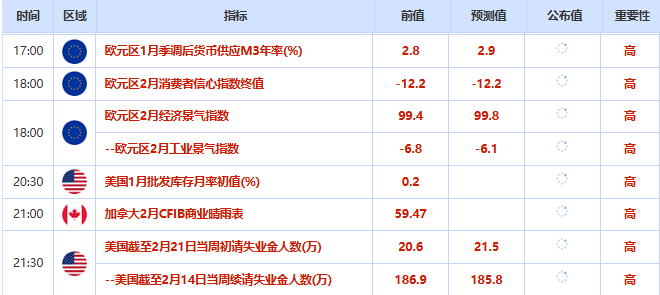
U.S. stocks continued their rally on Wednesday, led by technology stocks, with all three major indexes rising and hitting two-week highs. The Dow Jones Industrial Average closed up 0.63%, the S&P 500 rose 0.81%, and the Nasdaq Composite climbed 1.26%, driven by chip stocks. This was mainly due to easing concerns about the potentially disruptive impact of artificial intelligence, which fueled renewed optimism.
Chip giant Nvidia reported fourth-quarter revenue of $68.13 billion after hours, exceeding analysts' expectations. Its stock price rose by about 3%, driving the Philadelphia Semiconductor Index up 1.6% before the earnings release. The previously sluggish S&P Software and Services sector also rebounded strongly by 2.9%.
Despite Lowe's weak revenue forecast dragging down housing-related stocks and internet service provider GoDaddy plunging 14.3%, investors will still be closely watching the follow-up earnings reports of software stocks such as Salesforce, Intuit, and Snowflake to assess recent market volatility.
Gold prices climbed on Wednesday, with spot gold rising 1.1% to $5,202.28 an ounce, mainly driven by inflationary pressures from U.S. tariffs and safe-haven demand fueled by geopolitical tensions ahead of Iran nuclear talks.

The United States has imposed a temporary 10% tariff on global goods, with the possibility of an increase, while the third round of negotiations between the US and Iran is scheduled for Thursday, further exacerbating market anxiety.
Silver rose 3.9% to a three-week high, while platinum surged 7.1% to its highest level since January 29. A Bank of America report noted that although gold investment has slowed and gold prices may weaken in the spring, tariff uncertainty could shorten the consolidation period, and the report predicts gold prices could break through $6,000 in the next 12 months.
Oil prices fell on Wednesday as U.S. crude inventories rose far more than expected, but continued concerns about geopolitical tensions in the Middle East provided support. Brent crude futures edged up to settle at $70.85 a barrel, while U.S. crude futures fell to settle at $65.42 a barrel. Data from the U.S. Energy Information Administration (EIA) showed that crude oil inventories surged by 16 million barrels last week, far exceeding analysts' expectations of a 1.5 million barrel increase, mainly due to declining refinery utilization rates and increased imports.
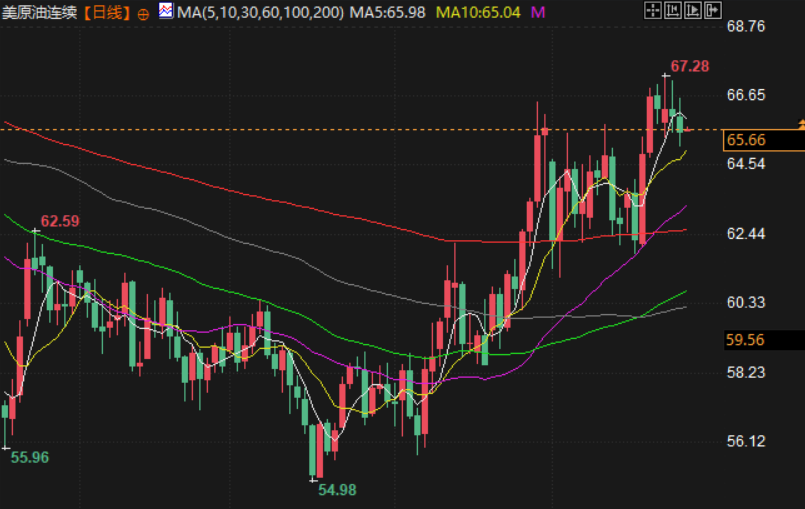
However, the increased US military presence in the Middle East to pressure Iran into negotiations raised market concerns that a potential military conflict could disrupt oil supplies, limiting the negative impact of inventory data.
Meanwhile, Saudi Arabia has launched a short-term production increase and export plan to cope with possible supply disruptions, and major OPEC+ oil-producing countries are also considering a slight increase in production in April. The market is closely watching the developments of the US-Iran Geneva talks on Thursday and the OPEC+ meeting on March 1.
The yen fell to a two-week low of 156.44 against the dollar on Wednesday as the Japanese government appointed two academics who advocate reflation to the central bank's policy board, exacerbating market concerns about a slowdown in the pace of interest rate hikes. Meanwhile, reports that Prime Minister Sanae Takaichi had reservations about further rate increases further pressured the yen.
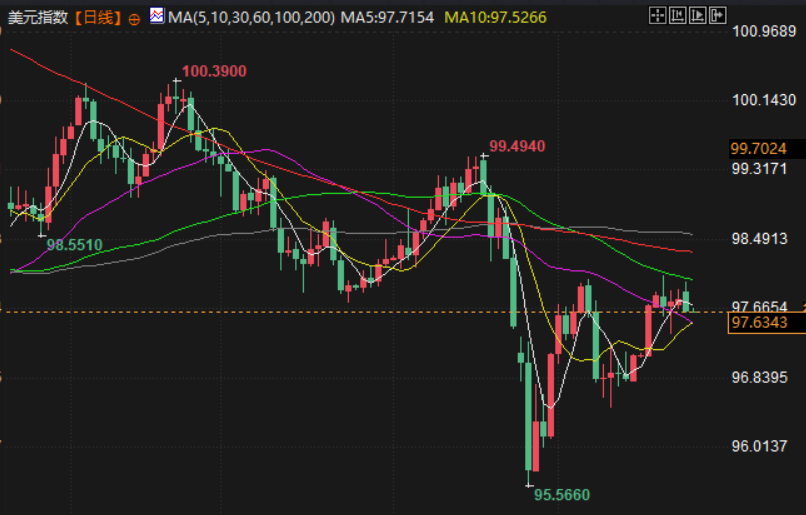
The dollar index fell 0.2% to 97.69 after the U.S. Supreme Court on Friday overturned President Trump’s emergency tariff policy, and traders are assessing the impact of the new tariffs.
The euro rose 0.3% to $1.1806 as traders assessed uncertainty surrounding U.S. tariff policy and the interest rate outlook for the Federal Reserve and the European Central Bank. Given policymakers' concerns about persistently high U.S. inflation, the Federal Reserve is expected to keep interest rates unchanged until at least June, while the European Central Bank is likely to maintain rates unchanged throughout 2026.
In addition, the Australian dollar rose 0.96% to US$0.7123 due to higher-than-expected domestic inflation, as the market focuses on the progress of US-Iran negotiations.
Expectations for a Fed rate cut in March have narrowed further.
According to the latest data from CME's "FedWatch," the market still expects a 98.0% probability that the Federal Reserve will keep interest rates unchanged at its March meeting, while the probability of a 25 basis point rate cut remains at 2.0%. The market has largely priced in a rate cut in March. For subsequent meetings: by April, the probability of a cumulative 25 basis point rate cut is 15.9%, the probability of keeping rates unchanged is 83.8%, and the probability of a cumulative 50 basis point rate cut is only 0.3%. By June, the probability of a cumulative 25 basis point rate cut has decreased to 39.5%, further narrowing, indicating that market expectations for a mid-year rate cut are also weakening.
The United States plans to conditionally ease its oil embargo against Cuba.
A guidance document released on the 25th by the U.S. Treasury Department's Office of Foreign Assets Control (OFAC) indicates that the agency will implement a licensing policy allowing the resale of Venezuelan oil to Cuban non-governmental sectors. OFAC, which enforces U.S. foreign economic sanctions, stated that potentially approved transactions must be used to "support the Cuban people, including the private sector," such as exports for Cuban commercial and humanitarian purposes. This licensing policy does not cover transactions involving Cuban military or government agencies, individuals, or entities.
Trump plans to ask tech giants to sign commitments next week.
US President Donald Trump will convene tech executives at the White House next week to sign pledges guaranteeing their companies will cover the electricity costs of their energy-intensive data centers. A White House official said representatives from companies including Amazon, Meta Platforms Inc., Microsoft, and Google's parent company Alphabet are expected to attend the event with Trump on March 4. The invitee list also includes Elon Musk's xAI, Oracle, and OpenAI. While these pledges will be non-binding and lack legal force, government officials believe that formal and public commitments will help with accountability and provide reassurance to consumers concerned about potential environmental damage and rising electricity costs from the rapid expansion of data centers.
Trump and Zelensky spoke by phone to discuss the US-Ukraine Geneva talks on the 26th.
It was learned on February 25 local time that US President Trump was speaking by phone with Ukrainian President Zelensky. Later that day, the White House also issued a statement confirming the call, saying that President Trump and President Zelensky exchanged views on the upcoming round of US-Ukraine negotiations scheduled for February 26 in Geneva. (CCTV News)
The EU reportedly assesses that the new US tariffs may exceed the agreed 15% cap, affecting €4.2 billion worth of goods.
US President Donald Trump's new tariff plan will subject approximately €4.2 billion ($5 billion) of EU exports to tariffs above the 15% cap set under the US-EU trade agreement. Sources familiar with the matter said Trump's new policy will raise tariffs on European exports, including cheese, butter, some agricultural products, as well as certain plastic products, textiles, and chemicals, to levels exceeding the maximum allowed by the agreement. Other goods, such as some spirits, will be subject to tariffs below 15%.
US media reports that the US government is considering imposing new tariffs.
The U.S. Supreme Court recently ruled that the U.S. government's massive tariff policy was illegal. Several U.S. media outlets have reported that the U.S. government is preparing to invoke other legal provisions to impose new tariffs on products from multiple industries. Following the Supreme Court's ruling, thousands of companies, including large U.S. corporations such as FedEx, Costco, and Reebok, filed lawsuits in the U.S. Court of International Trade, demanding the government return the tariffs they have already paid. State governments in New York, California, and Illinois have also requested tariff refunds from the federal government. (CCTV)
The Israeli military claims to have discovered Hezbollah militant facilities in southern Lebanon, alleging that they violated the Lebanon-Israel ceasefire agreement.
On the 25th local time, the Israel Defense Forces (IDF) stated that over the past few months, it has conducted operations in southern Lebanon, discovering and dismantling numerous armed facilities, including observation posts, firing positions, and anti-tank weapons. The IDF claims these facilities belong to Hezbollah and their existence violates the ceasefire agreement between Israel and Lebanon. The IDF stated that these targeted operations are aimed at preventing Hezbollah from rearming and dismantling its infrastructure in the region. The IDF emphasized that it will continue to take action to prevent Hezbollah from regrouping and strengthening its armed capabilities. Hezbollah has not yet responded. (CCTV News)
US mortgage rates fell to their lowest level since 2022, stimulating increased refinancing activity.
U.S. mortgage rates edged lower last week to their lowest level since 2022, spurring increased refinancing activity. According to data released Wednesday by the Mortgage Bankers Association (MBA), the contracted rate for a 30-year mortgage fell 8 basis points to 6.09% in the week ending February 20. Adjustable-rate mortgages with a locked-in rate for the first five years fell to 5.23%, the lowest level since September 2022. An index measuring refinancing activity rose more than 4%, reaching its second-highest level in five months. According to the MBA, refinancing activity has increased in all but two weeks this year.
The silver economy market size is expected to reach 30 trillion yuan by 2035.
On February 24, the State Council held its first executive meeting of the new year, focusing on promoting the development of the silver economy and elderly care services. Forecast data shows that by 2035, the market size of my country's silver economy will reach 30 trillion yuan, accounting for about 10% of GDP. The silver economy has gradually evolved from a public welfare sector into a trillion-yuan industry. (CCTV Finance)
Robot rental orders increased by nearly 70% from the first to the seventh day of the Lunar New Year compared to the previous period.
Robots will make a group appearance at the 2026 Spring Festival Gala (Year of the Horse). From the Gala stage to the "cyber workers" on the streets, robots are taking up their posts. In 2025, more than 1,500 robot rental companies were established nationwide, a year-on-year increase of 48.1%. From factories to markets, rental has become the "first stop" for robots to enter people's lives. Li Yiyan, founder of Qingtian Rental, said: "From March to May 2025, the daily rental price of a robot was about 10,000 to 20,000 yuan. Now it has dropped a lot, and you can rent a robot for about 3,000 yuan." Li Yiyan said that from the first to the seventh day of the Lunar New Year this year, robot rental orders increased by nearly 70% compared to the previous period. (CCTV Finance)
Key Focus Today
stock market
U.S. stocks continued their rally on Wednesday, led by technology stocks, with all three major indexes rising and hitting two-week highs. The Dow Jones Industrial Average closed up 0.63%, the S&P 500 rose 0.81%, and the Nasdaq Composite climbed 1.26%, driven by chip stocks. This was mainly due to easing concerns about the potentially disruptive impact of artificial intelligence, which fueled renewed optimism.
Chip giant Nvidia reported fourth-quarter revenue of $68.13 billion after hours, exceeding analysts' expectations. Its stock price rose by about 3%, driving the Philadelphia Semiconductor Index up 1.6% before the earnings release. The previously sluggish S&P Software and Services sector also rebounded strongly by 2.9%.
Despite Lowe's weak revenue forecast dragging down housing-related stocks and internet service provider GoDaddy plunging 14.3%, investors will still be closely watching the follow-up earnings reports of software stocks such as Salesforce, Intuit, and Snowflake to assess recent market volatility.
Gold Market
Gold prices climbed on Wednesday, with spot gold rising 1.1% to $5,202.28 an ounce, mainly driven by inflationary pressures from U.S. tariffs and safe-haven demand fueled by geopolitical tensions ahead of Iran nuclear talks.
The United States has imposed a temporary 10% tariff on global goods, with the possibility of an increase, while the third round of negotiations between the US and Iran is scheduled for Thursday, further exacerbating market anxiety.
Silver rose 3.9% to a three-week high, while platinum surged 7.1% to its highest level since January 29. A Bank of America report noted that although gold investment has slowed and gold prices may weaken in the spring, tariff uncertainty could shorten the consolidation period, and the report predicts gold prices could break through $6,000 in the next 12 months.
oil market
Oil prices fell on Wednesday as U.S. crude inventories rose far more than expected, but continued concerns about geopolitical tensions in the Middle East provided support. Brent crude futures edged up to settle at $70.85 a barrel, while U.S. crude futures fell to settle at $65.42 a barrel. Data from the U.S. Energy Information Administration (EIA) showed that crude oil inventories surged by 16 million barrels last week, far exceeding analysts' expectations of a 1.5 million barrel increase, mainly due to declining refinery utilization rates and increased imports.
However, the increased US military presence in the Middle East to pressure Iran into negotiations raised market concerns that a potential military conflict could disrupt oil supplies, limiting the negative impact of inventory data.
Meanwhile, Saudi Arabia has launched a short-term production increase and export plan to cope with possible supply disruptions, and major OPEC+ oil-producing countries are also considering a slight increase in production in April. The market is closely watching the developments of the US-Iran Geneva talks on Thursday and the OPEC+ meeting on March 1.
Foreign exchange market
The yen fell to a two-week low of 156.44 against the dollar on Wednesday as the Japanese government appointed two academics who advocate reflation to the central bank's policy board, exacerbating market concerns about a slowdown in the pace of interest rate hikes. Meanwhile, reports that Prime Minister Sanae Takaichi had reservations about further rate increases further pressured the yen.
The dollar index fell 0.2% to 97.69 after the U.S. Supreme Court on Friday overturned President Trump’s emergency tariff policy, and traders are assessing the impact of the new tariffs.
The euro rose 0.3% to $1.1806 as traders assessed uncertainty surrounding U.S. tariff policy and the interest rate outlook for the Federal Reserve and the European Central Bank. Given policymakers' concerns about persistently high U.S. inflation, the Federal Reserve is expected to keep interest rates unchanged until at least June, while the European Central Bank is likely to maintain rates unchanged throughout 2026.
In addition, the Australian dollar rose 0.96% to US$0.7123 due to higher-than-expected domestic inflation, as the market focuses on the progress of US-Iran negotiations.
International News
Expectations for a Fed rate cut in March have narrowed further.
According to the latest data from CME's "FedWatch," the market still expects a 98.0% probability that the Federal Reserve will keep interest rates unchanged at its March meeting, while the probability of a 25 basis point rate cut remains at 2.0%. The market has largely priced in a rate cut in March. For subsequent meetings: by April, the probability of a cumulative 25 basis point rate cut is 15.9%, the probability of keeping rates unchanged is 83.8%, and the probability of a cumulative 50 basis point rate cut is only 0.3%. By June, the probability of a cumulative 25 basis point rate cut has decreased to 39.5%, further narrowing, indicating that market expectations for a mid-year rate cut are also weakening.
The United States plans to conditionally ease its oil embargo against Cuba.
A guidance document released on the 25th by the U.S. Treasury Department's Office of Foreign Assets Control (OFAC) indicates that the agency will implement a licensing policy allowing the resale of Venezuelan oil to Cuban non-governmental sectors. OFAC, which enforces U.S. foreign economic sanctions, stated that potentially approved transactions must be used to "support the Cuban people, including the private sector," such as exports for Cuban commercial and humanitarian purposes. This licensing policy does not cover transactions involving Cuban military or government agencies, individuals, or entities.
Trump plans to ask tech giants to sign commitments next week.
US President Donald Trump will convene tech executives at the White House next week to sign pledges guaranteeing their companies will cover the electricity costs of their energy-intensive data centers. A White House official said representatives from companies including Amazon, Meta Platforms Inc., Microsoft, and Google's parent company Alphabet are expected to attend the event with Trump on March 4. The invitee list also includes Elon Musk's xAI, Oracle, and OpenAI. While these pledges will be non-binding and lack legal force, government officials believe that formal and public commitments will help with accountability and provide reassurance to consumers concerned about potential environmental damage and rising electricity costs from the rapid expansion of data centers.
Trump and Zelensky spoke by phone to discuss the US-Ukraine Geneva talks on the 26th.
It was learned on February 25 local time that US President Trump was speaking by phone with Ukrainian President Zelensky. Later that day, the White House also issued a statement confirming the call, saying that President Trump and President Zelensky exchanged views on the upcoming round of US-Ukraine negotiations scheduled for February 26 in Geneva. (CCTV News)
The EU reportedly assesses that the new US tariffs may exceed the agreed 15% cap, affecting €4.2 billion worth of goods.
US President Donald Trump's new tariff plan will subject approximately €4.2 billion ($5 billion) of EU exports to tariffs above the 15% cap set under the US-EU trade agreement. Sources familiar with the matter said Trump's new policy will raise tariffs on European exports, including cheese, butter, some agricultural products, as well as certain plastic products, textiles, and chemicals, to levels exceeding the maximum allowed by the agreement. Other goods, such as some spirits, will be subject to tariffs below 15%.
US media reports that the US government is considering imposing new tariffs.
The U.S. Supreme Court recently ruled that the U.S. government's massive tariff policy was illegal. Several U.S. media outlets have reported that the U.S. government is preparing to invoke other legal provisions to impose new tariffs on products from multiple industries. Following the Supreme Court's ruling, thousands of companies, including large U.S. corporations such as FedEx, Costco, and Reebok, filed lawsuits in the U.S. Court of International Trade, demanding the government return the tariffs they have already paid. State governments in New York, California, and Illinois have also requested tariff refunds from the federal government. (CCTV)
The Israeli military claims to have discovered Hezbollah militant facilities in southern Lebanon, alleging that they violated the Lebanon-Israel ceasefire agreement.
On the 25th local time, the Israel Defense Forces (IDF) stated that over the past few months, it has conducted operations in southern Lebanon, discovering and dismantling numerous armed facilities, including observation posts, firing positions, and anti-tank weapons. The IDF claims these facilities belong to Hezbollah and their existence violates the ceasefire agreement between Israel and Lebanon. The IDF stated that these targeted operations are aimed at preventing Hezbollah from rearming and dismantling its infrastructure in the region. The IDF emphasized that it will continue to take action to prevent Hezbollah from regrouping and strengthening its armed capabilities. Hezbollah has not yet responded. (CCTV News)
US mortgage rates fell to their lowest level since 2022, stimulating increased refinancing activity.
U.S. mortgage rates edged lower last week to their lowest level since 2022, spurring increased refinancing activity. According to data released Wednesday by the Mortgage Bankers Association (MBA), the contracted rate for a 30-year mortgage fell 8 basis points to 6.09% in the week ending February 20. Adjustable-rate mortgages with a locked-in rate for the first five years fell to 5.23%, the lowest level since September 2022. An index measuring refinancing activity rose more than 4%, reaching its second-highest level in five months. According to the MBA, refinancing activity has increased in all but two weeks this year.
Domestic News
The silver economy market size is expected to reach 30 trillion yuan by 2035.
On February 24, the State Council held its first executive meeting of the new year, focusing on promoting the development of the silver economy and elderly care services. Forecast data shows that by 2035, the market size of my country's silver economy will reach 30 trillion yuan, accounting for about 10% of GDP. The silver economy has gradually evolved from a public welfare sector into a trillion-yuan industry. (CCTV Finance)
Robot rental orders increased by nearly 70% from the first to the seventh day of the Lunar New Year compared to the previous period.
Robots will make a group appearance at the 2026 Spring Festival Gala (Year of the Horse). From the Gala stage to the "cyber workers" on the streets, robots are taking up their posts. In 2025, more than 1,500 robot rental companies were established nationwide, a year-on-year increase of 48.1%. From factories to markets, rental has become the "first stop" for robots to enter people's lives. Li Yiyan, founder of Qingtian Rental, said: "From March to May 2025, the daily rental price of a robot was about 10,000 to 20,000 yuan. Now it has dropped a lot, and you can rent a robot for about 3,000 yuan." Li Yiyan said that from the first to the seventh day of the Lunar New Year this year, robot rental orders increased by nearly 70% compared to the previous period. (CCTV Finance)
- Risk Warning and Disclaimer
- The market involves risk, and trading may not be suitable for all investors. This article is for reference only and does not constitute personal investment advice, nor does it take into account certain users’ specific investment objectives, financial situation, or other needs. Any investment decisions made based on this information are at your own risk.