War or peace? Geneva tonight will decide the fate of the war; are oil prices ready?
2026-02-26 11:36:44
On Thursday (February 26) during Asian trading hours, US crude oil prices rose slightly, currently trading around $65.50 per barrel, with a daily increase of approximately 0.17%. The market is awaiting the US-Iran Geneva talks later today. Following its large-scale military deployment, the US has adopted a hardline stance, demanding that its missile program be included in the negotiations; Iran, however, insists that the issue is limited to its nuclear program and demands that the US simultaneously lift sanctions. The two sides have significant differences on missile range assessments. The outcome of this round of negotiations will directly impact geopolitical risk premiums and oil price trends. A diplomatic breakthrough could alleviate supply concerns, while a breakdown in negotiations could further increase oil price volatility.
The United States and Iran will begin a new round of indirect talks in Geneva, Switzerland, later Thursday, aiming to avoid escalation of the conflict through diplomatic means and end the weeks-long military and verbal standoff. The talks come ahead of a large-scale U.S. military deployment in the Middle East, and President Trump has repeatedly warned of military action against Iran if an agreement is not reached.
In his State of the Union address on Wednesday, Trump again accused Iran of "pursuing dangerous nuclear ambitions," claiming that Iran already possesses missiles capable of threatening Europe and US overseas bases, and is developing long-range ballistic missiles with a range capable of reaching the US mainland. The Iranian Foreign Ministry quickly refuted these accusations, calling them "utter lies."
According to publicly available information from Iranian officials, the maximum range of its ballistic missiles is approximately 2,000 kilometers. The Congressional Research Service (CRS) estimates the maximum range of Iran's currently operational missiles to be close to 3,000 kilometers—still less than a third of the distance to the continental United States. This disagreement between the two sides regarding the actual threat range of their missiles has become another core point of contention in this round of negotiations, besides the nuclear issue.
On the eve of negotiations, U.S. Secretary of State Marco Rubio made it clear that Iran must negotiate its ballistic missile program, and that its refusal to discuss the missile issue would be a "major obstacle." However, he also emphasized that the Trump administration still prioritizes seeking a diplomatic solution.
Iran has taken a hard line: President Masoud Pezeshkian stated yesterday that he has "positive expectations" for the negotiations, hoping to break the current deadlock, which is "neither war nor peace." Foreign Minister Abbas Araqchi called the Geneva talks a "historic opportunity," saying an agreement is "within reach." Iran insists that the negotiation topics must not exceed its nuclear program and demands that the United States simultaneously lift sanctions that have severely impacted the Iranian economy as a prerequisite for any agreement.
The US and Iran had previously completed their first round of indirect consultations in Oman, and held their second round of talks in Geneva last week. A more substantial attempt at negotiations broke down completely last June when Israel launched a surprise attack on Iran, which subsequently triggered a brief 12-day war, during which the US also briefly participated in airstrikes against Iranian nuclear facilities.
In January 2026, large-scale protests in Iran were forcefully suppressed, once again drawing the attention of the United States. Trump repeatedly stated that he might intervene to "aid the Iranian people." Emir Khokayem, a Middle East security expert at the International Institute for Strategic Studies, pointed out that the risk of war is generally expected to rise in the Middle East, and if a conflict were to resume, its scale could far exceed the limited war of last summer.
The outcome of the Geneva negotiations will directly impact sentiment in the international crude oil market. A breakthrough in diplomatic efforts could partially alleviate geopolitical premiums; conversely, escalating tensions could reignite oil price volatility, impacting global stock markets, shipping costs, and inflation expectations. Investors should closely monitor the progress of negotiations later today and any unexpected announcements for their immediate impact on commodities and risk assets.
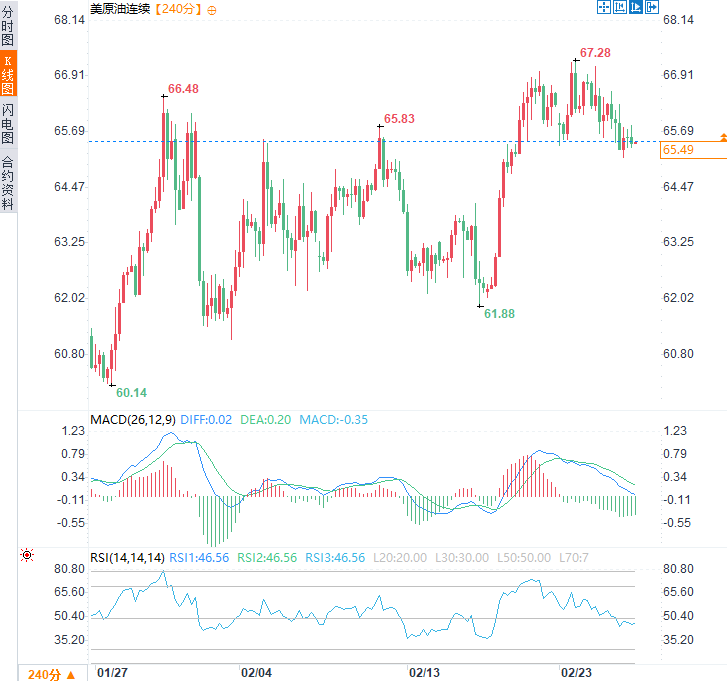
(US crude oil 4-hour chart, source: FX678)
At 11:36 Beijing time, US crude oil futures were trading at $65.54 per barrel.
Negotiation Background: Large-scale US military deployment and Trump's tough stance
The United States and Iran will begin a new round of indirect talks in Geneva, Switzerland, later Thursday, aiming to avoid escalation of the conflict through diplomatic means and end the weeks-long military and verbal standoff. The talks come ahead of a large-scale U.S. military deployment in the Middle East, and President Trump has repeatedly warned of military action against Iran if an agreement is not reached.
In his State of the Union address on Wednesday, Trump again accused Iran of "pursuing dangerous nuclear ambitions," claiming that Iran already possesses missiles capable of threatening Europe and US overseas bases, and is developing long-range ballistic missiles with a range capable of reaching the US mainland. The Iranian Foreign Ministry quickly refuted these accusations, calling them "utter lies."
Missile range controversy: Significant discrepancy between Iranian official data and US assessments
According to publicly available information from Iranian officials, the maximum range of its ballistic missiles is approximately 2,000 kilometers. The Congressional Research Service (CRS) estimates the maximum range of Iran's currently operational missiles to be close to 3,000 kilometers—still less than a third of the distance to the continental United States. This disagreement between the two sides regarding the actual threat range of their missiles has become another core point of contention in this round of negotiations, besides the nuclear issue.
The US expanded the scope of the discussion, but Iran insisted on only discussing nuclear weapons and not missiles.
On the eve of negotiations, U.S. Secretary of State Marco Rubio made it clear that Iran must negotiate its ballistic missile program, and that its refusal to discuss the missile issue would be a "major obstacle." However, he also emphasized that the Trump administration still prioritizes seeking a diplomatic solution.
Iran has taken a hard line: President Masoud Pezeshkian stated yesterday that he has "positive expectations" for the negotiations, hoping to break the current deadlock, which is "neither war nor peace." Foreign Minister Abbas Araqchi called the Geneva talks a "historic opportunity," saying an agreement is "within reach." Iran insists that the negotiation topics must not exceed its nuclear program and demands that the United States simultaneously lift sanctions that have severely impacted the Iranian economy as a prerequisite for any agreement.
A Review of the Negotiation Process and an Outlook on Geopolitical Risks
The US and Iran had previously completed their first round of indirect consultations in Oman, and held their second round of talks in Geneva last week. A more substantial attempt at negotiations broke down completely last June when Israel launched a surprise attack on Iran, which subsequently triggered a brief 12-day war, during which the US also briefly participated in airstrikes against Iranian nuclear facilities.
In January 2026, large-scale protests in Iran were forcefully suppressed, once again drawing the attention of the United States. Trump repeatedly stated that he might intervene to "aid the Iranian people." Emir Khokayem, a Middle East security expert at the International Institute for Strategic Studies, pointed out that the risk of war is generally expected to rise in the Middle East, and if a conflict were to resume, its scale could far exceed the limited war of last summer.
Market Focus: The Potential Impact of Geopolitical Risks on Oil Prices and Global Finance
The outcome of the Geneva negotiations will directly impact sentiment in the international crude oil market. A breakthrough in diplomatic efforts could partially alleviate geopolitical premiums; conversely, escalating tensions could reignite oil price volatility, impacting global stock markets, shipping costs, and inflation expectations. Investors should closely monitor the progress of negotiations later today and any unexpected announcements for their immediate impact on commodities and risk assets.
(US crude oil 4-hour chart, source: FX678)
At 11:36 Beijing time, US crude oil futures were trading at $65.54 per barrel.
- Risk Warning and Disclaimer
- The market involves risk, and trading may not be suitable for all investors. This article is for reference only and does not constitute personal investment advice, nor does it take into account certain users’ specific investment objectives, financial situation, or other needs. Any investment decisions made based on this information are at your own risk.