Institutions predict the New Zealand dollar will soon peak against the US dollar.
2026-02-26 11:22:11
Commonwealth Bank (CBA) stated, "We expect the New Zealand dollar to reach its peak against the US dollar soon." To be sure, analysts believe the New Zealand dollar still has some fuel in its tank and could rise by 1 or 2 cents in the coming months, as "a stronger global outlook or robust New Zealand economic data could push the New Zealand dollar higher against the US dollar."

However, some fundamental factors cannot be ignored. A report released by the CBA on February 25th stated: " The economies of this major Asian nation remain weak, posing downside risks to agricultural commodity prices and the New Zealand dollar. This country is New Zealand's largest trading partner. "
CBA also stated that the yield differential of bonds linked to central bank interest rates will have an impact.
Despite a strong start to the year, the New Zealand dollar has shown some signs of cooling. It pared some of its gains as investors realized the Reserve Bank of New Zealand (RBNZ) was unlikely to raise interest rates before the end of the year.
Investors are seeing the Reserve Bank of Australia (RBA) raise interest rates and expect Australia’s nearest neighbors to respond with similar policies, meaning the New Zealand dollar is actually tracking the Australian dollar’s strong performance, which is at least partly dependent on interest rate expectations.
However, the Reserve Bank of New Zealand's cautious stance against the consensus expressed at its February policy meeting prompted the market to lower its expectations for a rate hike in 2026. This was a setback for New Zealand dollar bulls, who viewed the New Zealand dollar as another tool for chasing different central bank monetary policy cycles.
CBA stated, " We expect the New Zealand dollar to peak against the US dollar soon. Our forecast for the end of March 2026 is 0.60, and we predict the New Zealand dollar will fall sharply to 0.54 by the end of the year. "
CBA economists predict that the boom in US artificial intelligence will once again alter the narrative of the US economy, shifting from the negative impact of tariff shocks in 2025 to the positive impact of 'American exceptionalism' in 2026. If American exceptionalism is a headwind for the New Zealand dollar in 2025, it could reappear later this year.
CBA stated, "The New Zealand dollar will fall against the US dollar as the dollar recovers." All else being equal, this would mean weakness for the New Zealand dollar against currencies such as the British pound.
CBA stated: "The combination of a peak in the NZD/USD spot rate and below the NZD/USD average implied volatility presents an opportunity for New Zealand importers or foreign owners of New Zealand assets to lock in favorable NZD/USD spot rates before a significant drop in the NZD/USD."
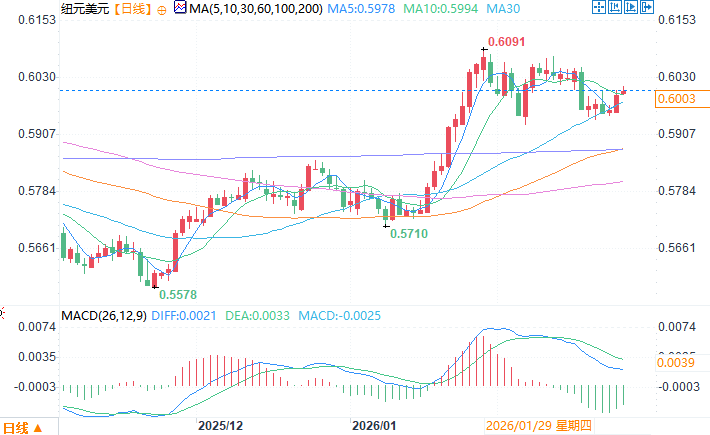
NZD/USD daily chart source: EasyTrade
At 11:21 Beijing time on February 26, the New Zealand dollar was trading at 0.6003/04 against the US dollar.
However, some fundamental factors cannot be ignored. A report released by the CBA on February 25th stated: " The economies of this major Asian nation remain weak, posing downside risks to agricultural commodity prices and the New Zealand dollar. This country is New Zealand's largest trading partner. "
CBA also stated that the yield differential of bonds linked to central bank interest rates will have an impact.
Despite a strong start to the year, the New Zealand dollar has shown some signs of cooling. It pared some of its gains as investors realized the Reserve Bank of New Zealand (RBNZ) was unlikely to raise interest rates before the end of the year.
Investors are seeing the Reserve Bank of Australia (RBA) raise interest rates and expect Australia’s nearest neighbors to respond with similar policies, meaning the New Zealand dollar is actually tracking the Australian dollar’s strong performance, which is at least partly dependent on interest rate expectations.
However, the Reserve Bank of New Zealand's cautious stance against the consensus expressed at its February policy meeting prompted the market to lower its expectations for a rate hike in 2026. This was a setback for New Zealand dollar bulls, who viewed the New Zealand dollar as another tool for chasing different central bank monetary policy cycles.
CBA stated, " We expect the New Zealand dollar to peak against the US dollar soon. Our forecast for the end of March 2026 is 0.60, and we predict the New Zealand dollar will fall sharply to 0.54 by the end of the year. "
CBA economists predict that the boom in US artificial intelligence will once again alter the narrative of the US economy, shifting from the negative impact of tariff shocks in 2025 to the positive impact of 'American exceptionalism' in 2026. If American exceptionalism is a headwind for the New Zealand dollar in 2025, it could reappear later this year.
CBA stated, "The New Zealand dollar will fall against the US dollar as the dollar recovers." All else being equal, this would mean weakness for the New Zealand dollar against currencies such as the British pound.
CBA stated: "The combination of a peak in the NZD/USD spot rate and below the NZD/USD average implied volatility presents an opportunity for New Zealand importers or foreign owners of New Zealand assets to lock in favorable NZD/USD spot rates before a significant drop in the NZD/USD."
NZD/USD daily chart source: EasyTrade
At 11:21 Beijing time on February 26, the New Zealand dollar was trading at 0.6003/04 against the US dollar.
- Risk Warning and Disclaimer
- The market involves risk, and trading may not be suitable for all investors. This article is for reference only and does not constitute personal investment advice, nor does it take into account certain users’ specific investment objectives, financial situation, or other needs. Any investment decisions made based on this information are at your own risk.