Japan's 30-year demonstration showed that central bank independence is merely a hollow promise in the face of high debt.
2026-02-26 13:13:45
When Japan granted its central bank independence in 1998, it coincided with deflation, rendering the independence merely a formality. Over the next thirty years, through zero interest rates, quantitative and qualitative easing, and yield curve control, the central bank ultimately held half of the government's bonds, resulting in a debt ratio of 225%. The 2026 administration of Sanae Takaichi marked the replacement of central bank independence with fiscal policy, inflation as a debt reduction tool, and the yen as a macroeconomic pressure relief valve—formal independence was ultimately swallowed up by substantial debt. This process will be analyzed in detail below.

Japan's contemporary macroeconomic framework can be traced back to the bursting of the asset bubble in the 1990s, and was institutionalized through the revision of the Bank of Japan Law in 1998. The collapse of the asset bubble in the late 1980s left a heavy legacy: a buildup of non-performing loans in banks, severely damaged corporate balance sheets due to the sharp decline in the value of collateral, and a private sector prioritizing deleveraging over expansion. Land prices fell for several consecutive years, stock market valuations contracted significantly, credit creation slowed, investment weakened, nominal GDP growth deteriorated, and price pressures gradually subsided.
By the mid-1990s, Japan had entered a typical balance sheet recession, with private sector behavior shifting from profit maximization to debt minimization. The government repeatedly introduced fiscal stimulus packages, and public debt steadily increased. By 1998, total government debt as a percentage of GDP was close to 100%, which, although high, was maintained by domestic savings and a persistent trade surplus.
It was against this fragile backdrop that the Bank of Japan's 1998 Bank of Japan Law granted the Bank of Japan operational independence, aligning with the prevailing global notion that central bank independence could enhance credibility, insulate against short-term political pressures, and ensure price stability. Ironically, however, when the independence reform was introduced, Japan was facing persistent deflation rather than overheated inflation, and deflationary forces were already accumulating. Institutional changes aimed at anchoring stability occurred in an environment of continuously declining nominal growth .
Shortly after gaining independence, the Bank of Japan reached the limits of its conventional policy space. In February 1999, Japan implemented a zero interest rate policy (ZIRP), becoming the first major developed economy to persistently approach the zero lower bound. The policy rate approaching zero was not a temporary stimulus, but a structural response to persistently weak demand and falling prices.
From 1998 to 2011, Japan introduced multiple fiscal programs to support economic activity. Measured by actual discretionary spending, the scale of fiscal efforts was considerable. The 2008 global financial crisis triggered another wave of counter-cyclical spending. Nominal GDP growth remained sluggish or even negative for a prolonged period, primary deficits persisted, and the debt-to-GDP ratio steadily increased. By 2010, total government debt as a percentage of GDP approached 200%.
Stability during this phase depends on a structural trade surplus and a positive current account balance. External demand and returns from overseas investment support sovereign confidence, while domestic savings absorb government bond issuance at low yields, creating a unique equilibrium of "high debt + surplus flow anchoring".
The turning point came in 2011. The 3.11 earthquake, tsunami, and Fukushima nuclear accident completely altered the macroeconomic trajectory. Post-disaster reconstruction required massive fiscal mobilization, and more importantly, the complete shutdown of nuclear power plants led to a reshaping of the energy structure. Japan significantly increased its imports of LNG, oil, and coal, resulting in a marked deterioration in its trade balance.
For the first time in over three decades, an annual trade deficit occurred, and since then, a current account deficit in goods trade has become the new normal. External buffers that once supported fiscal sustainability have weakened significantly. Energy imports are embedded in macroeconomic equations, and exchange rate fluctuations are directly transmitted to inflation through import prices.
In 2013, "Abenomics" combined fiscal expansion with aggressive monetary easing. The Bank of Japan launched quantitative and qualitative easing (QQE), rapidly expanding the monetary base and purchasing large amounts of Japanese government bonds. Monetary policy shifted from targeting interest rates to primarily expanding the balance sheet. In 2016, negative interest rates were introduced, followed by yield curve control (YCC), achieving price administration over the sovereign yield curve.
Fiscal intervention escalated further during the pandemic, with actual discretionary spending far exceeding previous cycles. From 2011 to the mid-2020s, cumulative fiscal expansion was significantly higher than in the previous era. The Bank of Japan gradually acquired approximately half of Japanese government bonds, becoming the de facto dominant player in the sovereign bond market.
When the Bank of Japan held approximately 50% of sovereign debt, a fundamental shift occurred in the macroeconomic structure: interest payments circulated primarily within the public sector, the yield curve was administratively influenced by policy objectives, and fiscal financing conditions structurally depended on central bank operations. The independent framework established in 1998 evolved into a system of "deep integration of monetary and fiscal policies."
Currently, Japan's debt-to-GDP ratio is close to 225%, with about half held by the Bank of Japan. From a consolidated perspective, this means that debt equivalent to 110-115% of GDP is internalized, with the government paying interest to itself and circulating the interest rate spread. Traditional default risk is no longer the primary constraint; the real limiting factors have shifted to inflation, monetary confidence, and political tolerance for negative real returns.
Inflation acts as a transfer mechanism in this structure : rising prices erode the real value of nominal liabilities, private sector bondholders lose purchasing power, and public sector real benefits are consolidated into the balance sheets. Negative real interest rates and balance sheet consolidation together reduce the government's real burden.
With domestic yields suppressed by government administration and global yields offering higher real returns, capital outflows have driven adjustments in the yen's structure. A weaker yen increases energy import costs, transmitting inflation through import channels; a stronger yen eases import pressures but tightens financial conditions and harms export competitiveness.
Monetary policy, fiscal sustainability, and exchange rate dynamics are highly integrated within a single framework. The Japanese yen has effectively become the macroeconomic release valve for this highly indebted system, facing unprecedented depreciation pressure. Its trajectory reflects not only interest rate differentials but also the credibility of coordinated governance.
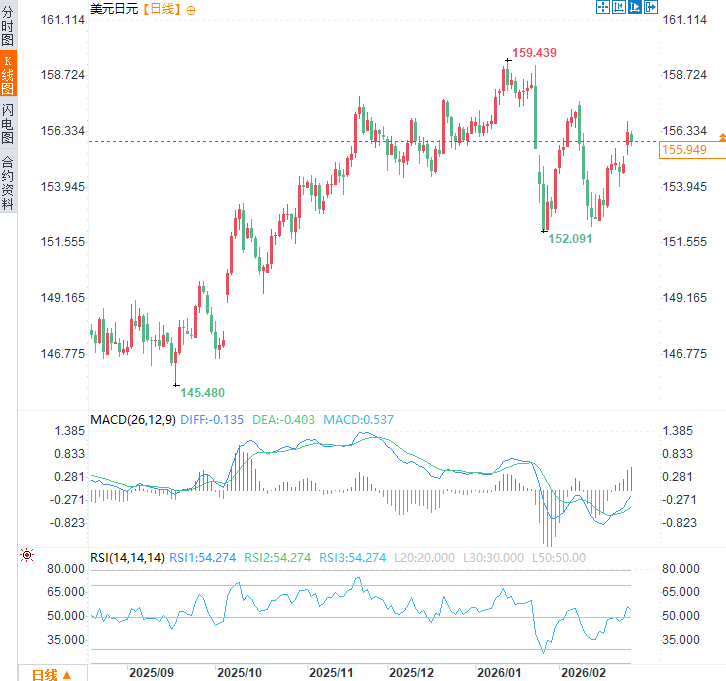
(USD/JPY daily chart, source: FX678)
The inauguration of Prime Minister Sanae Takaichi in 2026 will mark a new phase in this institutional equilibrium. Under a high-debt system, even a slight increase in real yields will significantly alter the cost of servicing massive debt, and the political sensitivity to normalization has become a structural rather than a cyclical issue.
The meetings between the Prime Minister and the Central Bank Governor, the Finance Minister's role in fiscal policy, and the authority to intervene in exchange rates together constitute a mechanism for recalibrating the hierarchical relationship between the fiscal and financial systems. Through subtle shifts in tone, appointments, and coordinated signals, the Kaohsiung City government is attempting to re-establish a guiding framework for fiscal strategy in monetary operations within a consolidated system where "inflation and monetary stability replace default risk."
The narrative, which began in 1998 as an independent force, evolved by the mid-2020s into “guiding coordination” and even “abandonment of independence under explicit fiscal dominance.” This is a high-debt equilibrium: monetary policy is realigned under a broader fiscal strategy, inflation serves as a balance sheet tool, and the yen acts as a transmission channel for three decades of structural evolution.
At 13:13 Beijing time, the US dollar was trading at 155.92/93 against the Japanese yen.
The paradoxical starting point of the 1990s crisis and the Bank of Japan's independence reform
Japan's contemporary macroeconomic framework can be traced back to the bursting of the asset bubble in the 1990s, and was institutionalized through the revision of the Bank of Japan Law in 1998. The collapse of the asset bubble in the late 1980s left a heavy legacy: a buildup of non-performing loans in banks, severely damaged corporate balance sheets due to the sharp decline in the value of collateral, and a private sector prioritizing deleveraging over expansion. Land prices fell for several consecutive years, stock market valuations contracted significantly, credit creation slowed, investment weakened, nominal GDP growth deteriorated, and price pressures gradually subsided.
By the mid-1990s, Japan had entered a typical balance sheet recession, with private sector behavior shifting from profit maximization to debt minimization. The government repeatedly introduced fiscal stimulus packages, and public debt steadily increased. By 1998, total government debt as a percentage of GDP was close to 100%, which, although high, was maintained by domestic savings and a persistent trade surplus.
It was against this fragile backdrop that the Bank of Japan's 1998 Bank of Japan Law granted the Bank of Japan operational independence, aligning with the prevailing global notion that central bank independence could enhance credibility, insulate against short-term political pressures, and ensure price stability. Ironically, however, when the independence reform was introduced, Japan was facing persistent deflation rather than overheated inflation, and deflationary forces were already accumulating. Institutional changes aimed at anchoring stability occurred in an environment of continuously declining nominal growth .
The era of zero interest rates and the formation of a dual-engine fiscal-monetary system (1999–2010)
Shortly after gaining independence, the Bank of Japan reached the limits of its conventional policy space. In February 1999, Japan implemented a zero interest rate policy (ZIRP), becoming the first major developed economy to persistently approach the zero lower bound. The policy rate approaching zero was not a temporary stimulus, but a structural response to persistently weak demand and falling prices.
From 1998 to 2011, Japan introduced multiple fiscal programs to support economic activity. Measured by actual discretionary spending, the scale of fiscal efforts was considerable. The 2008 global financial crisis triggered another wave of counter-cyclical spending. Nominal GDP growth remained sluggish or even negative for a prolonged period, primary deficits persisted, and the debt-to-GDP ratio steadily increased. By 2010, total government debt as a percentage of GDP approached 200%.
Stability during this phase depends on a structural trade surplus and a positive current account balance. External demand and returns from overseas investment support sovereign confidence, while domestic savings absorb government bond issuance at low yields, creating a unique equilibrium of "high debt + surplus flow anchoring".
Structural fracture in 2011: Reversal of energy imports and disappearance of external buffers
The turning point came in 2011. The 3.11 earthquake, tsunami, and Fukushima nuclear accident completely altered the macroeconomic trajectory. Post-disaster reconstruction required massive fiscal mobilization, and more importantly, the complete shutdown of nuclear power plants led to a reshaping of the energy structure. Japan significantly increased its imports of LNG, oil, and coal, resulting in a marked deterioration in its trade balance.
For the first time in over three decades, an annual trade deficit occurred, and since then, a current account deficit in goods trade has become the new normal. External buffers that once supported fiscal sustainability have weakened significantly. Energy imports are embedded in macroeconomic equations, and exchange rate fluctuations are directly transmitted to inflation through import prices.
Abenomics and the Era of Super Quantitative Easing (2013–2020)
In 2013, "Abenomics" combined fiscal expansion with aggressive monetary easing. The Bank of Japan launched quantitative and qualitative easing (QQE), rapidly expanding the monetary base and purchasing large amounts of Japanese government bonds. Monetary policy shifted from targeting interest rates to primarily expanding the balance sheet. In 2016, negative interest rates were introduced, followed by yield curve control (YCC), achieving price administration over the sovereign yield curve.
Fiscal intervention escalated further during the pandemic, with actual discretionary spending far exceeding previous cycles. From 2011 to the mid-2020s, cumulative fiscal expansion was significantly higher than in the previous era. The Bank of Japan gradually acquired approximately half of Japanese government bonds, becoming the de facto dominant player in the sovereign bond market.
High Debt Consolidation: A New Equilibrium of Monetary-Fiscal Integration
When the Bank of Japan held approximately 50% of sovereign debt, a fundamental shift occurred in the macroeconomic structure: interest payments circulated primarily within the public sector, the yield curve was administratively influenced by policy objectives, and fiscal financing conditions structurally depended on central bank operations. The independent framework established in 1998 evolved into a system of "deep integration of monetary and fiscal policies."
Currently, Japan's debt-to-GDP ratio is close to 225%, with about half held by the Bank of Japan. From a consolidated perspective, this means that debt equivalent to 110-115% of GDP is internalized, with the government paying interest to itself and circulating the interest rate spread. Traditional default risk is no longer the primary constraint; the real limiting factors have shifted to inflation, monetary confidence, and political tolerance for negative real returns.
Inflation acts as a transfer mechanism in this structure : rising prices erode the real value of nominal liabilities, private sector bondholders lose purchasing power, and public sector real benefits are consolidated into the balance sheets. Negative real interest rates and balance sheet consolidation together reduce the government's real burden.
The exchange rate, acting as a pressure valve, is the only path to competitive reversion with the yen.
With domestic yields suppressed by government administration and global yields offering higher real returns, capital outflows have driven adjustments in the yen's structure. A weaker yen increases energy import costs, transmitting inflation through import channels; a stronger yen eases import pressures but tightens financial conditions and harms export competitiveness.
Monetary policy, fiscal sustainability, and exchange rate dynamics are highly integrated within a single framework. The Japanese yen has effectively become the macroeconomic release valve for this highly indebted system, facing unprecedented depreciation pressure. Its trajectory reflects not only interest rate differentials but also the credibility of coordinated governance.
(USD/JPY daily chart, source: FX678)
Kaohsiung's Sanae Era: From Formal Independence to Substantive Fiscal Dominance - A Rebalancing
The inauguration of Prime Minister Sanae Takaichi in 2026 will mark a new phase in this institutional equilibrium. Under a high-debt system, even a slight increase in real yields will significantly alter the cost of servicing massive debt, and the political sensitivity to normalization has become a structural rather than a cyclical issue.
The meetings between the Prime Minister and the Central Bank Governor, the Finance Minister's role in fiscal policy, and the authority to intervene in exchange rates together constitute a mechanism for recalibrating the hierarchical relationship between the fiscal and financial systems. Through subtle shifts in tone, appointments, and coordinated signals, the Kaohsiung City government is attempting to re-establish a guiding framework for fiscal strategy in monetary operations within a consolidated system where "inflation and monetary stability replace default risk."
The narrative, which began in 1998 as an independent force, evolved by the mid-2020s into “guiding coordination” and even “abandonment of independence under explicit fiscal dominance.” This is a high-debt equilibrium: monetary policy is realigned under a broader fiscal strategy, inflation serves as a balance sheet tool, and the yen acts as a transmission channel for three decades of structural evolution.
At 13:13 Beijing time, the US dollar was trading at 155.92/93 against the Japanese yen.
- Risk Warning and Disclaimer
- The market involves risk, and trading may not be suitable for all investors. This article is for reference only and does not constitute personal investment advice, nor does it take into account certain users’ specific investment objectives, financial situation, or other needs. Any investment decisions made based on this information are at your own risk.