The British pound remained range-bound against the US dollar, awaiting stabilization.
2026-02-27 13:59:20
On Friday during Asian trading hours, GBP/USD fell back to around 1.3485. The pound's weakness was mainly due to political uncertainty in the UK. The by-election in Manchester is currently being counted. This election is seen as a crucial test of Prime Minister Keir Starmer's political approval ratings.
Market analysts believe that a poor performance by the ruling party could increase domestic political pressure in the UK and drag down expectations of capital inflows into the pound. Mitsubishi UFJ Financial Group points out that if the ruling party's approval rating continues to decline, the risks of future local elections could further impact market confidence.
 Regarding the US dollar, uncertainty surrounding tariff policy limits its potential for unilateral appreciation. The US Supreme Court ruled that the emergency powers tariff framework used by the Trump administration does not fully support its policy system.
Subsequently, US President Donald Trump announced a 10% tariff on global imports and threatened to raise it to 15% in the future. These policy shifts reduced market risk appetite but also increased short-term volatility in the US dollar.
On the macroeconomic front, the market is focused on the upcoming US January PPI inflation data. If the inflation data is higher than expected, it could delay the Federal Reserve's rate-cutting cycle and reinforce the high-interest-rate environment. The Federal Reserve's current policy path remains highly uncertain, keeping the US dollar relatively strong.
Overall, the pound was dragged down by political risks, while the dollar was supported by interest rate expectations, resulting in a short-term weak and volatile exchange rate.
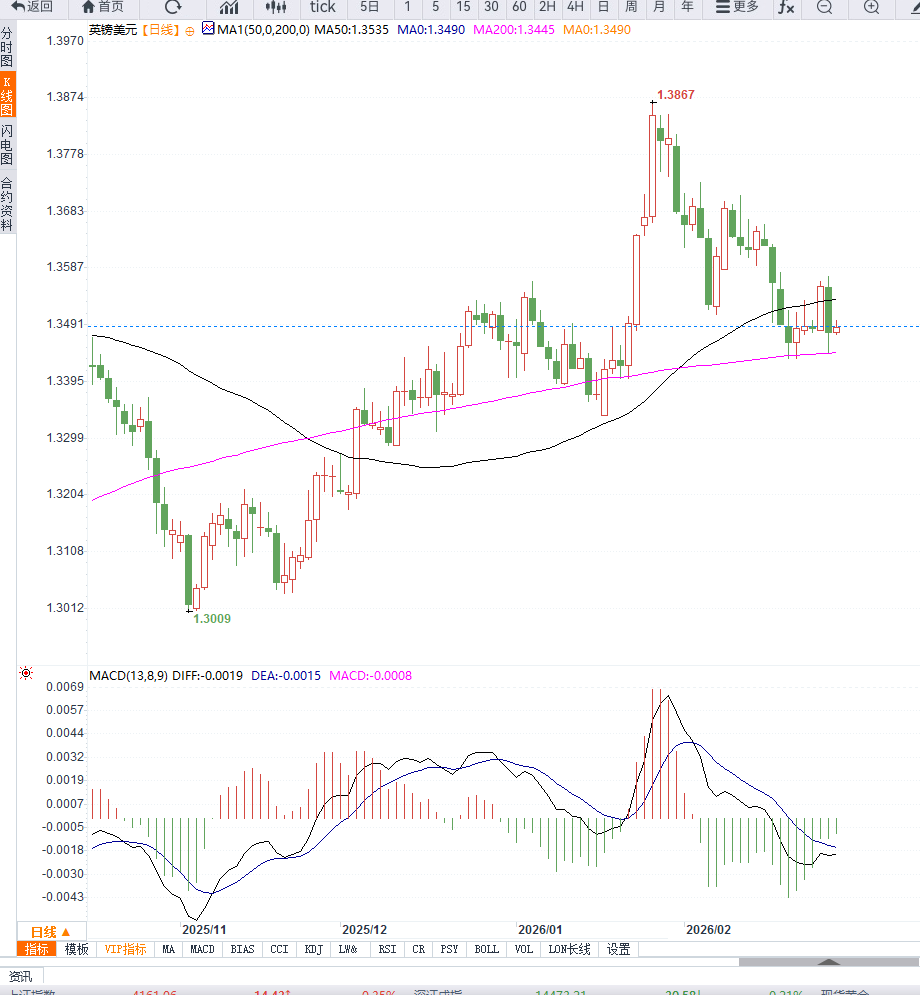
The daily chart shows that GBP/USD is generally trading within a medium-term downtrend channel, with the price gradually retreating after encountering resistance near 1.3600. The moving average system is in a bearish alignment, but the downward slope has slowed, indicating that the bearish momentum is weakening.
The MACD indicator's bearish histogram is gradually contracting, indicating a slight easing of downward pressure. The RSI is around 45, in a weak but not oversold zone. The Bollinger Bands are narrowing slightly, with the price moving closer to the middle band, suggesting the market has entered a consolidation and correction phase.
Key support levels on the daily chart are at 1.3450 and 1.3400; a break below these levels could lead to a further test of the 1.3300 area. Resistance levels are at 1.3550 and 1.3600; a break above 1.3600 could signal a short-term rebound.
Editor's Note:
The current GBP/USD exchange rate is primarily driven by both political risk and monetary policy expectations. Political uncertainty in the UK is diminishing the pound's appeal, while US inflation data and interest rate trends are supporting the dollar. In the short term, the exchange rate is more likely to remain range-bound.
If US inflation continues to rise, GBP/USD may face further pressure; if inflation falls, the pound may experience a technical rebound. The medium-term trend still depends on the UK economic fundamentals and the pace of the Federal Reserve's policy.
Market analysts believe that a poor performance by the ruling party could increase domestic political pressure in the UK and drag down expectations of capital inflows into the pound. Mitsubishi UFJ Financial Group points out that if the ruling party's approval rating continues to decline, the risks of future local elections could further impact market confidence.
Regarding the US dollar, uncertainty surrounding tariff policy limits its potential for unilateral appreciation. The US Supreme Court ruled that the emergency powers tariff framework used by the Trump administration does not fully support its policy system.Subsequently, US President Donald Trump announced a 10% tariff on global imports and threatened to raise it to 15% in the future. These policy shifts reduced market risk appetite but also increased short-term volatility in the US dollar.
On the macroeconomic front, the market is focused on the upcoming US January PPI inflation data. If the inflation data is higher than expected, it could delay the Federal Reserve's rate-cutting cycle and reinforce the high-interest-rate environment. The Federal Reserve's current policy path remains highly uncertain, keeping the US dollar relatively strong.
Overall, the pound was dragged down by political risks, while the dollar was supported by interest rate expectations, resulting in a short-term weak and volatile exchange rate.
The daily chart shows that GBP/USD is generally trading within a medium-term downtrend channel, with the price gradually retreating after encountering resistance near 1.3600. The moving average system is in a bearish alignment, but the downward slope has slowed, indicating that the bearish momentum is weakening.
The MACD indicator's bearish histogram is gradually contracting, indicating a slight easing of downward pressure. The RSI is around 45, in a weak but not oversold zone. The Bollinger Bands are narrowing slightly, with the price moving closer to the middle band, suggesting the market has entered a consolidation and correction phase.
Key support levels on the daily chart are at 1.3450 and 1.3400; a break below these levels could lead to a further test of the 1.3300 area. Resistance levels are at 1.3550 and 1.3600; a break above 1.3600 could signal a short-term rebound.
Editor's Note:
The current GBP/USD exchange rate is primarily driven by both political risk and monetary policy expectations. Political uncertainty in the UK is diminishing the pound's appeal, while US inflation data and interest rate trends are supporting the dollar. In the short term, the exchange rate is more likely to remain range-bound.
If US inflation continues to rise, GBP/USD may face further pressure; if inflation falls, the pound may experience a technical rebound. The medium-term trend still depends on the UK economic fundamentals and the pace of the Federal Reserve's policy.
- Risk Warning and Disclaimer
- The market involves risk, and trading may not be suitable for all investors. This article is for reference only and does not constitute personal investment advice, nor does it take into account certain users’ specific investment objectives, financial situation, or other needs. Any investment decisions made based on this information are at your own risk.