













Escalating tensions in the Middle East boosted demand for the US dollar as a safe haven, causing USD/JPY to rebound and approach 157, but bullish momentum was limited.
2026-03-02 10:22:27
During Monday's Asian session, USD/JPY received new buying support, with the exchange rate fluctuating upwards and approaching last week's high. However, it remained below the 157.00 level, indicating that the bullish momentum has not yet been fully released.
The coordinated military strikes by the United States and Israel against Iran have significantly escalated geopolitical risks, led to a decline in market risk appetite, and resulted in a renewed flow of funds into the US dollar, the global reserve currency.

At the same time, market concerns that the closure of the Strait of Hormuz could drive up oil prices and drag down global economic growth have strengthened the safe-haven appeal of the US dollar, providing upward momentum for USD/JPY.
However, the yen did not weaken unilaterally. On the one hand, rising global risk aversion also supported the yen as a traditional safe-haven currency; on the other hand, the market expected the Bank of Japan to continue its policy normalization path, so that interest rate differential expectations would no longer be a one-way negative factor for the yen.
Furthermore, as the exchange rate approaches its previous highs, market concerns are growing that Japanese authorities may intervene to curb excessive yen depreciation, which psychologically constrains bullish sentiment. Therefore, USD/JPY currently exhibits a pattern of mutual hedging between the safe-haven attributes of the US dollar and the yen, and its short-term trend is more likely to remain volatile at high levels rather than forming a one-sided breakout.
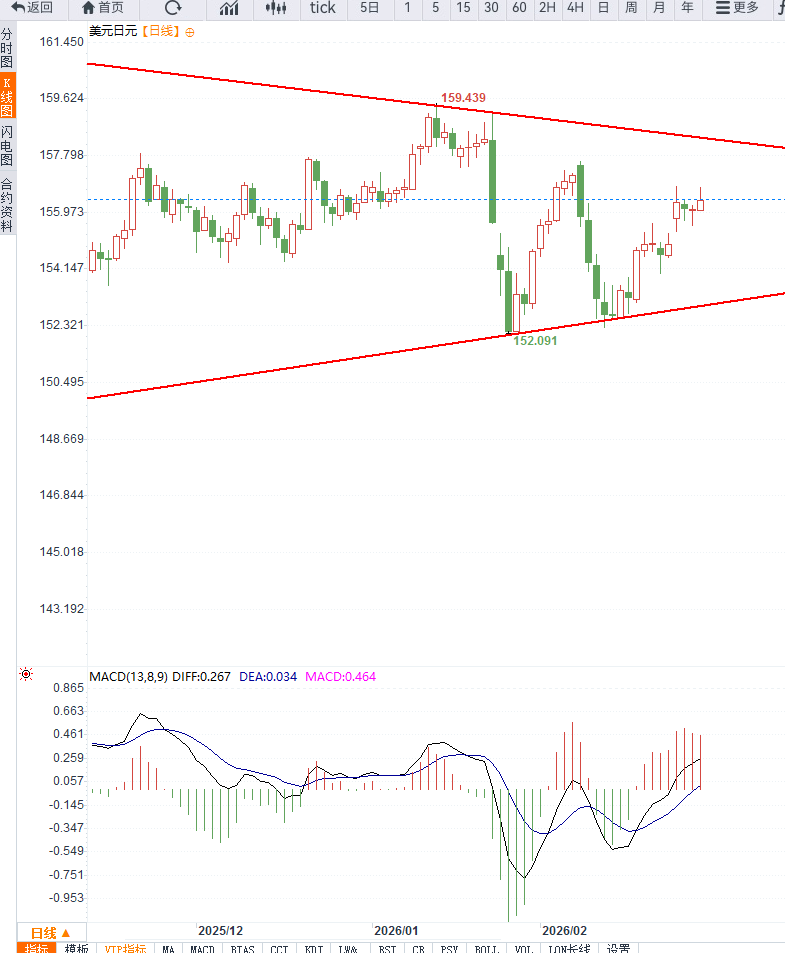
From a daily chart perspective, USD/JPY rebounded after falling from its previous highs and is currently trading above the short-term uptrend line, but has not yet broken through the key resistance level of 157.00. If it can effectively hold above 157.00, the next resistance areas to watch are around 158.20 and 159.00; if it fails to break through multiple times, there is a risk of a double top formation.
The first support level to watch is 155.80, followed by the 154.50 area. A break below the latter would weaken the short-term bullish structure. Technically, the RSI is in a neutral-to-strong range, with momentum not yet reaching extreme overbought levels; the MACD is above the zero line, but the histogram momentum is converging, suggesting a marginal weakening of upward momentum.
The 4-hour chart shows the exchange rate consolidating at a high level. A break below the lower edge of this consolidation range could trigger a short-term pullback. Overall, given the mixed fundamentals, the technical indicators suggest that while the exchange rate has upward momentum, a stronger catalyst is needed to break through key resistance levels.
Editor's Note:
The core logic of USD/JPY currently lies in the interplay between the "safe-haven advantage of the US dollar" and the "support from expected Japanese yen policy." If geopolitical conflicts escalate further and significantly impact global risk assets, the US dollar may continue to dominate; however, if market focus shifts to the Bank of Japan's policy outlook and potential intervention risks, the yen may receive temporary support.
The coordinated military strikes by the United States and Israel against Iran have significantly escalated geopolitical risks, led to a decline in market risk appetite, and resulted in a renewed flow of funds into the US dollar, the global reserve currency.
At the same time, market concerns that the closure of the Strait of Hormuz could drive up oil prices and drag down global economic growth have strengthened the safe-haven appeal of the US dollar, providing upward momentum for USD/JPY.
However, the yen did not weaken unilaterally. On the one hand, rising global risk aversion also supported the yen as a traditional safe-haven currency; on the other hand, the market expected the Bank of Japan to continue its policy normalization path, so that interest rate differential expectations would no longer be a one-way negative factor for the yen.
Furthermore, as the exchange rate approaches its previous highs, market concerns are growing that Japanese authorities may intervene to curb excessive yen depreciation, which psychologically constrains bullish sentiment. Therefore, USD/JPY currently exhibits a pattern of mutual hedging between the safe-haven attributes of the US dollar and the yen, and its short-term trend is more likely to remain volatile at high levels rather than forming a one-sided breakout.
From a daily chart perspective, USD/JPY rebounded after falling from its previous highs and is currently trading above the short-term uptrend line, but has not yet broken through the key resistance level of 157.00. If it can effectively hold above 157.00, the next resistance areas to watch are around 158.20 and 159.00; if it fails to break through multiple times, there is a risk of a double top formation.
The first support level to watch is 155.80, followed by the 154.50 area. A break below the latter would weaken the short-term bullish structure. Technically, the RSI is in a neutral-to-strong range, with momentum not yet reaching extreme overbought levels; the MACD is above the zero line, but the histogram momentum is converging, suggesting a marginal weakening of upward momentum.
The 4-hour chart shows the exchange rate consolidating at a high level. A break below the lower edge of this consolidation range could trigger a short-term pullback. Overall, given the mixed fundamentals, the technical indicators suggest that while the exchange rate has upward momentum, a stronger catalyst is needed to break through key resistance levels.
Editor's Note:
The core logic of USD/JPY currently lies in the interplay between the "safe-haven advantage of the US dollar" and the "support from expected Japanese yen policy." If geopolitical conflicts escalate further and significantly impact global risk assets, the US dollar may continue to dominate; however, if market focus shifts to the Bank of Japan's policy outlook and potential intervention risks, the yen may receive temporary support.
- Risk Warning and Disclaimer
- The market involves risk, and trading may not be suitable for all investors. This article is for reference only and does not constitute personal investment advice, nor does it take into account certain users’ specific investment objectives, financial situation, or other needs. Any investment decisions made based on this information are at your own risk.

