A comprehensive risk aversion! The US dollar surges violently, triggering a devaluation storm for Asian currencies.
2026-03-02 16:51:20
On Monday (March 2), during the Asian and European sessions, the US dollar index rose by 0.9%, trading around 98.50.
Military tensions in the Middle East have escalated sharply, leading to a significant increase in global risk aversion. Investors have flocked to safe-haven assets such as the US dollar, directly pushing the dollar index to above 98 during Asian trading hours on Monday, a five-week high.
Market concerns about the escalation of the conflict continue to rise, coupled with disruptions to shipping and energy supplies in the Gulf region. "Cash is king" has become the main theme in the short term. As most Asian countries are oil importers, the US dollar has performed strongly against most non-US currencies during the Asian session.
Last weekend, the United States and Israel launched a series of military strikes against Iran. It was reported that 48 high-ranking Iranian officials, including Supreme Leader Ayatollah Ali Khamenei, were killed in the attacks. Iran subsequently appointed Ayatollah Alireza Alafi as interim leader.
In retaliation, the Iranian Islamic Revolutionary Guard Corps launched a retaliatory operation with missiles and drones: targeting Israeli government buildings, the Haifa military security center, and East Jerusalem, and warning Israelis to stay away from these targets.
On the other hand, attacks were launched against U.S. military and asset targets in multiple countries, including the UAE, Bahrain, Kuwait, Qatar, Saudi Arabia, Jordan, Iraq, and Syria. Saudi Aramco's oil refinery was also attacked by drones.
The conflict has effectively closed the Strait of Hormuz, severely impacting shipping and energy supplies in the Gulf.
The U.S. Producer Price Index (PPI) released last Friday showed a larger-than-expected increase in January, indicating that businesses are passing on tariff costs to consumers. This renewed resilience in U.S. inflation casts a shadow over the Federal Reserve's easing policies.
Although the market still expects the Federal Reserve to implement two 25-basis-point rate cuts this year, believing that short-term market turmoil may accelerate the central bank's shift to monetary easing, the dollar's short-term trend is strongly supported by the combined effects of geopolitical risk aversion and inflation data.
Against the backdrop of a strong US dollar, non-US currencies are generally under pressure.
Analysts at Mizuho Securities stated that the euro and most non-oil-exporting currencies are more vulnerable to geopolitical risks in the Middle East, coupled with rising energy costs, making their exchange rate movements relatively passive.
A senior currency analyst at MUFG Bank pointed out that most Asian economies are net importers of oil. If the conflict in the Middle East continues to escalate and oil prices rise further, it will continue to put downward pressure on Asian currencies. As a result, the Singapore dollar has weakened against the US dollar during Asian trading hours.
Whenever tensions rise between the US and Iran, the US dollar often becomes the main currency in Asian markets and even global markets. Since international crude oil is mainly priced and settled in US dollars, when oil prices rise sharply, countries must reserve and pay more US dollars in the market in order to purchase the same amount of oil.
This rigid demand will cause a "liquidity shortage" of the US dollar in the short term, thereby pushing up the exchange rate.
Meanwhile, the tensions between the US and Iran occurred during the closing phase of the US and European markets. Asia, as the first trading time zone to take over, saw a surge of negative news overnight, triggering significant market movements.
Meanwhile, most of Asia's major economies (such as China, Japan, South Korea, and India) are net importers of crude oil.
Rising oil prices mean that these countries' current account deficits may widen, their currencies may weaken, and the US dollar will appear stronger in comparison.
From a technical perspective, the US dollar index is currently near the middle of its trading range and has the potential to challenge the upper limit of 99.23.
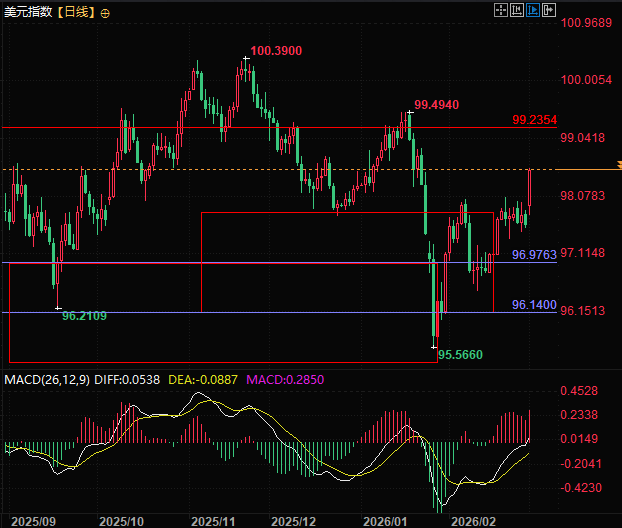
(US Dollar Index Daily Chart, Source: FX678)
At 16:49 Beijing time, the US dollar index is currently at 98.39.
Military tensions in the Middle East have escalated sharply, leading to a significant increase in global risk aversion. Investors have flocked to safe-haven assets such as the US dollar, directly pushing the dollar index to above 98 during Asian trading hours on Monday, a five-week high.
Market concerns about the escalation of the conflict continue to rise, coupled with disruptions to shipping and energy supplies in the Gulf region. "Cash is king" has become the main theme in the short term. As most Asian countries are oil importers, the US dollar has performed strongly against most non-US currencies during the Asian session.
The joint US-Israeli strikes against Iran have escalated tensions across the Middle East.
Last weekend, the United States and Israel launched a series of military strikes against Iran. It was reported that 48 high-ranking Iranian officials, including Supreme Leader Ayatollah Ali Khamenei, were killed in the attacks. Iran subsequently appointed Ayatollah Alireza Alafi as interim leader.
In retaliation, the Iranian Islamic Revolutionary Guard Corps launched a retaliatory operation with missiles and drones: targeting Israeli government buildings, the Haifa military security center, and East Jerusalem, and warning Israelis to stay away from these targets.
On the other hand, attacks were launched against U.S. military and asset targets in multiple countries, including the UAE, Bahrain, Kuwait, Qatar, Saudi Arabia, Jordan, Iraq, and Syria. Saudi Aramco's oil refinery was also attacked by drones.
The conflict has effectively closed the Strait of Hormuz, severely impacting shipping and energy supplies in the Gulf.
US inflation exceeding expectations adds further uncertainty to the Fed's interest rate cut path.
The U.S. Producer Price Index (PPI) released last Friday showed a larger-than-expected increase in January, indicating that businesses are passing on tariff costs to consumers. This renewed resilience in U.S. inflation casts a shadow over the Federal Reserve's easing policies.
Although the market still expects the Federal Reserve to implement two 25-basis-point rate cuts this year, believing that short-term market turmoil may accelerate the central bank's shift to monetary easing, the dollar's short-term trend is strongly supported by the combined effects of geopolitical risk aversion and inflation data.
Non-US currencies are generally under pressure, while Asian currencies are dragged down by oil prices.
Against the backdrop of a strong US dollar, non-US currencies are generally under pressure.
Analysts at Mizuho Securities stated that the euro and most non-oil-exporting currencies are more vulnerable to geopolitical risks in the Middle East, coupled with rising energy costs, making their exchange rate movements relatively passive.
A senior currency analyst at MUFG Bank pointed out that most Asian economies are net importers of oil. If the conflict in the Middle East continues to escalate and oil prices rise further, it will continue to put downward pressure on Asian currencies. As a result, the Singapore dollar has weakened against the US dollar during Asian trading hours.
Summary and Technical Analysis:
Whenever tensions rise between the US and Iran, the US dollar often becomes the main currency in Asian markets and even global markets. Since international crude oil is mainly priced and settled in US dollars, when oil prices rise sharply, countries must reserve and pay more US dollars in the market in order to purchase the same amount of oil.
This rigid demand will cause a "liquidity shortage" of the US dollar in the short term, thereby pushing up the exchange rate.
Meanwhile, the tensions between the US and Iran occurred during the closing phase of the US and European markets. Asia, as the first trading time zone to take over, saw a surge of negative news overnight, triggering significant market movements.
Meanwhile, most of Asia's major economies (such as China, Japan, South Korea, and India) are net importers of crude oil.
Rising oil prices mean that these countries' current account deficits may widen, their currencies may weaken, and the US dollar will appear stronger in comparison.
From a technical perspective, the US dollar index is currently near the middle of its trading range and has the potential to challenge the upper limit of 99.23.
(US Dollar Index Daily Chart, Source: FX678)
At 16:49 Beijing time, the US dollar index is currently at 98.39.
- Risk Warning and Disclaimer
- The market involves risk, and trading may not be suitable for all investors. This article is for reference only and does not constitute personal investment advice, nor does it take into account certain users’ specific investment objectives, financial situation, or other needs. Any investment decisions made based on this information are at your own risk.