The ultimate showdown is imminent: the safe-haven US dollar versus the petro-Canadian dollar.
2026-03-02 17:57:46
The US dollar rebounded against the Canadian dollar after falling on Friday, driven by a sudden geopolitical crisis, and almost completely recovered its losses during the European session on Monday, March 2. The catalyst for this reversal was the sharp deterioration of the situation in the Middle East: a joint US-Israeli strike on Iranian targets resulted in the death of Iran's Supreme Leader, Ali Khamenei.
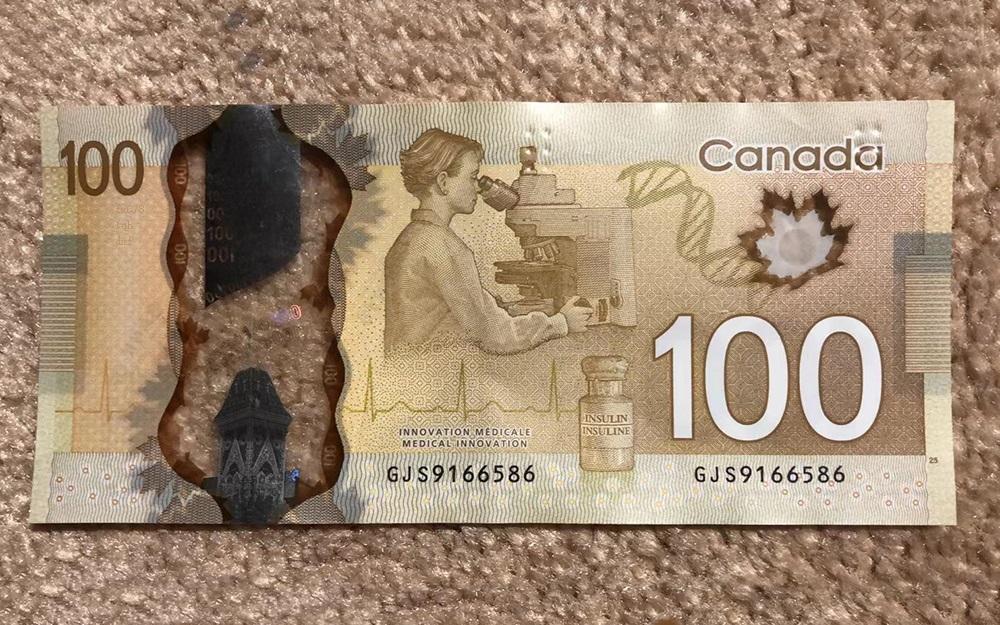
In retaliation, Iran launched a large number of missiles at US bases and areas near its Middle Eastern allies, sparking deep global concerns about a full-blown regional war. US President Trump further threatened indefinite strikes, instantly igniting risk aversion in markets. The US dollar quickly became a safe haven, pushing its exchange rate to its highest level since January 22, injecting strong upward momentum into the USD/CAD exchange rate. However, the story is not one-sided; the surge in oil prices became a lifeline for the Canadian dollar, plunging the currency pair into a complex game of wits.
Just as traders were frantically chasing the US dollar, another force was quietly emerging, attempting to curb its rise. Iran's Islamic Revolutionary Guard Corps announced the closure of the Strait of Hormuz, a move that effectively choked a vital global energy artery. As the gateway for over 20% of global oil shipments, the strait's closure triggered extreme panic over supply disruptions, directly pushing crude oil prices to their highest level since June 2025. Although OPEC and its allies decided to increase production by 206,000 barrels to stabilize prices, this measure proved insufficient in the face of such a massive geopolitical shock. For the Canadian dollar, which is highly correlated with commodities, the surge in oil prices provided strong support, effectively limiting its downside. This created a peculiar market landscape: on the one hand, the conflict pushed up the US dollar; on the other hand, high oil prices supported the Canadian dollar. These two opposing forces wrestled, causing the USD/CAD pair to fluctuate wildly during the day, leaving traders seemingly caught in a silent tug-of-war, unable to discern a clear short-term direction.
From a technical chart perspective, the USD/CAD pair is currently at a delicate equilibrium, with the price repeatedly testing the 1.3650 level. Looking back at the daily chart, after experiencing significant volatility from a high of 1.3927 to a low of 1.3481, the pair has entered a period of consolidation. Although the price stabilized and rebounded after touching 1.3481, selling pressure above remains heavy.
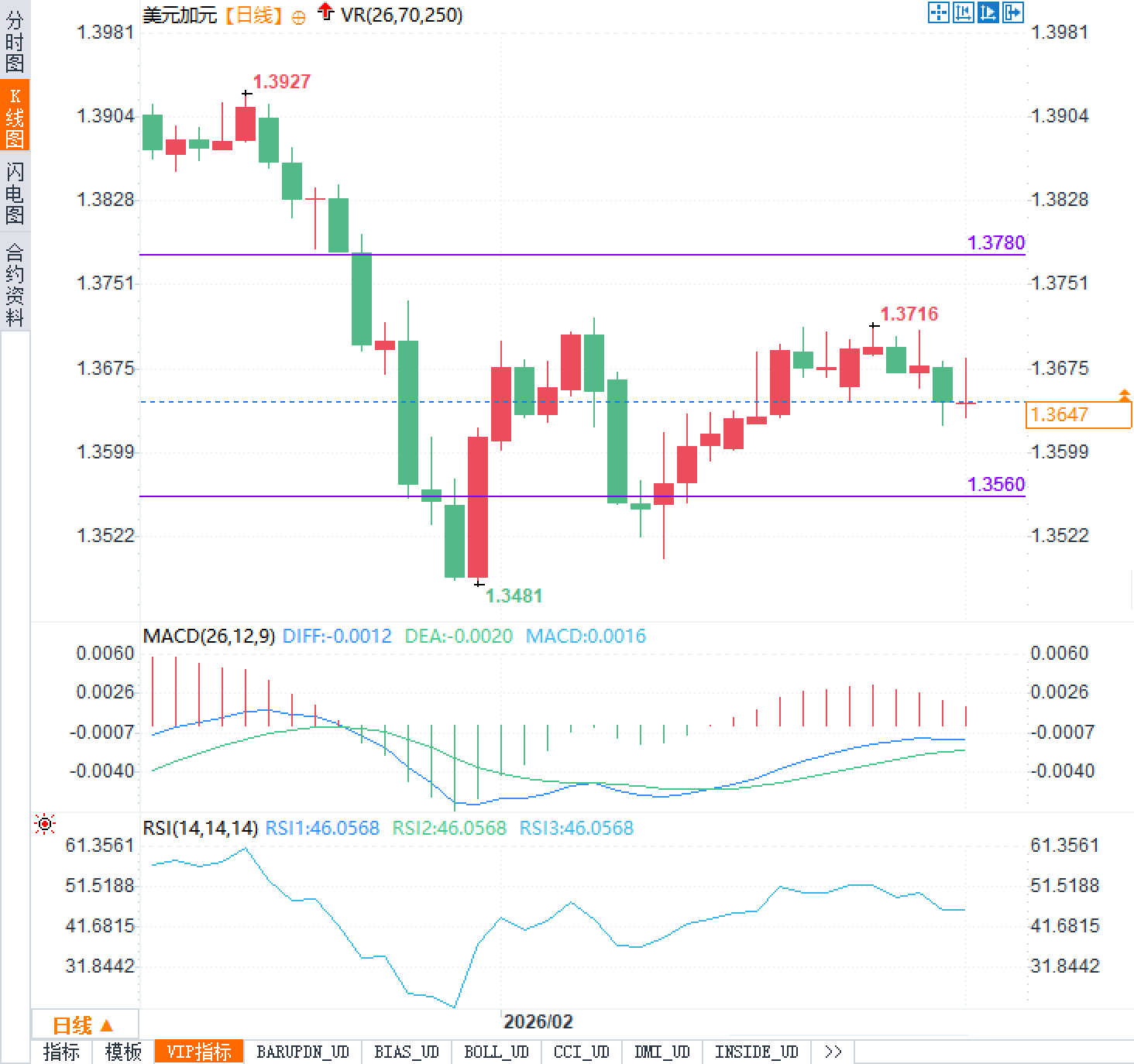
Analysts believe that 1.3675 is the first key level, representing the midpoint of the recent trading range. If the bulls can break through this level, the next target will be the recent high of 1.3716. Stronger resistance lies at the purple horizontal line at 1.3780. Conversely, 1.36 forms a short-term defense, while the support line at 1.3560 is a crucial battleground for both bulls and bears. A break below this level could lead to a retest of the previous low of 1.3481. In terms of indicators, the MACD lines are converging below the zero line, the histogram is weak, and the RSI remains at a neutral-to-bearish level of 46. All of this indicates insufficient market momentum and a state of uncertainty awaiting new guidance.
The current stalemate may soon be broken by a series of key economic data releases. Market participants are holding their breath awaiting the release of the most important US macroeconomic data this month. First, there's the ISM Manufacturing Purchasing Managers' Index (PMI) later today, followed by the ADP Private Sector Employment Report and the ISM Services PMI on Wednesday, with Friday's non-farm payrolls report being the most crucial. The strength or weakness of these data will directly determine the next move of the US dollar and resonate with oil price dynamics and geopolitical situations, potentially triggering significant volatility in the USD/CAD exchange rate this week. Analysts believe the market may continue to fluctuate within the 1.3560 to 1.3780 range until a clear breakout signal emerges from the fundamentals.
In retaliation, Iran launched a large number of missiles at US bases and areas near its Middle Eastern allies, sparking deep global concerns about a full-blown regional war. US President Trump further threatened indefinite strikes, instantly igniting risk aversion in markets. The US dollar quickly became a safe haven, pushing its exchange rate to its highest level since January 22, injecting strong upward momentum into the USD/CAD exchange rate. However, the story is not one-sided; the surge in oil prices became a lifeline for the Canadian dollar, plunging the currency pair into a complex game of wits.
Oil supply disruption: a counterbalancing mechanism in the energy crisis
Just as traders were frantically chasing the US dollar, another force was quietly emerging, attempting to curb its rise. Iran's Islamic Revolutionary Guard Corps announced the closure of the Strait of Hormuz, a move that effectively choked a vital global energy artery. As the gateway for over 20% of global oil shipments, the strait's closure triggered extreme panic over supply disruptions, directly pushing crude oil prices to their highest level since June 2025. Although OPEC and its allies decided to increase production by 206,000 barrels to stabilize prices, this measure proved insufficient in the face of such a massive geopolitical shock. For the Canadian dollar, which is highly correlated with commodities, the surge in oil prices provided strong support, effectively limiting its downside. This created a peculiar market landscape: on the one hand, the conflict pushed up the US dollar; on the other hand, high oil prices supported the Canadian dollar. These two opposing forces wrestled, causing the USD/CAD pair to fluctuate wildly during the day, leaving traders seemingly caught in a silent tug-of-war, unable to discern a clear short-term direction.
Technical Puzzle: The Battle Between Bulls and Bears at Key Levels
From a technical chart perspective, the USD/CAD pair is currently at a delicate equilibrium, with the price repeatedly testing the 1.3650 level. Looking back at the daily chart, after experiencing significant volatility from a high of 1.3927 to a low of 1.3481, the pair has entered a period of consolidation. Although the price stabilized and rebounded after touching 1.3481, selling pressure above remains heavy.
Analysts believe that 1.3675 is the first key level, representing the midpoint of the recent trading range. If the bulls can break through this level, the next target will be the recent high of 1.3716. Stronger resistance lies at the purple horizontal line at 1.3780. Conversely, 1.36 forms a short-term defense, while the support line at 1.3560 is a crucial battleground for both bulls and bears. A break below this level could lead to a retest of the previous low of 1.3481. In terms of indicators, the MACD lines are converging below the zero line, the histogram is weak, and the RSI remains at a neutral-to-bearish level of 46. All of this indicates insufficient market momentum and a state of uncertainty awaiting new guidance.
Data Storm: The Last Key to Breaking the Deadlock
The current stalemate may soon be broken by a series of key economic data releases. Market participants are holding their breath awaiting the release of the most important US macroeconomic data this month. First, there's the ISM Manufacturing Purchasing Managers' Index (PMI) later today, followed by the ADP Private Sector Employment Report and the ISM Services PMI on Wednesday, with Friday's non-farm payrolls report being the most crucial. The strength or weakness of these data will directly determine the next move of the US dollar and resonate with oil price dynamics and geopolitical situations, potentially triggering significant volatility in the USD/CAD exchange rate this week. Analysts believe the market may continue to fluctuate within the 1.3560 to 1.3780 range until a clear breakout signal emerges from the fundamentals.
- Risk Warning and Disclaimer
- The market involves risk, and trading may not be suitable for all investors. This article is for reference only and does not constitute personal investment advice, nor does it take into account certain users’ specific investment objectives, financial situation, or other needs. Any investment decisions made based on this information are at your own risk.