Shocking! Poll Reveals: Majority of Americans Strongly Oppose Trump's Latest Military Action Against Iran
2026-03-03 12:19:43
Against the backdrop of the recent US military strikes against Iran, three authoritative polls have revealed a striking reality: the American public generally expresses disapproval of these military actions in the Middle East. This reflects not only domestic political divisions but also a deep-seated public concern about a potential full-scale war. Data from surveys conducted by the Washington Post, CNN, and Ipsos reveals a stark divide between Democrats and Republicans, particularly strong opposition from women and younger groups, and a general distrust of Trump's decisions. These poll results offer valuable insights into the current international situation and may influence future policy directions. Below, we will analyze the detailed findings of these polls and explore their deeper implications.

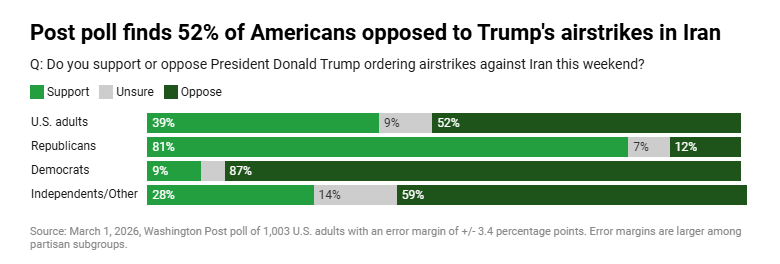
A Washington Post poll conducted via text message on March 1, 2026, surveyed 1,003 American adults with a margin of error of plus or minus 3.4 percentage points. The survey showed that 52% of respondents explicitly opposed President Donald Trump's order to launch airstrikes against Iran over the weekend, while only 39% expressed support, and 9% were undecided. More notably, the proportion of those strongly opposed (39%) far exceeded the 22% who strongly supported, indicating a stronger opposition. From a partisan perspective, nearly 90% of Democrats and about 60% of independent voters opposed the strikes, while about 80% of Republicans expressed support. This partisan divide extends to demographic characteristics: women opposed the airstrikes by a significant 26 percentage points, while men's opinions were more evenly divided; younger Americans also tended to oppose them, reflecting generational differences in foreign policy.
Furthermore, the poll explored public opinion on subsequent actions. Nearly half of the respondents, 47%, believed the U.S. should immediately halt military strikes against Iran, while only 25% advocated for continuation, and 28% remained undecided. Among Democrats, this call for a halt was overwhelmingly strong at 76%; while Republicans had a narrow majority of 54% supporting continuation, independent voters leaned towards a halt by approximately 3 to 1, demonstrating the balancing effect of centrist forces. More alarmingly, three-quarters of Americans expressed concern about U.S. involvement in a full-scale war with Iran, with 40% saying they were "very worried." This data underscores public anxiety about escalating conflict, especially given the military context of the U.S. Navy launching aircraft from the USS Abraham Lincoln aircraft carrier in support of Operation Epic Fury.
A CNN poll conducted via text message from February 28 to March 1, 2026, with a sample of 1,004 American adults and a margin of error of plus or minus 3.9 percentage points, found that 59% of Americans disapprove of U.S. military action against Iran. This figure is similar to the 56% disapproval rate when the Trump administration last bombed Iran in June 2025, indicating consistency in public opinion. The proportion of those strongly disapproving (31%) exceeds the 16% strongly in favor, further highlighting the dominance of negative sentiment. Subtle differences in the poll results may stem from variations in the wording of the questions and the dynamic process of public opinion formation after an event.

Partisan analysis shows that 82% of Democrats and 68% of independent voters disapprove of military action, while 77% of Republicans support it. This divergence extends to assessments of Trump's overall strategy: in current and previous CNN polls, over half of respondents believe that U.S. action would make Iran see the U.S. as a greater threat, and a majority do not trust Trump to make the right choice in using force against Iran. Specifically, 60% of Americans believe Trump lacks a clear plan for dealing with the situation in Iran; 56% oppose U.S. attempts to overthrow the Iranian government; and 60% oppose sending ground troops into Iran. These views differ significantly across parties: nearly 90% of Democrats and 70% of independent voters believe Trump lacks a clear plan, while over 80% of Republicans hold the opposite view. On the issue of ground troops, the opposition rates among Democrats and independent voters are 76% and 64% respectively, while Republicans are more divided, with 38% opposing, 27% supporting, and 35% unsure.
Furthermore, the poll also touched upon the role of congressional oversight: 62% of Americans believe Trump should obtain congressional approval before taking further military action, including over 80% of Democrats, nearly 70% of independent voters, and about 30% of Republicans. However, a majority of 44% of Republicans believe congressional approval is unnecessary, demonstrating support for executive power within the party. Regarding the prospect of a protracted conflict, 56% of respondents believe a prolonged military confrontation between the US and Iran is highly likely, a view shared by a majority of Democrats and independent voters, while Republicans are divided, with 44% believing it is possible and 44% not. Meanwhile, 70% of Americans said they are "somewhat" or "very" closely monitoring Iranian military actions, transcending partisan boundaries and indicating extremely high public attention to the event.
A poll conducted by Ipsos from February 28 to March 1, 2026, with a sample size of 1,282 and a margin of error of plus or minus 3 percentage points, revealed that 43% of Americans opposed a military strike against Iran, while only 27% supported it. Another 30% were unsure or skipped the question, a high level of uncertainty reflecting the volatility of public opinion following a sudden event. More deeply, the poll revealed the public's overall assessment of Trump's military strategy: a majority of 56% believed Trump was "too willing to use military force to advance American interests," only 35% thought his willingness was "moderate," and only 5% felt he was "not willing enough." Partisan polarization was also evident: nearly 90% of Democrats and 60% of independent voters considered Trump too hawkish, while a majority of 73% of Republicans believed his level of military use was appropriate.
This poll also contrasts with statements from the Trump administration, such as Trump's disagreements with U.S. intelligence agencies on intelligence issues and the absence of further mention of regime change, which has exacerbated public distrust. Overall, the poll highlights the cautious attitude of American society towards military intervention, especially within the historical context of the long-standing conflicts in the Middle East.
In conclusion, these three polls consistently show that a majority of Americans oppose or are concerned about Trump's latest strike against Iran. While support is relatively high within the Republican Party, opposition from Democrats and independent voters forms the mainstream voice. This public sentiment stems not only from partisan loyalty but also from concerns about the risks of war, transparency in decision-making, and congressional oversight. Moving forward, as events unfold, these public opinions may drive policy adjustments and even influence the domestic political landscape.
Washington Post Poll: Opposition Dominates, War Fears Rise
A Washington Post poll conducted via text message on March 1, 2026, surveyed 1,003 American adults with a margin of error of plus or minus 3.4 percentage points. The survey showed that 52% of respondents explicitly opposed President Donald Trump's order to launch airstrikes against Iran over the weekend, while only 39% expressed support, and 9% were undecided. More notably, the proportion of those strongly opposed (39%) far exceeded the 22% who strongly supported, indicating a stronger opposition. From a partisan perspective, nearly 90% of Democrats and about 60% of independent voters opposed the strikes, while about 80% of Republicans expressed support. This partisan divide extends to demographic characteristics: women opposed the airstrikes by a significant 26 percentage points, while men's opinions were more evenly divided; younger Americans also tended to oppose them, reflecting generational differences in foreign policy.
Furthermore, the poll explored public opinion on subsequent actions. Nearly half of the respondents, 47%, believed the U.S. should immediately halt military strikes against Iran, while only 25% advocated for continuation, and 28% remained undecided. Among Democrats, this call for a halt was overwhelmingly strong at 76%; while Republicans had a narrow majority of 54% supporting continuation, independent voters leaned towards a halt by approximately 3 to 1, demonstrating the balancing effect of centrist forces. More alarmingly, three-quarters of Americans expressed concern about U.S. involvement in a full-scale war with Iran, with 40% saying they were "very worried." This data underscores public anxiety about escalating conflict, especially given the military context of the U.S. Navy launching aircraft from the USS Abraham Lincoln aircraft carrier in support of Operation Epic Fury.
CNN Poll: Disapproval Rating Remains High, Trump's Plans Face Significant Scrutiny
A CNN poll conducted via text message from February 28 to March 1, 2026, with a sample of 1,004 American adults and a margin of error of plus or minus 3.9 percentage points, found that 59% of Americans disapprove of U.S. military action against Iran. This figure is similar to the 56% disapproval rate when the Trump administration last bombed Iran in June 2025, indicating consistency in public opinion. The proportion of those strongly disapproving (31%) exceeds the 16% strongly in favor, further highlighting the dominance of negative sentiment. Subtle differences in the poll results may stem from variations in the wording of the questions and the dynamic process of public opinion formation after an event.
Partisan analysis shows that 82% of Democrats and 68% of independent voters disapprove of military action, while 77% of Republicans support it. This divergence extends to assessments of Trump's overall strategy: in current and previous CNN polls, over half of respondents believe that U.S. action would make Iran see the U.S. as a greater threat, and a majority do not trust Trump to make the right choice in using force against Iran. Specifically, 60% of Americans believe Trump lacks a clear plan for dealing with the situation in Iran; 56% oppose U.S. attempts to overthrow the Iranian government; and 60% oppose sending ground troops into Iran. These views differ significantly across parties: nearly 90% of Democrats and 70% of independent voters believe Trump lacks a clear plan, while over 80% of Republicans hold the opposite view. On the issue of ground troops, the opposition rates among Democrats and independent voters are 76% and 64% respectively, while Republicans are more divided, with 38% opposing, 27% supporting, and 35% unsure.
Furthermore, the poll also touched upon the role of congressional oversight: 62% of Americans believe Trump should obtain congressional approval before taking further military action, including over 80% of Democrats, nearly 70% of independent voters, and about 30% of Republicans. However, a majority of 44% of Republicans believe congressional approval is unnecessary, demonstrating support for executive power within the party. Regarding the prospect of a protracted conflict, 56% of respondents believe a prolonged military confrontation between the US and Iran is highly likely, a view shared by a majority of Democrats and independent voters, while Republicans are divided, with 44% believing it is possible and 44% not. Meanwhile, 70% of Americans said they are "somewhat" or "very" closely monitoring Iranian military actions, transcending partisan boundaries and indicating extremely high public attention to the event.
Ipsos Poll: Trump's Military Will is Questioned, Uncertainty Highlighted
A poll conducted by Ipsos from February 28 to March 1, 2026, with a sample size of 1,282 and a margin of error of plus or minus 3 percentage points, revealed that 43% of Americans opposed a military strike against Iran, while only 27% supported it. Another 30% were unsure or skipped the question, a high level of uncertainty reflecting the volatility of public opinion following a sudden event. More deeply, the poll revealed the public's overall assessment of Trump's military strategy: a majority of 56% believed Trump was "too willing to use military force to advance American interests," only 35% thought his willingness was "moderate," and only 5% felt he was "not willing enough." Partisan polarization was also evident: nearly 90% of Democrats and 60% of independent voters considered Trump too hawkish, while a majority of 73% of Republicans believed his level of military use was appropriate.
This poll also contrasts with statements from the Trump administration, such as Trump's disagreements with U.S. intelligence agencies on intelligence issues and the absence of further mention of regime change, which has exacerbated public distrust. Overall, the poll highlights the cautious attitude of American society towards military intervention, especially within the historical context of the long-standing conflicts in the Middle East.
In conclusion, these three polls consistently show that a majority of Americans oppose or are concerned about Trump's latest strike against Iran. While support is relatively high within the Republican Party, opposition from Democrats and independent voters forms the mainstream voice. This public sentiment stems not only from partisan loyalty but also from concerns about the risks of war, transparency in decision-making, and congressional oversight. Moving forward, as events unfold, these public opinions may drive policy adjustments and even influence the domestic political landscape.
- Risk Warning and Disclaimer
- The market involves risk, and trading may not be suitable for all investors. This article is for reference only and does not constitute personal investment advice, nor does it take into account certain users’ specific investment objectives, financial situation, or other needs. Any investment decisions made based on this information are at your own risk.