Principal and interest included, not a penny less! The US Department of Justice again rejects tariffs; could refunds cripple the dollar?
2026-03-03 13:58:37
The U.S. Court of Appeals for the Federal Circuit rejected the Trump administration's request for an extension on Monday (March 2), paving the way for a massive tariff refund process. This followed a 6-3 ruling last month by the U.S. Supreme Court that President Trump's global tariffs, imposed under the International Emergency Economic Powers Act (IEEPA), lacked legal authorization, a ruling that undermined one of the Trump administration's core economic policies.
This decision directly remands the case to a lower court—the U.S. Court of International Trade—which can now begin developing relief measures for small businesses that have successfully challenged Trump’s global tariffs.
The Trump administration had previously stated that if the Supreme Court ultimately ruled these tariffs against virtually all of America's trading partners illegal, it would refund the tariffs already levied to importers.
While the Supreme Court's ruling explicitly repealed the tariff-imposing power under IEEPA, it did not address the specific mechanism for refunds. Last Friday, the Trump administration requested a 90-day extension from the Federal Circuit Court to issue an enforcement order, allowing the "political branch time to consider alternatives."
Justice Department lawyers estimate that even if refunds are initiated, the entire process could take years.
However, lawyers representing the plaintiff small businesses strongly opposed any delays. In court filings on Monday, they emphasized the government's extensive experience in handling tariff refunds and that Trump administration officials had repeatedly promised in court that if the tariffs were found illegal, they would be fully refunded with interest.
The plaintiff's lawyer wrote: "There is no reason to support an extension on the issue of refunds, let alone an astonishing three-month extension. Now is the right time to issue an enforcement order."
Since the Supreme Court's ruling on February 20, numerous companies and importers have filed lawsuits with the Court of International Trade, demanding refunds of import duties already paid. These include well-known companies such as FedEx, Revlon, and Costco.
Market estimates suggest that the total amount of tariffs levied under the IEEPA could reach tens of billions of dollars, and the potential refunds will put significant pressure on federal finances. Neal Katyal, one of the plaintiffs' lawyers, stated after the court's decision was announced that his team "will immediately move forward with the process to ensure that Americans receive the refunds they deserve."
The US Federal Circuit Court's rejection of the extension request and initiation of a large-scale tariff refund process poses a multi-dimensional negative impact on the US dollar. While the dollar may be affected in the short term by other macroeconomic factors (such as safe-haven buying driven by the US-Iran situation), this event fundamentally weakens the dollar's policy credit premium and the inflationary logic supported by trade barriers. If more companies file lawsuits and receive refunds, the medium- to long-term depreciation pressure on the dollar will further accumulate.
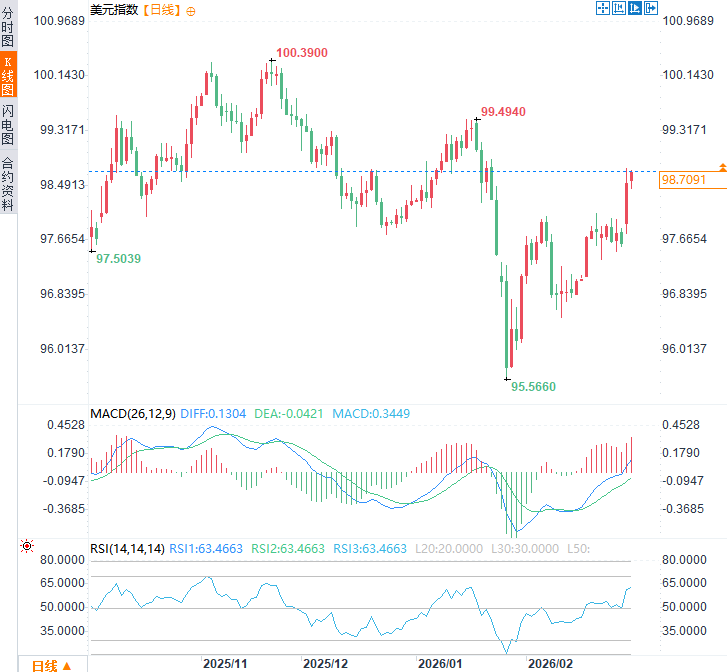
(US Dollar Index Daily Chart, Source: FX678)
This case highlights the judicial constraints on the implementation of U.S. trade policy. Although the Trump administration quickly shifted to other legally authorized means (such as Section 122 of the Trade Act of 1974) to implement new tariffs after losing the Supreme Court case, once the IEEPA tariff refund process is fully launched, it will become one of the largest government tax refund initiatives in recent years, with a profound impact on importers' cash flow, supply chain costs, and the overall fiscal budget.
How the Court of International Trade designs the refund framework, interest rate calculation standards, and priority order will be a focus of close attention from the market.
At 13:58 Beijing time, the US dollar index is currently at 98.72.
The case has been remanded to the Court of International Trade, and the refund process is about to begin.
This decision directly remands the case to a lower court—the U.S. Court of International Trade—which can now begin developing relief measures for small businesses that have successfully challenged Trump’s global tariffs.
The Trump administration had previously stated that if the Supreme Court ultimately ruled these tariffs against virtually all of America's trading partners illegal, it would refund the tariffs already levied to importers.
The U.S. government's request for a 90-day extension was rejected.
While the Supreme Court's ruling explicitly repealed the tariff-imposing power under IEEPA, it did not address the specific mechanism for refunds. Last Friday, the Trump administration requested a 90-day extension from the Federal Circuit Court to issue an enforcement order, allowing the "political branch time to consider alternatives."
Justice Department lawyers estimate that even if refunds are initiated, the entire process could take years.
The plaintiff's lawyer strongly opposed the extension.
However, lawyers representing the plaintiff small businesses strongly opposed any delays. In court filings on Monday, they emphasized the government's extensive experience in handling tariff refunds and that Trump administration officials had repeatedly promised in court that if the tariffs were found illegal, they would be fully refunded with interest.
The plaintiff's lawyer wrote: "There is no reason to support an extension on the issue of refunds, let alone an astonishing three-month extension. Now is the right time to issue an enforcement order."
Numerous companies have filed lawsuits seeking refunds, potentially involving hundreds of billions of dollars.
Since the Supreme Court's ruling on February 20, numerous companies and importers have filed lawsuits with the Court of International Trade, demanding refunds of import duties already paid. These include well-known companies such as FedEx, Revlon, and Costco.
Market estimates suggest that the total amount of tariffs levied under the IEEPA could reach tens of billions of dollars, and the potential refunds will put significant pressure on federal finances. Neal Katyal, one of the plaintiffs' lawyers, stated after the court's decision was announced that his team "will immediately move forward with the process to ensure that Americans receive the refunds they deserve."
Analysis of the impact on the US dollar
The US Federal Circuit Court's rejection of the extension request and initiation of a large-scale tariff refund process poses a multi-dimensional negative impact on the US dollar. While the dollar may be affected in the short term by other macroeconomic factors (such as safe-haven buying driven by the US-Iran situation), this event fundamentally weakens the dollar's policy credit premium and the inflationary logic supported by trade barriers. If more companies file lawsuits and receive refunds, the medium- to long-term depreciation pressure on the dollar will further accumulate.
(US Dollar Index Daily Chart, Source: FX678)
Judicial constraints on trade policy and its future impact
This case highlights the judicial constraints on the implementation of U.S. trade policy. Although the Trump administration quickly shifted to other legally authorized means (such as Section 122 of the Trade Act of 1974) to implement new tariffs after losing the Supreme Court case, once the IEEPA tariff refund process is fully launched, it will become one of the largest government tax refund initiatives in recent years, with a profound impact on importers' cash flow, supply chain costs, and the overall fiscal budget.
How the Court of International Trade designs the refund framework, interest rate calculation standards, and priority order will be a focus of close attention from the market.
At 13:58 Beijing time, the US dollar index is currently at 98.72.
- Risk Warning and Disclaimer
- The market involves risk, and trading may not be suitable for all investors. This article is for reference only and does not constitute personal investment advice, nor does it take into account certain users’ specific investment objectives, financial situation, or other needs. Any investment decisions made based on this information are at your own risk.