Soaring natural gas prices could hit the pound sterling with inflationary pressures.
2026-03-03 14:07:35
The ongoing geopolitical conflict in the Middle East, particularly Iran's drone attack on Qatari energy facilities, has severely impacted global liquefied natural gas (LNG) supplies. This event directly pushed natural gas prices to peak levels seen since the outbreak of the Russia-Ukraine conflict, making the pound sterling significantly vulnerable. British businesses, residents, and the Treasury are eager for Monday's gains to reverse quickly, otherwise it could trigger another significant inflationary cycle.
Qatar, a key player accounting for approximately 18.8% of global LNG exports in 2024, confirmed on Monday that its state-owned enterprise, Qatar Energy, has completely suspended production of liquefied natural gas and related products following the Iranian drone attack on its Ras Laffan industrial city, the world's largest export facility. This unprecedented shutdown is considered the biggest shock to global energy prices since the Russia-Ukraine conflict.
The Las Lafan plant supplies about one-fifth of the world's LNG, and the shutdown immediately triggered a chain reaction: European benchmark natural gas futures saw their biggest single-day gain in nearly four years, rising by more than 50% at one point during the session, and the price of UK April delivery natural gas surged to £121 per kilowatt-hour, a new high since December 2022.
Prior to this, the Strait of Hormuz, a crucial artery for global fuel transport, had already seen a significant number of oil tankers cease passage, further restricting LNG exports from the Persian Gulf region. Tightening global natural gas supplies and fierce competition among buyers have driven prices across the board. Analysts have likened this Middle East LNG loss to the price shock following the 2022 Russia-Ukraine conflict, predicting that if the production halt continues, it will pose a severe challenge to energy security.
For British businesses and residents, this energy event will manifest itself in unexpected inflationary spikes in the coming months. The sharp rise in energy costs severely limits the Bank of England's ability to cut interest rates to stimulate economic growth.
Robert Wood, chief UK economist at Pantheon Macroeconomics, points out that it is too early to judge the long-term impact of the Iran war on energy prices. If energy prices decline positively (i.e., rapidly) relative to current market expectations, the impact on UK inflation will be limited; however, if prices remain high, inflation may only hit a low of 2.4% in July 2027, before rebounding to 3.1% in January 2027. Wood further warns: "Energy prices could prevent the Monetary Policy Committee (MPC) from cutting interest rates this year."
British public finances were already precarious, and Chancellor of the Exchequer Rachel Reeves was desperately hoping for a de-escalation in the Middle East, otherwise its borrowing and spending plans would deteriorate significantly. Analysts generally believe that a key vulnerability for the pound in 2026 lies in a renewed collapse in investor confidence in the UK's ability to maintain its current debt levels.
Following Qatar's production halt, global competition for natural gas has intensified, pushing up prices across all sources. Reports indicate that starting Thursday, over half of the world's largest marine insurance networks will cease providing war risk coverage for vessels entering the Persian Gulf, further exacerbating the economic impact. While markets showed some optimism (stocks and the pound recovered somewhat from their intraday lows), the longer the conflict persists, the more detrimental it will be to the pound and the UK economy's prospects.
A recurring consensus in the reports is that the United States wants Iran to return to the negotiating table. Current President Trump understands that if inflation surges again, he will quickly lose public support. However, the US precision strikes have eliminated Iran's top leadership, leaving it without a high-level negotiating team. Iran may be in a state of "steering adversarial" for some time, and may respond with continued military action.
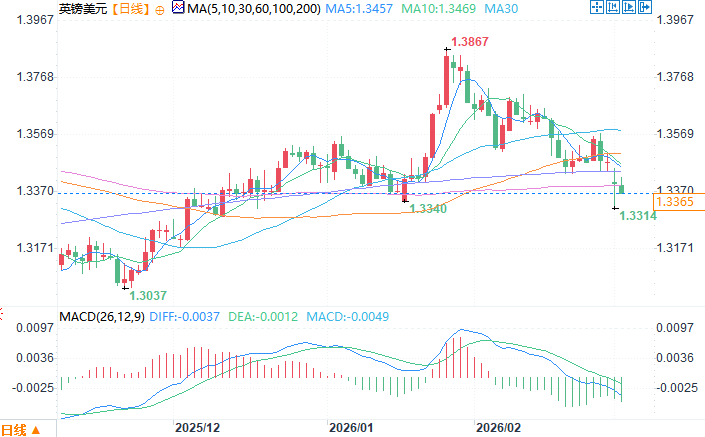
GBP/USD daily chart source: FX678
At 14:04 Beijing time on March 3, the British pound was trading at 1.3355/56 against the US dollar.
Disruption of Qatar's LNG production triggers turmoil in global energy markets
Qatar, a key player accounting for approximately 18.8% of global LNG exports in 2024, confirmed on Monday that its state-owned enterprise, Qatar Energy, has completely suspended production of liquefied natural gas and related products following the Iranian drone attack on its Ras Laffan industrial city, the world's largest export facility. This unprecedented shutdown is considered the biggest shock to global energy prices since the Russia-Ukraine conflict.
The Las Lafan plant supplies about one-fifth of the world's LNG, and the shutdown immediately triggered a chain reaction: European benchmark natural gas futures saw their biggest single-day gain in nearly four years, rising by more than 50% at one point during the session, and the price of UK April delivery natural gas surged to £121 per kilowatt-hour, a new high since December 2022.
Strait shipping has nearly ground to a halt, exacerbating the supply crisis.
Prior to this, the Strait of Hormuz, a crucial artery for global fuel transport, had already seen a significant number of oil tankers cease passage, further restricting LNG exports from the Persian Gulf region. Tightening global natural gas supplies and fierce competition among buyers have driven prices across the board. Analysts have likened this Middle East LNG loss to the price shock following the 2022 Russia-Ukraine conflict, predicting that if the production halt continues, it will pose a severe challenge to energy security.
Direct impact on the British economy and the pound sterling
For British businesses and residents, this energy event will manifest itself in unexpected inflationary spikes in the coming months. The sharp rise in energy costs severely limits the Bank of England's ability to cut interest rates to stimulate economic growth.
Robert Wood, chief UK economist at Pantheon Macroeconomics, points out that it is too early to judge the long-term impact of the Iran war on energy prices. If energy prices decline positively (i.e., rapidly) relative to current market expectations, the impact on UK inflation will be limited; however, if prices remain high, inflation may only hit a low of 2.4% in July 2027, before rebounding to 3.1% in January 2027. Wood further warns: "Energy prices could prevent the Monetary Policy Committee (MPC) from cutting interest rates this year."
British public finances were already precarious, and Chancellor of the Exchequer Rachel Reeves was desperately hoping for a de-escalation in the Middle East, otherwise its borrowing and spending plans would deteriorate significantly. Analysts generally believe that a key vulnerability for the pound in 2026 lies in a renewed collapse in investor confidence in the UK's ability to maintain its current debt levels.
Intensified global competition for natural gas and its broader consequences
Following Qatar's production halt, global competition for natural gas has intensified, pushing up prices across all sources. Reports indicate that starting Thursday, over half of the world's largest marine insurance networks will cease providing war risk coverage for vessels entering the Persian Gulf, further exacerbating the economic impact. While markets showed some optimism (stocks and the pound recovered somewhat from their intraday lows), the longer the conflict persists, the more detrimental it will be to the pound and the UK economy's prospects.
A recurring consensus in the reports is that the United States wants Iran to return to the negotiating table. Current President Trump understands that if inflation surges again, he will quickly lose public support. However, the US precision strikes have eliminated Iran's top leadership, leaving it without a high-level negotiating team. Iran may be in a state of "steering adversarial" for some time, and may respond with continued military action.
GBP/USD daily chart source: FX678
At 14:04 Beijing time on March 3, the British pound was trading at 1.3355/56 against the US dollar.
- Risk Warning and Disclaimer
- The market involves risk, and trading may not be suitable for all investors. This article is for reference only and does not constitute personal investment advice, nor does it take into account certain users’ specific investment objectives, financial situation, or other needs. Any investment decisions made based on this information are at your own risk.