World Gold Council: Central bank gold demand plummeted in January, but sovereign demand base expanded.
2026-03-04 13:01:36
The latest data from the World Gold Council (WGC) shows that in January 2026, global central bank gold purchases were less than 20% of the average monthly demand since 2025. However, the entry of new sovereign entities into the market indicates that the demand base for gold reserve accumulation is gradually broadening . Marissa Salim, Senior Head of Research for Asia Pacific at the WGC, noted in her latest monthly report: “Compared to the 12-month average of 27 tons, central bank gold purchasing momentum slowed at the beginning of the year, with net purchases in January at only 5 tons. Gold price volatility and holiday factors may have led some central banks to temporarily suspend gold purchases, but with no signs of easing geopolitical tensions, gold reserve accumulation is expected to continue in 2026 and beyond.”

Salim emphasized that sovereign gold purchases in January were concentrated in Asia and Eastern Europe. "The Central Bank of Uzbekistan purchased 9 tons of gold that month, continuing its ongoing gold-buying trend since October 2025, bringing its gold reserves to 399 tons. This represents a significant breakthrough in the country's gold reserve growth: from 57% of total reserves in the same period of 2020 to 86% by January 2026." Bank Negara Malaysia joined the ranks of gold buyers for the first time, adding 3 tons of gold in January, its first such purchase since 2018. As of the end of January, its gold reserves reached 42 tons, accounting for 5% of its total reserves.
Other central banks that purchased gold in January included the Czech Republic and Indonesia (2 tons each), a major Asian power and Serbia (1 ton each). Salim noted, "The major Asian power has increased its gold holdings for 15 consecutive months, and its gold reserves now account for nearly 10% of its total reserves."
On the net selling side, the Central Bank of Russia was the largest net seller in January, selling 9 tons of gold. The National Bank of Bulgaria followed closely, selling 2 tons of gold as part of the country's plan to transfer its gold reserves to the European Central Bank (ECB) upon joining the Eurozone on January 1, 2026 (becoming the 21st member state of the European Union). Kazakhstan and Kyrgyzstan also each sold 1 ton of their gold reserves.
The Bank of Korea (BOK) has returned to the gold market after more than a decade. Salim noted, "The Bank of Korea announced plans to include overseas-listed physical gold ETFs in its foreign exchange reserve portfolio starting in the first quarter of 2026, marking its first gold-related investment since 2013." The BOK stated that ETFs offer superior liquidity and trading convenience compared to physical gold; currently, the bank holds 104 tons of physical gold (approximately 4% of its total reserves), ranking 41st among global central bank gold reserves.
Salim added, "Our 2025 Central Bank Gold Reserves Survey shows that gold allocation through ETFs is rare among central banks, and none of the central banks surveyed have adopted this method of purchasing gold."
The World Gold Council believes that expanding demand from global central banks may become a core trend in 2026. Salim summarized: " As the January data shows, both the Malaysian and Korean central banks, after a long period of absence, have resumed their interest in increasing their gold holdings . The next 10-15 days may have a key impact on this year's geopolitical landscape, with escalating tensions between the US and Iran and little sign of a diplomatic solution. The strong gold accumulation by central banks since 2022 is closely related to the strategic positioning of various countries in the transformation of the global order."
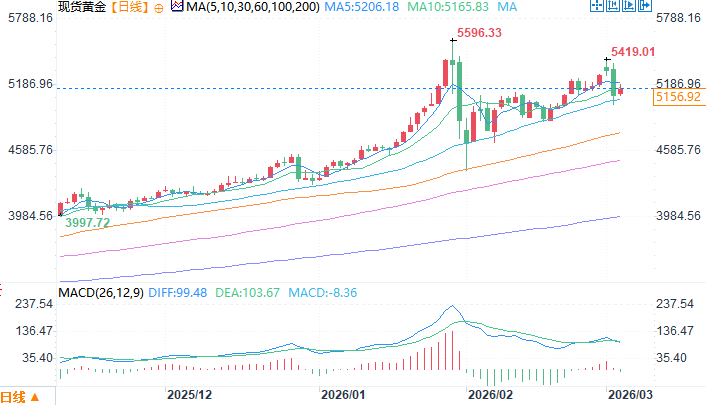
Spot gold daily chart source: EasyForex
At 13:01 Beijing time on March 4, spot gold was trading at $5158.55 per ounce.
Salim emphasized that sovereign gold purchases in January were concentrated in Asia and Eastern Europe. "The Central Bank of Uzbekistan purchased 9 tons of gold that month, continuing its ongoing gold-buying trend since October 2025, bringing its gold reserves to 399 tons. This represents a significant breakthrough in the country's gold reserve growth: from 57% of total reserves in the same period of 2020 to 86% by January 2026." Bank Negara Malaysia joined the ranks of gold buyers for the first time, adding 3 tons of gold in January, its first such purchase since 2018. As of the end of January, its gold reserves reached 42 tons, accounting for 5% of its total reserves.
Other central banks that purchased gold in January included the Czech Republic and Indonesia (2 tons each), a major Asian power and Serbia (1 ton each). Salim noted, "The major Asian power has increased its gold holdings for 15 consecutive months, and its gold reserves now account for nearly 10% of its total reserves."
On the net selling side, the Central Bank of Russia was the largest net seller in January, selling 9 tons of gold. The National Bank of Bulgaria followed closely, selling 2 tons of gold as part of the country's plan to transfer its gold reserves to the European Central Bank (ECB) upon joining the Eurozone on January 1, 2026 (becoming the 21st member state of the European Union). Kazakhstan and Kyrgyzstan also each sold 1 ton of their gold reserves.
The Bank of Korea (BOK) has returned to the gold market after more than a decade. Salim noted, "The Bank of Korea announced plans to include overseas-listed physical gold ETFs in its foreign exchange reserve portfolio starting in the first quarter of 2026, marking its first gold-related investment since 2013." The BOK stated that ETFs offer superior liquidity and trading convenience compared to physical gold; currently, the bank holds 104 tons of physical gold (approximately 4% of its total reserves), ranking 41st among global central bank gold reserves.
Salim added, "Our 2025 Central Bank Gold Reserves Survey shows that gold allocation through ETFs is rare among central banks, and none of the central banks surveyed have adopted this method of purchasing gold."
The World Gold Council believes that expanding demand from global central banks may become a core trend in 2026. Salim summarized: " As the January data shows, both the Malaysian and Korean central banks, after a long period of absence, have resumed their interest in increasing their gold holdings . The next 10-15 days may have a key impact on this year's geopolitical landscape, with escalating tensions between the US and Iran and little sign of a diplomatic solution. The strong gold accumulation by central banks since 2022 is closely related to the strategic positioning of various countries in the transformation of the global order."
Spot gold daily chart source: EasyForex
At 13:01 Beijing time on March 4, spot gold was trading at $5158.55 per ounce.
- Risk Warning and Disclaimer
- The market involves risk, and trading may not be suitable for all investors. This article is for reference only and does not constitute personal investment advice, nor does it take into account certain users’ specific investment objectives, financial situation, or other needs. Any investment decisions made based on this information are at your own risk.