With 150 oil tankers stranded, Trump ordered a forced entry, only to be ridiculed by the industry.
2026-03-04 14:23:50
On Tuesday (March 3), U.S. President Trump announced that, in response to the escalating tensions in the Middle East following the U.S.-Israeli military action against Iran, particularly the Iranian Revolutionary Guard's threat to block the Strait of Hormuz and attack ships passing through, which has disrupted approximately one-fifth of global oil and liquefied natural gas transport, the U.S. Navy will begin providing escorts for oil tankers as soon as possible, if necessary.
He also instructed the U.S. International Development Finance Corporation (DFC) to immediately provide political risk insurance and financial guarantees at "very reasonable prices" for maritime trade (especially energy trade) transiting the Gulf region, aiming to safeguard the financial security of shipping companies and promote the free flow of energy to global markets. Following this statement, international oil price volatility narrowed. During Wednesday's Asian trading session, U.S. crude oil prices fluctuated upwards, currently trading around $75.90 per barrel, a daily increase of approximately 1.7%. Compared to Tuesday's more than 5% increase and Monday's jump of over 12%, Wednesday's price gains were weaker, indicating that the market remains cautious about the actual effectiveness of the measures.
Since the joint military strikes by the United States and Israel against Iran, the situation in the Middle East has deteriorated sharply. Iran's Islamic Revolutionary Guard Corps responded swiftly, announcing a ban on any ships passing through the Strait of Hormuz and warning that any vessels attempting to pass would be destroyed or "burned to ashes."
Revolutionary Guard Commander Jabari recently stated publicly, "We will not let a single drop of oil flow out of this region, nor will we allow a single drop of oil to flow to the Americans." This tough stance has directly led to shipping companies avoiding the waterway on a large scale. Currently, approximately 150 oil tankers and LNG carriers are stranded along the Gulf coast, 26 oil tankers are lingering near the strait, and dozens more have completely ceased operations, with a total capacity equivalent to millions of barrels of crude oil.
The Strait of Hormuz is a critical choke point for global energy, carrying approximately 20% of seaborne oil and a large amount of liquefied natural gas. A prolonged disruption to it would directly impact the stability of global energy supply and supply chains.
Trump emphasized that the United States has the world's leading economic and military strength, and will ensure the free flow of energy, promising "more actions to come." His core measures include two aspects: first, providing low-cost political risk insurance and guarantees through the DFC, covering all shipping companies; and second, the Navy initiating escort operations when necessary.
Trump stated that these measures, effective immediately, are designed to alleviate shipping companies' financial and security concerns and facilitate the resumption of oil tanker traffic. He also revealed that Treasury Secretary Scott Bessant and Energy Secretary Chris Wright had held closed-door meetings with him to discuss further solutions to address rising energy prices.
While Trump's promise to escort ships was strong, it quickly drew widespread skepticism from shipping, insurance, and defense analysts, who argued that the U.S. military currently lacks the capacity to undertake such a high-risk mission on a large scale and sustainably. The Strait of Hormuz is only about 33 kilometers wide at its narrowest point, and Iran possesses a multi-layered asymmetric warfare system, including cruise/ballistic missiles, one-way attack drones, explosive speedboats, mines, and shore-based firepower. U.S. warships entering the Strait would be under the threat of saturation attacks.
Multiple media reports indicate that less than 24 hours before Trump's announcement, U.S. Navy officials had clearly told shipping representatives that escorting ships was "unlikely in the short term," making this abrupt change of heart a hasty decision. Currently, the U.S. military has approximately 12 ships (including one aircraft carrier) deployed in the Middle East, but is facing resource constraints due to the need to handle multiple missions simultaneously.
Experts point out that even if escort operations are initiated, it will require several weeks of suppression to weaken the Iranian navy, and a full resumption of navigation will not be achieved in just a few days. Professional publications such as Lloyd's List emphasize that escorting the fleet would place the US military directly under Iran's "crosshairs," with potentially huge losses, and the actual execution difficulty far exceeds that of the "tanker war" of the 1980s.
As an official development finance institution, the DFC specializes in providing guarantees for high-risk overseas projects. This expansion into maritime energy trade could lower the underwriting threshold for private insurance companies, helping shipping companies obtain lower premiums. However, industry insiders point out that insurance only addresses financial risks and cannot eliminate the threat of physical attacks. If a ship is attacked, the compensation mechanism takes time to activate and cannot prevent supply disruptions.
"This will bring about a major change, at least in terms of eliminating financial risk," commented Dan Pickering, chief investment officer at Houston-based Pickering Energy Partners. However, analysts believe that insurance combined with safeguards will be most effective, and relying solely on insurance will not be enough to quickly restart traffic.
Since the outbreak of the conflict, crude oil prices have risen by more than $10 per barrel. Although the gains narrowed after Trump's remarks, traders remain concerned that prolonged supply disruptions will push up global gasoline and industrial fuel costs. American consumers may have to bear higher oil prices in the short term. Trump acknowledged that "people may have to endure it for a while," but optimistically predicted that oil prices would fall back or even fall below previous levels after the situation ends. Global supply chains face a ripple effect, particularly in European and Asian markets that rely on Middle Eastern crude oil, with a significant risk of soaring transportation costs.
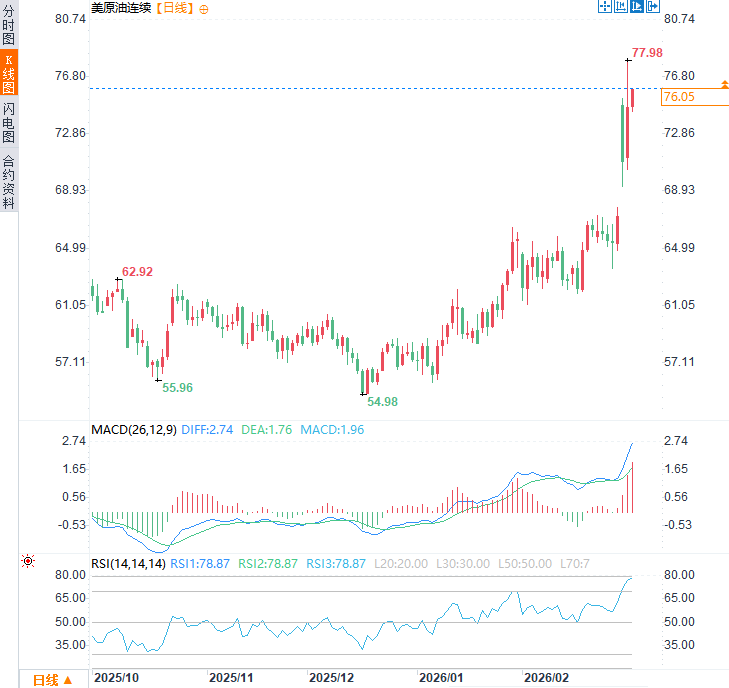
(US crude oil daily chart, source: FX678)
The Trump administration's two-pronged approach of naval escort and DFC insurance, launched against the backdrop of the US-Israel conflict with Iran, demonstrates its determination to strongly intervene in the energy supply chain. In the short term, this may help alleviate market panic and encourage some oil tankers to resume operations. However, given the extremely complex and threatening environment of the Strait of Hormuz, the actual realization of the US military's escort capabilities faces multiple constraints, including resource, tactical, and political factors. Furthermore, the insurance mechanism cannot completely offset physical risks. The overall effect depends on the course of the conflict. If Iran continues its blockade or escalates its attacks, the high-volume, volatile global energy price pattern is likely to persist, testing the limits of the comprehensive response capabilities of the US and its allies.
At 14:23 Beijing time, US crude oil futures were trading at $76.43 per barrel.
He also instructed the U.S. International Development Finance Corporation (DFC) to immediately provide political risk insurance and financial guarantees at "very reasonable prices" for maritime trade (especially energy trade) transiting the Gulf region, aiming to safeguard the financial security of shipping companies and promote the free flow of energy to global markets. Following this statement, international oil price volatility narrowed. During Wednesday's Asian trading session, U.S. crude oil prices fluctuated upwards, currently trading around $75.90 per barrel, a daily increase of approximately 1.7%. Compared to Tuesday's more than 5% increase and Monday's jump of over 12%, Wednesday's price gains were weaker, indicating that the market remains cautious about the actual effectiveness of the measures.
Escalation of Middle East Conflict and Strait Crisis
Since the joint military strikes by the United States and Israel against Iran, the situation in the Middle East has deteriorated sharply. Iran's Islamic Revolutionary Guard Corps responded swiftly, announcing a ban on any ships passing through the Strait of Hormuz and warning that any vessels attempting to pass would be destroyed or "burned to ashes."
Revolutionary Guard Commander Jabari recently stated publicly, "We will not let a single drop of oil flow out of this region, nor will we allow a single drop of oil to flow to the Americans." This tough stance has directly led to shipping companies avoiding the waterway on a large scale. Currently, approximately 150 oil tankers and LNG carriers are stranded along the Gulf coast, 26 oil tankers are lingering near the strait, and dozens more have completely ceased operations, with a total capacity equivalent to millions of barrels of crude oil.
The Strait of Hormuz is a critical choke point for global energy, carrying approximately 20% of seaborne oil and a large amount of liquefied natural gas. A prolonged disruption to it would directly impact the stability of global energy supply and supply chains.
A detailed explanation of Trump's double protection plan
Trump emphasized that the United States has the world's leading economic and military strength, and will ensure the free flow of energy, promising "more actions to come." His core measures include two aspects: first, providing low-cost political risk insurance and guarantees through the DFC, covering all shipping companies; and second, the Navy initiating escort operations when necessary.
Trump stated that these measures, effective immediately, are designed to alleviate shipping companies' financial and security concerns and facilitate the resumption of oil tanker traffic. He also revealed that Treasury Secretary Scott Bessant and Energy Secretary Chris Wright had held closed-door meetings with him to discuss further solutions to address rising energy prices.
The feasibility of US military escort is strongly questioned within the industry.
While Trump's promise to escort ships was strong, it quickly drew widespread skepticism from shipping, insurance, and defense analysts, who argued that the U.S. military currently lacks the capacity to undertake such a high-risk mission on a large scale and sustainably. The Strait of Hormuz is only about 33 kilometers wide at its narrowest point, and Iran possesses a multi-layered asymmetric warfare system, including cruise/ballistic missiles, one-way attack drones, explosive speedboats, mines, and shore-based firepower. U.S. warships entering the Strait would be under the threat of saturation attacks.
Multiple media reports indicate that less than 24 hours before Trump's announcement, U.S. Navy officials had clearly told shipping representatives that escorting ships was "unlikely in the short term," making this abrupt change of heart a hasty decision. Currently, the U.S. military has approximately 12 ships (including one aircraft carrier) deployed in the Middle East, but is facing resource constraints due to the need to handle multiple missions simultaneously.
Experts point out that even if escort operations are initiated, it will require several weeks of suppression to weaken the Iranian navy, and a full resumption of navigation will not be achieved in just a few days. Professional publications such as Lloyd's List emphasize that escorting the fleet would place the US military directly under Iran's "crosshairs," with potentially huge losses, and the actual execution difficulty far exceeds that of the "tanker war" of the 1980s.
The Role and Limitations of DFC Political Risk Insurance
As an official development finance institution, the DFC specializes in providing guarantees for high-risk overseas projects. This expansion into maritime energy trade could lower the underwriting threshold for private insurance companies, helping shipping companies obtain lower premiums. However, industry insiders point out that insurance only addresses financial risks and cannot eliminate the threat of physical attacks. If a ship is attacked, the compensation mechanism takes time to activate and cannot prevent supply disruptions.
"This will bring about a major change, at least in terms of eliminating financial risk," commented Dan Pickering, chief investment officer at Houston-based Pickering Energy Partners. However, analysts believe that insurance combined with safeguards will be most effective, and relying solely on insurance will not be enough to quickly restart traffic.
Energy prices and global supply chain shocks
Since the outbreak of the conflict, crude oil prices have risen by more than $10 per barrel. Although the gains narrowed after Trump's remarks, traders remain concerned that prolonged supply disruptions will push up global gasoline and industrial fuel costs. American consumers may have to bear higher oil prices in the short term. Trump acknowledged that "people may have to endure it for a while," but optimistically predicted that oil prices would fall back or even fall below previous levels after the situation ends. Global supply chains face a ripple effect, particularly in European and Asian markets that rely on Middle Eastern crude oil, with a significant risk of soaring transportation costs.
(US crude oil daily chart, source: FX678)
Editor's Summary
The Trump administration's two-pronged approach of naval escort and DFC insurance, launched against the backdrop of the US-Israel conflict with Iran, demonstrates its determination to strongly intervene in the energy supply chain. In the short term, this may help alleviate market panic and encourage some oil tankers to resume operations. However, given the extremely complex and threatening environment of the Strait of Hormuz, the actual realization of the US military's escort capabilities faces multiple constraints, including resource, tactical, and political factors. Furthermore, the insurance mechanism cannot completely offset physical risks. The overall effect depends on the course of the conflict. If Iran continues its blockade or escalates its attacks, the high-volume, volatile global energy price pattern is likely to persist, testing the limits of the comprehensive response capabilities of the US and its allies.
At 14:23 Beijing time, US crude oil futures were trading at $76.43 per barrel.
- Risk Warning and Disclaimer
- The market involves risk, and trading may not be suitable for all investors. This article is for reference only and does not constitute personal investment advice, nor does it take into account certain users’ specific investment objectives, financial situation, or other needs. Any investment decisions made based on this information are at your own risk.