The sinking of an Iranian warship by the United States has completely paralyzed shipping in the Strait of Hormuz.
2026-03-05 10:08:41
Amidst the rapidly deteriorating situation in the Middle East, conflict is escalating and impacting global energy lifelines. A U.S. Navy submarine's deadly strike against an Iranian warship near Sri Lanka marks the expansion of the conflict from the Persian Gulf to the Indian Ocean, further escalating the crisis surrounding the potential blockade of the Strait of Hormuz.
The strait, a vital waterway for approximately one-fifth of the world's oil and gas transportation, has been disrupted for several days, causing dramatic fluctuations in energy prices and triggering high alert in international markets. This article will begin with the latest developments in the conflict, analyzing the severe situation of the shipping paralysis, the dilemmas faced by major oil-producing countries, and the emergency intervention measures taken by the US government, ultimately revealing the profound impact of this crisis on global energy security.
Since the outbreak of the conflict between the US and Iran, the US and Israel have continued their military operations against Iran. On Wednesday, a US Navy submarine torpedoed an Iranian Navy frigate in international waters near the southern coast of Sri Lanka, causing the ship to sink.
This strike is considered the first time since World War II that an enemy ship has been sunk by a torpedo, marking a shift in the US pursuit of the Iranian navy beyond the Middle East. US Defense Secretary Hergese publicly confirmed the incident, describing it as a "quiet death."
Sri Lankan authorities reported that dozens of bodies have been recovered from the sunken ship, and some crew members have been rescued. This long-range strike not only weakened the Iranian navy but also directly responded to Iran's threat to blockade the Strait of Hormuz, further escalating the confrontation between the two sides.
Shipping in the Strait of Hormuz has become a central focus of the current crisis. This strait, which carries a crucial share of global oil supplies, has been paralyzed for the fifth consecutive day.
Based on ship tracking data, it is estimated that at least 200 vessels, including crude oil tankers, liquefied natural gas carriers, and various cargo ships, are anchored and unable to continue their voyages in the open waters near the coasts of major oil-producing countries in the Gulf, such as Iraq, Saudi Arabia, and Qatar.
In addition, hundreds of ships are stranded outside the strait entrance, unable to enter the port to load cargo. This blockade directly cuts off the flow of Middle Eastern oil and gas to global markets, causing severe disruptions to the supply chain.
Shipping sources revealed that the Maltese-flagged container ship Safeen Prestige was damaged by projectiles as it approached the northern end of the Strait of Hormuz, forcing the crew to abandon ship.
This incident further exacerbated the panic in the shipping industry, with many shipowners choosing to wait and see or take detours, completely disrupting the normal rhythm of energy trade.
The escalating conflict has directly impacted the normal operations of Gulf oil-producing countries. Qatar has announced a suspension of liquefied natural gas production, while Iraq has significantly reduced its oil production, primarily due to insufficient storage space to continue loading cargo onto ships.
Saudi Arabia, the United Arab Emirates, and Kuwait are also facing difficulties in loading goods. Although it remains to be confirmed whether these countries have officially reduced production, their overall export capacity has been significantly limited. These oil-producing countries rely on the Strait of Hormuz as their only major export route. Once this route is blocked, their oil and gas inventories will rapidly accumulate, forcing them to slow down their production pace. This chain reaction not only affects the economic stability of the Middle East but also transmits to the global market through supply shortages, pushing up energy prices and threatening downstream industries.
Faced with the pressure of soaring energy prices, US President Trump quickly took countermeasures.
On Tuesday, he publicly pledged to provide insurance coverage and naval escorts for ships exporting oil and gas from the Middle East to quell energy market volatility. On Wednesday, Trump further directed the U.S. International Development Finance Corporation (DFC) to provide political risk insurance and financial guarantees for maritime trade in the Gulf region. He emphasized on social media, "The United States will ensure the free flow of energy to the world, no matter what." These measures aim to instill confidence in shipping companies, encourage ships to resume passage, and deter potential Iranian attacks through potential naval escorts.
Nevertheless, BIMCO Chief Safety Officer Larsen pointed out that providing comprehensive protection for all tankers operating in threatened waters is unrealistic, as it would require a large number of warships and other military resources, and its actual implementation would face enormous challenges.
Oil prices experienced significant volatility due to the conflict. Since the outbreak of the conflict, oil prices had risen for four consecutive days, with a cumulative increase of 12%. Prices retreated on Wednesday, but the overall upward trend slowed.
Goldman Sachs has revised its forecasts, raising its second-quarter Brent crude oil price expectation by $10 to $76 per barrel and its U.S. crude oil price expectation by $9 to $71 per barrel. The firm believes that disruptions to oil and gas exports from the Strait of Hormuz may last longer than expected, and the risk of potential damage to oil production facilities has increased.
Furthermore, if traffic volume in the Strait of Hormuz remains low, it will lead to a significant decline in OECD country inventories and Middle Eastern production in March. Asian refineries will be the first to be affected, as some companies, which rely on the Middle East for 60% of their crude oil supply, are currently facing pressure to reduce production. Indonesian and Japanese refiners have increased their crude oil purchases from the United States to fill the gap, while India is considering expanding its purchases from Russia.
In conclusion, the rapid escalation of the US-Iran conflict has pushed the Strait of Hormuz to the brink of complete paralysis. While the US submarine strikes and the Trump administration's energy security promises attempt to stabilize the situation, they are unlikely to reverse the tense global energy supply situation in the short term. This crisis not only tests the military and diplomatic wisdom of all parties involved but will also profoundly impact the international energy landscape and the economic recovery process. Developments in the coming days will determine whether Middle Eastern oil and gas flows can gradually resume and whether global markets will face a more prolonged shock.
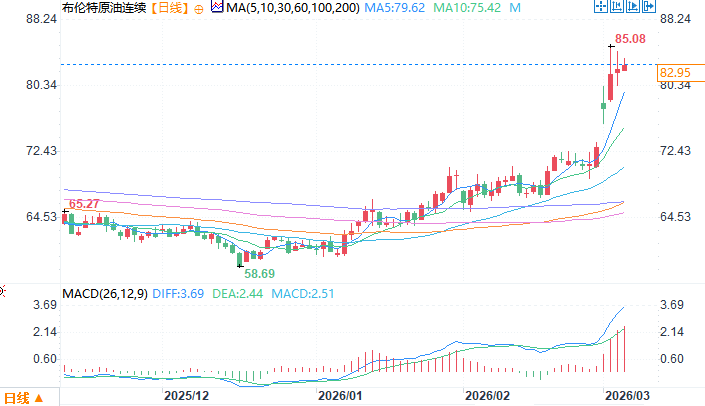
Brent crude oil daily chart source: EasyForex
At 10:07 AM Beijing time on March 5th, Brent crude oil futures were trading at $83.36 per barrel.
The strait, a vital waterway for approximately one-fifth of the world's oil and gas transportation, has been disrupted for several days, causing dramatic fluctuations in energy prices and triggering high alert in international markets. This article will begin with the latest developments in the conflict, analyzing the severe situation of the shipping paralysis, the dilemmas faced by major oil-producing countries, and the emergency intervention measures taken by the US government, ultimately revealing the profound impact of this crisis on global energy security.
Conflict Escalates: US Submarine Strikes Iranian Navy from Afar
Since the outbreak of the conflict between the US and Iran, the US and Israel have continued their military operations against Iran. On Wednesday, a US Navy submarine torpedoed an Iranian Navy frigate in international waters near the southern coast of Sri Lanka, causing the ship to sink.
This strike is considered the first time since World War II that an enemy ship has been sunk by a torpedo, marking a shift in the US pursuit of the Iranian navy beyond the Middle East. US Defense Secretary Hergese publicly confirmed the incident, describing it as a "quiet death."
Sri Lankan authorities reported that dozens of bodies have been recovered from the sunken ship, and some crew members have been rescued. This long-range strike not only weakened the Iranian navy but also directly responded to Iran's threat to blockade the Strait of Hormuz, further escalating the confrontation between the two sides.
Shipping in the Strait of Hormuz has come to a complete standstill.
Shipping in the Strait of Hormuz has become a central focus of the current crisis. This strait, which carries a crucial share of global oil supplies, has been paralyzed for the fifth consecutive day.
Based on ship tracking data, it is estimated that at least 200 vessels, including crude oil tankers, liquefied natural gas carriers, and various cargo ships, are anchored and unable to continue their voyages in the open waters near the coasts of major oil-producing countries in the Gulf, such as Iraq, Saudi Arabia, and Qatar.
In addition, hundreds of ships are stranded outside the strait entrance, unable to enter the port to load cargo. This blockade directly cuts off the flow of Middle Eastern oil and gas to global markets, causing severe disruptions to the supply chain.
Shipping sources revealed that the Maltese-flagged container ship Safeen Prestige was damaged by projectiles as it approached the northern end of the Strait of Hormuz, forcing the crew to abandon ship.
This incident further exacerbated the panic in the shipping industry, with many shipowners choosing to wait and see or take detours, completely disrupting the normal rhythm of energy trade.
Oil-producing countries face increased pressure to cut production and store supplies.
The escalating conflict has directly impacted the normal operations of Gulf oil-producing countries. Qatar has announced a suspension of liquefied natural gas production, while Iraq has significantly reduced its oil production, primarily due to insufficient storage space to continue loading cargo onto ships.
Saudi Arabia, the United Arab Emirates, and Kuwait are also facing difficulties in loading goods. Although it remains to be confirmed whether these countries have officially reduced production, their overall export capacity has been significantly limited. These oil-producing countries rely on the Strait of Hormuz as their only major export route. Once this route is blocked, their oil and gas inventories will rapidly accumulate, forcing them to slow down their production pace. This chain reaction not only affects the economic stability of the Middle East but also transmits to the global market through supply shortages, pushing up energy prices and threatening downstream industries.
The Trump administration intervened urgently to ensure energy flow.
Faced with the pressure of soaring energy prices, US President Trump quickly took countermeasures.
On Tuesday, he publicly pledged to provide insurance coverage and naval escorts for ships exporting oil and gas from the Middle East to quell energy market volatility. On Wednesday, Trump further directed the U.S. International Development Finance Corporation (DFC) to provide political risk insurance and financial guarantees for maritime trade in the Gulf region. He emphasized on social media, "The United States will ensure the free flow of energy to the world, no matter what." These measures aim to instill confidence in shipping companies, encourage ships to resume passage, and deter potential Iranian attacks through potential naval escorts.
Nevertheless, BIMCO Chief Safety Officer Larsen pointed out that providing comprehensive protection for all tankers operating in threatened waters is unrealistic, as it would require a large number of warships and other military resources, and its actual implementation would face enormous challenges.
Oil price fluctuations and market forecast adjustments
Oil prices experienced significant volatility due to the conflict. Since the outbreak of the conflict, oil prices had risen for four consecutive days, with a cumulative increase of 12%. Prices retreated on Wednesday, but the overall upward trend slowed.
Goldman Sachs has revised its forecasts, raising its second-quarter Brent crude oil price expectation by $10 to $76 per barrel and its U.S. crude oil price expectation by $9 to $71 per barrel. The firm believes that disruptions to oil and gas exports from the Strait of Hormuz may last longer than expected, and the risk of potential damage to oil production facilities has increased.
Furthermore, if traffic volume in the Strait of Hormuz remains low, it will lead to a significant decline in OECD country inventories and Middle Eastern production in March. Asian refineries will be the first to be affected, as some companies, which rely on the Middle East for 60% of their crude oil supply, are currently facing pressure to reduce production. Indonesian and Japanese refiners have increased their crude oil purchases from the United States to fill the gap, while India is considering expanding its purchases from Russia.
In conclusion, the rapid escalation of the US-Iran conflict has pushed the Strait of Hormuz to the brink of complete paralysis. While the US submarine strikes and the Trump administration's energy security promises attempt to stabilize the situation, they are unlikely to reverse the tense global energy supply situation in the short term. This crisis not only tests the military and diplomatic wisdom of all parties involved but will also profoundly impact the international energy landscape and the economic recovery process. Developments in the coming days will determine whether Middle Eastern oil and gas flows can gradually resume and whether global markets will face a more prolonged shock.
Brent crude oil daily chart source: EasyForex
At 10:07 AM Beijing time on March 5th, Brent crude oil futures were trading at $83.36 per barrel.
- Risk Warning and Disclaimer
- The market involves risk, and trading may not be suitable for all investors. This article is for reference only and does not constitute personal investment advice, nor does it take into account certain users’ specific investment objectives, financial situation, or other needs. Any investment decisions made based on this information are at your own risk.