Soaring oil prices and strait blockade could plunge global central banks into a "stagflation nightmare"!
2026-03-05 11:33:40
The situation in the Middle East has deteriorated rapidly. In late February, the US-Israeli coalition launched a large-scale precision strike against Iran, which directly resulted in the death of Iran's Supreme Leader Ali Khamenei and triggered retaliatory missile attacks on targets in several Gulf states. Iran subsequently announced the closure of the Strait of Hormuz, bringing the world's most critical oil transport chokepoint to a near standstill. Tanker traffic has plummeted by more than 80%, and many tankers have been attacked by drones or forced to anchor and wait.
This geopolitical black swan event rapidly pushed up global energy prices. Coupled with the risk of disruptions to Iranian oil exports, market concerns that supply disruptions could last for weeks or even longer have led to a new upward cycle in oil prices. Central banks around the world, which were originally trying to find a balance between slowing economic growth and persistent inflation, are now forced to reassess their monetary policy paths.

On Thursday (March 5) during Asian trading hours, US crude oil prices fluctuated upwards, currently trading around $77.10 per barrel, with a daily increase of approximately 3.2%, continuing the upward trend of the previous two trading days. If the Strait of Hormuz remains closed for an extended period, institutions such as Bank of America have warned that oil prices could break through $100 per barrel, and European natural gas prices could surge to over $70 per megawatt-hour.
Rising energy prices will gradually be transmitted to both the consumption and production ends, especially in countries heavily reliant on Middle Eastern imports. Increased costs in transportation, chemicals, and manufacturing will amplify the effects of a second round of inflation, potentially causing core inflation to spiral out of control.
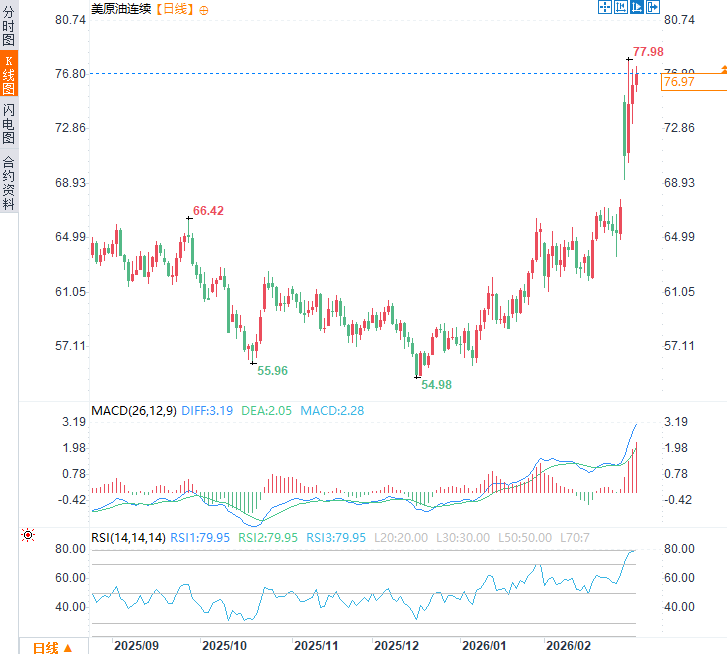
(US crude oil daily chart, source: FX678)
Central bank policymakers are facing a dilemma: on the one hand, oil price shocks could push up inflation, reducing the room for interest rate cuts; on the other hand, geopolitical conflicts are dragging down global demand and economic growth, requiring continued accommodative monetary policy to support the recovery. Nomura's economic team recently pointed out that "the escalating conflict in Iran makes most central banks inclined to keep interest rates unchanged in the short term."
Europe is highly dependent on imported oil and liquefied natural gas. Soaring oil prices, coupled with the pressure of US tariffs, have put the Eurozone in a real dilemma.
ING economists say the likelihood of an interest rate hike is extremely low unless the eurozone economy shows significant resilience.
ECB board member Pierre Wunsch emphasized this week: "If energy prices continue to rise and the magnitude is significant, we will rerun the models to assess the impact, but we will not react hastily."
The U.S. CPI rose 2.4% year-on-year in January, still above the Federal Reserve's 2% target. Yellen stated publicly on March 2nd, "The situation in Iran makes the Fed more inclined to hold rates steady and more hesitant to cut rates. They were already cautious before, and now the conflict is further pushing up energy prices, which will simultaneously dampen economic growth and exacerbate inflationary pressures." She warned that if the Strait of Hormuz remains disrupted for an extended period, inflation could rise above 3%.
Approximately 80% of crude oil flows through the Strait of Hormuz to major Asian countries. Goldman Sachs simulations show that if the strait were closed for six weeks and oil prices jumped from $70 to $85, inflation in the Asian region would rise by an average of 0.7 percentage points, with the Philippines and Thailand being the most vulnerable.
It is estimated that the conflict will push up the overall CPI in Asia by 7-27 basis points, with Thailand, South Korea, and Singapore, which have a higher weighting in the energy sector, being the most affected. MUFG analyst Michael Wan pointed out that the central banks of the Philippines and Indonesia may pause interest rate cuts, while India and South Korea will extend their period of stability.
Nomura predicts that Malaysia, as a net energy exporter, may benefit and tighten its policies, while Australia and Singapore also face the risk of raising interest rates, and the Philippine central bank's planned 25 basis point rate cut in April may be cancelled.
Asian governments can use fiscal tools to cushion shocks, such as price controls, fuel subsidies, and reductions in fuel consumption taxes or crude oil import tariffs. Nomura believes that "fiscal policy will be Asia's first line of defense." However, subsidies will exacerbate fiscal deficits. Rob Subbaraman, head of global macro research at Nomura, points out: "Governments must make a difficult choice between higher inflation and worse fiscal conditions."
The escalating conflict in the Middle East has pushed the global energy market into its worst-case scenario. A disruption in the Strait of Hormuz directly threatens 20% of the world's oil supply, and oil prices have already risen by over 35% this year, potentially breaking through key psychological levels. Central bank policy space has been significantly compressed: expectations for a Federal Reserve rate cut have cooled, the threshold for rate hikes in Europe has risen, and many Asian countries have turned to a wait-and-see approach or tightened their monetary policies. In the short term, rising inflation risks will dominate policy decisions; in the long term, if the conflict persists, global economic growth will face greater downward pressure, and the coordination of fiscal and monetary policies will become significantly more difficult. The evolution of the situation remains highly uncertain, and the market needs to closely monitor the rebuilding of Iran's leadership, the resumption of navigation in the Strait of Hormuz, and the degree of intervention by major powers.
1. Is the Strait of Hormuz currently closed? What is the impact on energy supply?
While not officially shut down, Iranian threats and actual drone attacks have caused tanker traffic to plummet by over 80%, with more than 150 vessels anchored to avoid risk. If this continues for several weeks, the supply gap will push prices above $100, leading to a sharp rise in global energy costs, with Asian importers facing the greatest inflationary pressure.
2. Why has this conflict had such a significant impact on central bank policy?
Energy prices are one of the main drivers of inflation. A 10% increase in oil prices can raise global inflation by an average of 0.2-0.4 percentage points; a $20-30 increase will trigger a second round of effects (the wage-price spiral). Central banks originally planned to cut interest rates to stimulate growth, but the resurgence of inflation has forced them to pause easing measures and even consider tightening to anchor expectations.
3. Why is the Federal Reserve less willing to cut interest rates?
The US CPI rose 2.4% in January, above the target. Conflict has pushed up energy and import costs, potentially causing inflation to climb back above 3%.
4. Which Asian countries will be most affected? How will they respond?
The Philippines and Thailand are the most vulnerable due to their high energy weighting and limited fiscal space; South Korea and Singapore are next. Most central banks are pausing interest rate cuts in the short term, prioritizing fiscal subsidies and tax reductions; net exporters like Malaysia may benefit from raising interest rates in the opposite direction. Overall, Asia is leaning towards a strategy of "fiscal prevention first, inflation tolerance".
At 11:33 Beijing time, US crude oil futures were trading at $77.15 per barrel.
This geopolitical black swan event rapidly pushed up global energy prices. Coupled with the risk of disruptions to Iranian oil exports, market concerns that supply disruptions could last for weeks or even longer have led to a new upward cycle in oil prices. Central banks around the world, which were originally trying to find a balance between slowing economic growth and persistent inflation, are now forced to reassess their monetary policy paths.
Crude oil price trends and their impact
On Thursday (March 5) during Asian trading hours, US crude oil prices fluctuated upwards, currently trading around $77.10 per barrel, with a daily increase of approximately 3.2%, continuing the upward trend of the previous two trading days. If the Strait of Hormuz remains closed for an extended period, institutions such as Bank of America have warned that oil prices could break through $100 per barrel, and European natural gas prices could surge to over $70 per megawatt-hour.
Rising energy prices will gradually be transmitted to both the consumption and production ends, especially in countries heavily reliant on Middle Eastern imports. Increased costs in transportation, chemicals, and manufacturing will amplify the effects of a second round of inflation, potentially causing core inflation to spiral out of control.
(US crude oil daily chart, source: FX678)
Global Central Banks' Warning and Policy Dilemma
Central bank policymakers are facing a dilemma: on the one hand, oil price shocks could push up inflation, reducing the room for interest rate cuts; on the other hand, geopolitical conflicts are dragging down global demand and economic growth, requiring continued accommodative monetary policy to support the recovery. Nomura's economic team recently pointed out that "the escalating conflict in Iran makes most central banks inclined to keep interest rates unchanged in the short term."
The European Central Bank faces dual energy trade shocks.
Europe is highly dependent on imported oil and liquefied natural gas. Soaring oil prices, coupled with the pressure of US tariffs, have put the Eurozone in a real dilemma.
ING economists say the likelihood of an interest rate hike is extremely low unless the eurozone economy shows significant resilience.
ECB board member Pierre Wunsch emphasized this week: "If energy prices continue to rise and the magnitude is significant, we will rerun the models to assess the impact, but we will not react hastily."
The Federal Reserve's stance is becoming more cautious.
The U.S. CPI rose 2.4% year-on-year in January, still above the Federal Reserve's 2% target. Yellen stated publicly on March 2nd, "The situation in Iran makes the Fed more inclined to hold rates steady and more hesitant to cut rates. They were already cautious before, and now the conflict is further pushing up energy prices, which will simultaneously dampen economic growth and exacerbate inflationary pressures." She warned that if the Strait of Hormuz remains disrupted for an extended period, inflation could rise above 3%.
Asian economies are bearing the brunt, with inflation risks intensifying.
Approximately 80% of crude oil flows through the Strait of Hormuz to major Asian countries. Goldman Sachs simulations show that if the strait were closed for six weeks and oil prices jumped from $70 to $85, inflation in the Asian region would rise by an average of 0.7 percentage points, with the Philippines and Thailand being the most vulnerable.
It is estimated that the conflict will push up the overall CPI in Asia by 7-27 basis points, with Thailand, South Korea, and Singapore, which have a higher weighting in the energy sector, being the most affected. MUFG analyst Michael Wan pointed out that the central banks of the Philippines and Indonesia may pause interest rate cuts, while India and South Korea will extend their period of stability.
Nomura predicts that Malaysia, as a net energy exporter, may benefit and tighten its policies, while Australia and Singapore also face the risk of raising interest rates, and the Philippine central bank's planned 25 basis point rate cut in April may be cancelled.
Fiscal buffers and policy trade-offs
Asian governments can use fiscal tools to cushion shocks, such as price controls, fuel subsidies, and reductions in fuel consumption taxes or crude oil import tariffs. Nomura believes that "fiscal policy will be Asia's first line of defense." However, subsidies will exacerbate fiscal deficits. Rob Subbaraman, head of global macro research at Nomura, points out: "Governments must make a difficult choice between higher inflation and worse fiscal conditions."
Editor's Summary
The escalating conflict in the Middle East has pushed the global energy market into its worst-case scenario. A disruption in the Strait of Hormuz directly threatens 20% of the world's oil supply, and oil prices have already risen by over 35% this year, potentially breaking through key psychological levels. Central bank policy space has been significantly compressed: expectations for a Federal Reserve rate cut have cooled, the threshold for rate hikes in Europe has risen, and many Asian countries have turned to a wait-and-see approach or tightened their monetary policies. In the short term, rising inflation risks will dominate policy decisions; in the long term, if the conflict persists, global economic growth will face greater downward pressure, and the coordination of fiscal and monetary policies will become significantly more difficult. The evolution of the situation remains highly uncertain, and the market needs to closely monitor the rebuilding of Iran's leadership, the resumption of navigation in the Strait of Hormuz, and the degree of intervention by major powers.
Frequently Asked Questions
1. Is the Strait of Hormuz currently closed? What is the impact on energy supply?
While not officially shut down, Iranian threats and actual drone attacks have caused tanker traffic to plummet by over 80%, with more than 150 vessels anchored to avoid risk. If this continues for several weeks, the supply gap will push prices above $100, leading to a sharp rise in global energy costs, with Asian importers facing the greatest inflationary pressure.
2. Why has this conflict had such a significant impact on central bank policy?
Energy prices are one of the main drivers of inflation. A 10% increase in oil prices can raise global inflation by an average of 0.2-0.4 percentage points; a $20-30 increase will trigger a second round of effects (the wage-price spiral). Central banks originally planned to cut interest rates to stimulate growth, but the resurgence of inflation has forced them to pause easing measures and even consider tightening to anchor expectations.
3. Why is the Federal Reserve less willing to cut interest rates?
The US CPI rose 2.4% in January, above the target. Conflict has pushed up energy and import costs, potentially causing inflation to climb back above 3%.
4. Which Asian countries will be most affected? How will they respond?
The Philippines and Thailand are the most vulnerable due to their high energy weighting and limited fiscal space; South Korea and Singapore are next. Most central banks are pausing interest rate cuts in the short term, prioritizing fiscal subsidies and tax reductions; net exporters like Malaysia may benefit from raising interest rates in the opposite direction. Overall, Asia is leaning towards a strategy of "fiscal prevention first, inflation tolerance".
At 11:33 Beijing time, US crude oil futures were trading at $77.15 per barrel.
- Risk Warning and Disclaimer
- The market involves risk, and trading may not be suitable for all investors. This article is for reference only and does not constitute personal investment advice, nor does it take into account certain users’ specific investment objectives, financial situation, or other needs. Any investment decisions made based on this information are at your own risk.