Crude oil trading alert: Geopolitical tensions are driving further volatility in oil prices; be wary of a potential decline in risk premiums.
2026-03-06 09:27:17
International oil prices remained strong during Friday's Asian trading session, with WTI crude oil trading around $78.80. The previous trading day saw oil prices surge by approximately 8.5%, marking the largest single-day gain since 2020, indicating a rapidly rising risk premium in the energy market.
The market generally believes that the recent surge in oil prices was primarily driven by escalating tensions in the Middle East, prompting investors to reassess the possibility of disruptions to global crude oil supply. As the conflict between the United States and Iran continues to escalate, global energy markets are beginning to worry about the security of crude oil transportation.

Latest reports indicate that Iran effectively suspended partial passage through the Strait of Hormuz on Tuesday. As one of the world's most critical energy transport routes, approximately one-fifth of global crude oil shipments pass through this strait; any disruption to passage would have a significant impact on global energy supplies.
Meanwhile, security risks in the Gulf region continue to rise. On Thursday, news of an explosion near the Iraqi port of Khor al-Zubair, where a Bahamian-flagged crude oil tanker named Sonangol Namibe suffered a breach in its hull, further exacerbated market concerns about the safety of oil tanker transportation.
ANZ analysts stated, "The crude oil market remains highly volatile, with attacks in the Middle East increasing supply risks. The core concern in the market remains whether oil shipments through the Strait of Hormuz can remain stable."
Meanwhile, U.S. crude oil inventory data limited oil price increases to some extent. The latest weekly data released by the U.S. Energy Information Administration showed that U.S. crude oil inventories increased by 3.475 million barrels in the week ending February 27, higher than the market expectation of a 2.2 million barrel increase.
Although the figure is a significant drop from the previous week's massive increase of 15.989 million barrels, the increase in inventories still means that short-term supply has not tightened significantly, which to some extent limits the potential for further increases in oil prices.
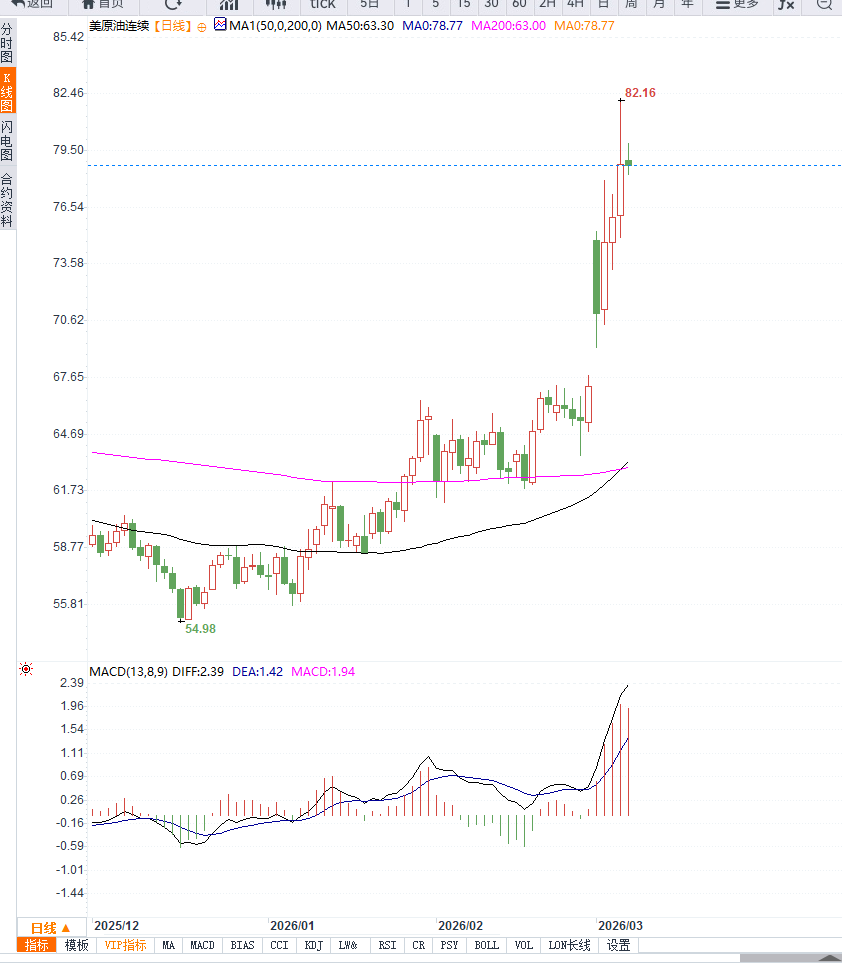
From a technical perspective, WTI crude oil has formed a clear strong breakout structure on the daily chart. Previously, oil prices had been consolidating within the $72 to $74 range, but this recent surge, stimulated by geopolitical tensions, quickly broke through the upper edge of the previous consolidation range, accompanied by a long bullish candle with significantly increased volume, indicating a substantial strengthening of bullish momentum.
The price has now risen above several short-term moving averages, with the 5-day and 10-day moving averages starting to diverge upwards, indicating a shift to a bullish short-term trend. Looking at momentum indicators, the RSI has risen rapidly to around 65 but has not yet entered extreme overbought territory, suggesting that the bulls still have some upward momentum.
The MACD indicator has formed a golden cross above the zero line, further strengthening the short-term upward trend. Looking at key price levels, the area around $78 is gradually becoming a short-term dividing line between bullish and bearish sentiment.
If oil prices can hold above this level, the market may continue to test the $80 mark, which is also an important psychological resistance level. Once broken, oil prices are expected to open up further upside potential towards the $82 to $85 range.
However, if geopolitical risk sentiment eases, oil prices may experience a technical pullback, with initial support around $75, which is close to a dense area of short-term moving averages. Stronger support lies in the $72 to $73 range, which is also the upper edge of the previous trading range.
Editor's Summary:
From the current market environment, the core driver of crude oil prices has shifted from traditional supply and demand logic to geopolitical risk premiums. As one of the world's most important energy transportation routes, the security of the Strait of Hormuz directly impacts the stability of global energy market expectations.
As long as uncertainty persists in the Middle East, the market will continue to factor potential supply risks into oil prices. In the short term, WTI crude oil has entered a period of strong volatility after breaking through $78, and the $80 mark may become a key level for the next phase of market battles between bulls and bears. Any news regarding easing tensions in the region or the resumption of transportation could quickly trigger significant price fluctuations. Overall, the energy market is entering a period of high volatility, and investors need to closely monitor the new round of pricing adjustments brought about by geopolitical developments and supply chain changes.
The market generally believes that the recent surge in oil prices was primarily driven by escalating tensions in the Middle East, prompting investors to reassess the possibility of disruptions to global crude oil supply. As the conflict between the United States and Iran continues to escalate, global energy markets are beginning to worry about the security of crude oil transportation.
Latest reports indicate that Iran effectively suspended partial passage through the Strait of Hormuz on Tuesday. As one of the world's most critical energy transport routes, approximately one-fifth of global crude oil shipments pass through this strait; any disruption to passage would have a significant impact on global energy supplies.
Meanwhile, security risks in the Gulf region continue to rise. On Thursday, news of an explosion near the Iraqi port of Khor al-Zubair, where a Bahamian-flagged crude oil tanker named Sonangol Namibe suffered a breach in its hull, further exacerbated market concerns about the safety of oil tanker transportation.
ANZ analysts stated, "The crude oil market remains highly volatile, with attacks in the Middle East increasing supply risks. The core concern in the market remains whether oil shipments through the Strait of Hormuz can remain stable."
Meanwhile, U.S. crude oil inventory data limited oil price increases to some extent. The latest weekly data released by the U.S. Energy Information Administration showed that U.S. crude oil inventories increased by 3.475 million barrels in the week ending February 27, higher than the market expectation of a 2.2 million barrel increase.
Although the figure is a significant drop from the previous week's massive increase of 15.989 million barrels, the increase in inventories still means that short-term supply has not tightened significantly, which to some extent limits the potential for further increases in oil prices.
From a technical perspective, WTI crude oil has formed a clear strong breakout structure on the daily chart. Previously, oil prices had been consolidating within the $72 to $74 range, but this recent surge, stimulated by geopolitical tensions, quickly broke through the upper edge of the previous consolidation range, accompanied by a long bullish candle with significantly increased volume, indicating a substantial strengthening of bullish momentum.
The price has now risen above several short-term moving averages, with the 5-day and 10-day moving averages starting to diverge upwards, indicating a shift to a bullish short-term trend. Looking at momentum indicators, the RSI has risen rapidly to around 65 but has not yet entered extreme overbought territory, suggesting that the bulls still have some upward momentum.
The MACD indicator has formed a golden cross above the zero line, further strengthening the short-term upward trend. Looking at key price levels, the area around $78 is gradually becoming a short-term dividing line between bullish and bearish sentiment.
If oil prices can hold above this level, the market may continue to test the $80 mark, which is also an important psychological resistance level. Once broken, oil prices are expected to open up further upside potential towards the $82 to $85 range.
However, if geopolitical risk sentiment eases, oil prices may experience a technical pullback, with initial support around $75, which is close to a dense area of short-term moving averages. Stronger support lies in the $72 to $73 range, which is also the upper edge of the previous trading range.
Editor's Summary:
From the current market environment, the core driver of crude oil prices has shifted from traditional supply and demand logic to geopolitical risk premiums. As one of the world's most important energy transportation routes, the security of the Strait of Hormuz directly impacts the stability of global energy market expectations.
As long as uncertainty persists in the Middle East, the market will continue to factor potential supply risks into oil prices. In the short term, WTI crude oil has entered a period of strong volatility after breaking through $78, and the $80 mark may become a key level for the next phase of market battles between bulls and bears. Any news regarding easing tensions in the region or the resumption of transportation could quickly trigger significant price fluctuations. Overall, the energy market is entering a period of high volatility, and investors need to closely monitor the new round of pricing adjustments brought about by geopolitical developments and supply chain changes.
- Risk Warning and Disclaimer
- The market involves risk, and trading may not be suitable for all investors. This article is for reference only and does not constitute personal investment advice, nor does it take into account certain users’ specific investment objectives, financial situation, or other needs. Any investment decisions made based on this information are at your own risk.