Even the US House of Representatives couldn't stop Trump! Operation "Epic Fury" is now unrestrained.
2026-03-06 09:57:16
The U.S. House of Representatives on Thursday (March 5) rejected H.Con.Res.38 by a vote of 219 to 212. The resolution, introduced by Republican Representative Thomas Massey and Democratic Representative Roe Cana, aimed to invoke the 1973 War Powers Resolution to demand that President Trump immediately cease unauthorized hostilities against Iran and withdraw U.S. troops unless Congress declares war or authorizes the use of military force (AUMF). The rejection effectively allows Congress to tacitly allow Trump to continue Operation Epic Fury, despite the operation having been ongoing for a week without a clear end or exit strategy.
This vote came after the Senate blocked a similar resolution by a vote of 53-47 on March 4, marking the failure of both houses of Congress to limit the president's unilateral power to wage war and highlighting the reality of partisan polarization and the expansion of executive power.

The vote largely followed partisan lines: the vast majority of Republicans opposed the resolution (supporting Trump), with only two Republican members voting in favor; Democrats almost unanimously supported it, with only four Democratic members (Jared Golden of Maine, Greg Landsman of Ohio, Henry Cuellar of Texas, and Juan Vargas of California) opposing it. With a narrow majority, House Republicans' rejection strengthened party unity.
The Republican chairman of the House Intelligence Committee criticized Democrats for "pushing the vote simply because they are against Trump, putting the American people at greater risk." Most Republicans believe that the president, as commander-in-chief, has the authority to address "the Iranian nuclear threat and terrorist support" without congressional intervention every time.
House Speaker Mike Johnson called passing the resolution a “serious congressional blunder.” The previous day, Senate Republicans also blocked a similar motion, emphasizing that their action was “defensive” and “successful.”
Democratic lawmakers accused Trump of waging an "unauthorized, vaguely targeted, and inconclusive" selective war, violating Congress's constitutional power to declare war. The bill proposes that Trump explain to Congress the reasons for the war, its duration, and the path to withdrawal.
Several Democrats warned that this move would repeat the mistakes of the "perpetual wars" in Afghanistan and Iraq, risking U.S. military casualties and economic burden. Organizations such as CAIR condemned the rejection as "condoning an illegal war."
As of March 6, Operation Epic Fury entered its seventh day, with the US-Israeli coalition completing multiple waves of airstrikes, destroying Iranian missile production facilities, command centers, and naval assets. Iranian missile launches against Israel and other targets decreased by approximately 86%, but Foreign Minister Abbas Araghchi stated that Iran was "confident in its ability to handle a ground invasion and had no intention of a ceasefire or negotiations." Iran's closure of the Strait of Hormuz continues, and proxies (such as Hezbollah) remain active. The US claims that Iran's conventional forces are "severely depleted," but there is no indication of ground troops.
The conflict has heightened energy risks, causing US crude oil prices to fluctuate downwards in Asian trading on Friday, currently trading around $79.20 per barrel, down about 2.2% on the day, but still at a relatively high level. The Hormuz disruption continues to fuel global supply concerns; if it persists, oil prices may retest the $90-$100 range, amplifying inflationary pressures.
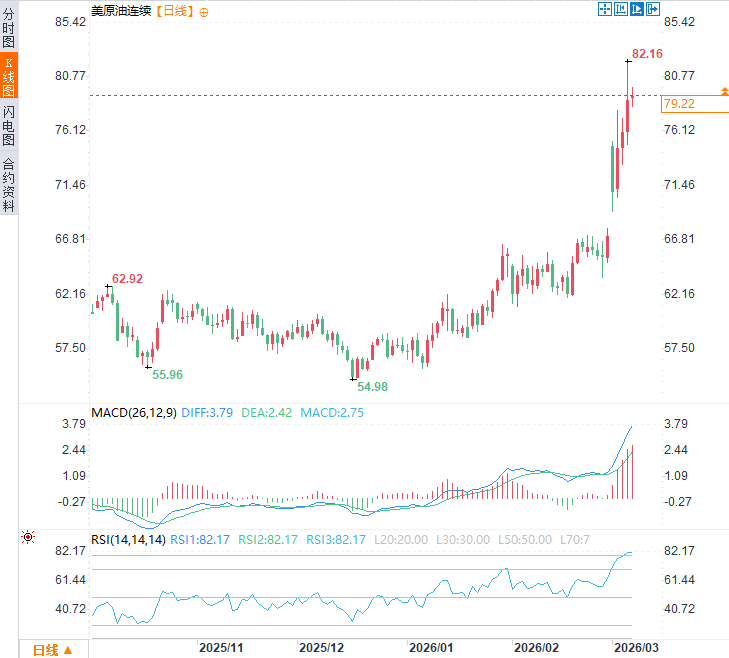
(US crude oil daily chart, source: FX678)
While the resolution is largely symbolic (and would likely face a presidential veto even if passed), the consecutive rejections by both houses of Congress highlight Republican support for Trump and the Democrats' inability to provide checks and balances. Trump's unilateral action, bypassing Congress, has gained short-term legitimacy, but long-term risks include public backlash, economic shocks, and regional escalation. Without a clear exit mechanism, the conflict could easily escalate into a war of attrition.
The U.S. House of Representatives rejected a resolution limiting war powers by 219-212, marking Congress's failure to effectively restrain Trump's military action against Iran. Partisan polarization rendered the constitutional debate on war powers a mere formality. Under Republican leadership, the president's command authority was tacitly approved, and the operation continued. While Democrats emphasized the necessity of authorization, bipartisan defections and procedural failures weakened their influence.
The conflict entered its seventh day, with the US and Israel maintaining a clear air superiority. Iran's counterattacks have weakened, but it shows no willingness to negotiate. The breakdown of the Hormuz trade talks continues to push up energy prices. In the short term, Trump has gained political and military space; in the long term, the lack of congressional consensus and a clear end result could amplify domestic divisions and international uncertainty. The world needs to be wary of the spillover effects of the Middle East situation.
At 9:56 AM Beijing time, US crude oil futures were trading at $79.59 per barrel.
This vote came after the Senate blocked a similar resolution by a vote of 53-47 on March 4, marking the failure of both houses of Congress to limit the president's unilateral power to wage war and highlighting the reality of partisan polarization and the expansion of executive power.
The vote count of 219-212 shows a clear partisan split.
The vote largely followed partisan lines: the vast majority of Republicans opposed the resolution (supporting Trump), with only two Republican members voting in favor; Democrats almost unanimously supported it, with only four Democratic members (Jared Golden of Maine, Greg Landsman of Ohio, Henry Cuellar of Texas, and Juan Vargas of California) opposing it. With a narrow majority, House Republicans' rejection strengthened party unity.
Republicans accused Democrats of political posturing and supported the president's command authority.
The Republican chairman of the House Intelligence Committee criticized Democrats for "pushing the vote simply because they are against Trump, putting the American people at greater risk." Most Republicans believe that the president, as commander-in-chief, has the authority to address "the Iranian nuclear threat and terrorist support" without congressional intervention every time.
House Speaker Mike Johnson called passing the resolution a “serious congressional blunder.” The previous day, Senate Republicans also blocked a similar motion, emphasizing that their action was “defensive” and “successful.”
The Democratic Party emphasizes the constitutional right to wage war and criticizes selective war.
Democratic lawmakers accused Trump of waging an "unauthorized, vaguely targeted, and inconclusive" selective war, violating Congress's constitutional power to declare war. The bill proposes that Trump explain to Congress the reasons for the war, its duration, and the path to withdrawal.
Several Democrats warned that this move would repeat the mistakes of the "perpetual wars" in Afghanistan and Iraq, risking U.S. military casualties and economic burden. Organizations such as CAIR condemned the rejection as "condoning an illegal war."
The conflict enters its seventh day; the US and Israel maintain air superiority, while Iran's counterattacks weaken.
As of March 6, Operation Epic Fury entered its seventh day, with the US-Israeli coalition completing multiple waves of airstrikes, destroying Iranian missile production facilities, command centers, and naval assets. Iranian missile launches against Israel and other targets decreased by approximately 86%, but Foreign Minister Abbas Araghchi stated that Iran was "confident in its ability to handle a ground invasion and had no intention of a ceasefire or negotiations." Iran's closure of the Strait of Hormuz continues, and proxies (such as Hezbollah) remain active. The US claims that Iran's conventional forces are "severely depleted," but there is no indication of ground troops.
Oil prices fluctuated at high levels
The conflict has heightened energy risks, causing US crude oil prices to fluctuate downwards in Asian trading on Friday, currently trading around $79.20 per barrel, down about 2.2% on the day, but still at a relatively high level. The Hormuz disruption continues to fuel global supply concerns; if it persists, oil prices may retest the $90-$100 range, amplifying inflationary pressures.
(US crude oil daily chart, source: FX678)
More symbolic than practical, Trump expands his war space.
While the resolution is largely symbolic (and would likely face a presidential veto even if passed), the consecutive rejections by both houses of Congress highlight Republican support for Trump and the Democrats' inability to provide checks and balances. Trump's unilateral action, bypassing Congress, has gained short-term legitimacy, but long-term risks include public backlash, economic shocks, and regional escalation. Without a clear exit mechanism, the conflict could easily escalate into a war of attrition.
Editor's Summary
The U.S. House of Representatives rejected a resolution limiting war powers by 219-212, marking Congress's failure to effectively restrain Trump's military action against Iran. Partisan polarization rendered the constitutional debate on war powers a mere formality. Under Republican leadership, the president's command authority was tacitly approved, and the operation continued. While Democrats emphasized the necessity of authorization, bipartisan defections and procedural failures weakened their influence.
The conflict entered its seventh day, with the US and Israel maintaining a clear air superiority. Iran's counterattacks have weakened, but it shows no willingness to negotiate. The breakdown of the Hormuz trade talks continues to push up energy prices. In the short term, Trump has gained political and military space; in the long term, the lack of congressional consensus and a clear end result could amplify domestic divisions and international uncertainty. The world needs to be wary of the spillover effects of the Middle East situation.
At 9:56 AM Beijing time, US crude oil futures were trading at $79.59 per barrel.
- Risk Warning and Disclaimer
- The market involves risk, and trading may not be suitable for all investors. This article is for reference only and does not constitute personal investment advice, nor does it take into account certain users’ specific investment objectives, financial situation, or other needs. Any investment decisions made based on this information are at your own risk.