Crude oil prices rose to $97 during trading after Iran's new Supreme Leader issued a strong statement.
2026-03-13 01:25:37
On Thursday (March 12, 2026), the crude oil market experienced significant volatility during the US trading session due to the escalating conflict between Iran, the US, and Israel. Market sentiment deteriorated sharply after Iran's new Supreme Leader, Mojtaba Khamenei, delivered a strong statement on state television, with concerns about supply disruptions quickly dominating trading. Brent crude oil prices rose by approximately 8-9% intraday, briefly breaking through $100 per barrel to around $101-102, before fluctuating between $99 and $100. WTI crude oil prices rose by about 7-10%, reaching a high of nearly $96-97, and are currently fluctuating between $94 and $96, having previously touched $95.97 before continuing its upward trend.
Overall, the de facto blockade of the Strait of Hormuz has become the core variable, disrupting approximately 20% of global oil flows. The IEA has explicitly called it "the largest oil supply disruption in history." Oil prices experienced a rollercoaster ride this week, initially retreating from a high of nearly $120 due to Trump's comments that "the war will end soon," but now rebounding rapidly driven by Khamenei's statement and attacks on multiple oil tankers, highlighting the overwhelming power of geopolitical risk premiums.
Key market drivers
Supply disruption concerns are currently the most crucial bullish factor in the market. The Strait of Hormuz is practically at a standstill. The Iranian Revolutionary Guard has taken responsibility for the fires on two oil tankers in Iraqi ports and the drone attacks in the Gulf, forcing Gulf oil-producing countries (Iraq, Kuwait, and the UAE) to cut production or declare force majeure, rapidly saturating storage capacity. The limited effectiveness of strategic reserve releases further exacerbates anxiety: the IEA coordinated the release of approximately 400 million barrels of oil (with the US contributing nearly half), the largest release in history, but with a release period of several months (the US plans 120 days), equivalent to only a three-week supply gap. Analysts unanimously believe that unless the strait reopens, it cannot effectively lower oil prices. Trump's rhetoric continues to cause confusion and disrupt the market. He repeatedly emphasized that "the war has been won, but the job needs to be done," but offered no clear plan to reopen the strait or provide naval escort. The US Energy Secretary also stated that there are no plans to escort oil tankers. This mixed signal leaves traders bewildered. The hardline stance of Iran's new leadership has reinforced its long-term strategy of economic pressure: Mojtaba Khamenei has demanded that neighboring countries close US military bases, continue attacks on targets in the Gulf, and vowed revenge for the martyrs. Domestic security forces have been fully reinforced, the war has resulted in approximately 2,000 deaths, and there are currently no signs of reconciliation.
Oil Price Outlook
Bullish sentiment currently dominates the crude oil market. Both Brent and WTI crude have broken through the psychological barrier of $100 per barrel, and the market widely expects that if the Strait of Hormuz blockade continues, oil prices will test $120-150 per barrel or even higher. Institutions such as Macquarie have explicitly stated that if the blockade continues for 60 days, oil prices could surge to over $150; Goldman Sachs has also raised its price forecast for the fourth quarter of 2026, assuming low flow rates continue for 21-30 days. $100 has become a pain point for the global economy; sustained high levels will trigger a chain reaction of inflation and a contraction in consumption. The only hope for bears lies in an eventual diplomatic breakthrough or a large-scale influx of reserves, but the hardline stance of Iran's new leadership limits the downside potential in the short term.
WTI Crude Oil Technical Analysis
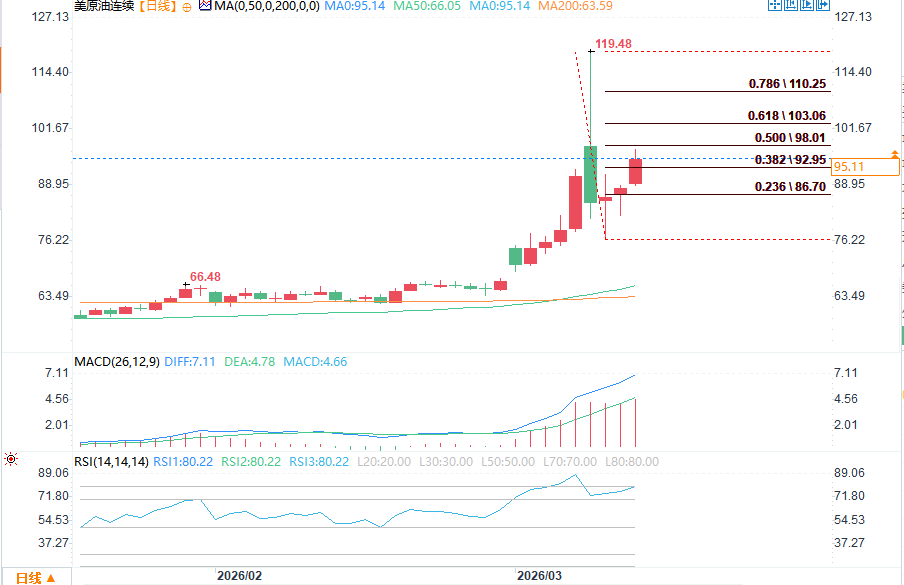
(WTI crude oil daily chart source: FX678)
From a technical perspective, WTI crude oil's short-term support level is firmly established around $92. It recently broke through $95 and even approached $97, fully reflecting the market's strong reaction to supply disruptions. If oil prices continue to trade at high levels, the main resistance zone is concentrated in the $98-$103 range. The key levels are: a break above $97 and a hold above $100 per barrel would further confirm the bullish trend; conversely, failure to break through effectively could lead to a technical correction, especially if there are any signs of easing geopolitical risks. Downside risk points to the $88-$81 area, but the current bullish trend is strong, and holding above $92 targets $102-$119.
Global economic and inflation risks
The dramatic fluctuations in oil prices have transcended the oil market itself, posing a systemic threat to the global economy and inflation. As the world's largest oil consumer and net exporter, the United States will directly experience increased domestic inflationary pressures due to high oil prices, raising consumption and production costs and impacting corporate profits and household spending. Although the EU has stated that there is no immediate direct supply crisis, the simultaneous surge in natural gas and diesel prices has increased global supply chain costs and significantly increased the risk of recession. Stock markets have already shown significant pressure (major indices such as the Dow Jones Industrial Average have fallen), and persistently high oil prices may force central banks worldwide to reassess their monetary policies, casting a shadow over the global economic growth outlook.
in conclusion
In the short term, bullish sentiment remains dominant in the crude oil market, with supply disruption concerns and geopolitical risks continuing to drive prices. The trend of oil prices breaking through $100/barrel and consolidating at high levels is relatively clear. Investors must closely monitor the progress of the Strait of Hormuz blockade, Trump's latest remarks, Iranian military movements, and any breakthroughs in diplomatic or naval escort operations, as these factors could trigger sharp price swings within hours. The crisis is still evolving rapidly; it is recommended to follow updates from mainstream media in real time and strictly manage position risk.
Frequently Asked Questions
Question 1: Why is the Strait of Hormuz so important?
Answer: The Strait of Hormuz is the most critical choke point for global oil trade, with approximately 21 million barrels of crude oil (accounting for 20% of global traffic) passing through it daily, mainly from Gulf oil-producing countries such as Saudi Arabia, Iraq, and the UAE. If it were to close, global supply would instantly decrease by 7-8 million barrels per day, far exceeding the impact of any single oil-producing country's production cuts. This is why the IEA calls it the "largest supply disruption in history."
Question 2: Why did the IEA's release of 400 million barrels of strategic reserves fail to lower oil prices?
Answer: Although the scale of the release is unprecedented, actual delivery will take several months (120 days in the US), only covering the gap from the three-week lockdown, and cannot immediately fill the real-time loss of millions of barrels per day. The market is trading on "present expectations," not supply months later, thus geopolitical risk premiums continue to push up prices.
Question 3: What direct impact will Mujtaba Khamenei's statement have on oil prices?
Answer: The statement clearly indicated that the Strait of Hormuz would continue to be closed, attacks would continue on targets in the Gulf, and the closure of US military bases would continue. This completely dispelled any illusions the market had about a quick settlement, directly triggering a surge in Brent crude oil prices above $100 and WTI crude oil prices nearing $97, reinforcing expectations of a "protracted economic war."
Question 4: What consequences will oil prices exceeding $100 have on the global economy?
Answer: Sustained high oil prices will push up costs across the entire industry chain, including transportation, chemicals, and agriculture, leading to a general rise in inflation. The United States, as the largest consumer, will be the most affected, potentially forcing the Federal Reserve to maintain high interest rates and suppress consumption and investment. Although the European Union is not facing a supply crisis in the short term, the risk of a global recession has increased significantly.
Question 5: How should ordinary investors respond in the current environment?
Answer: It is recommended to strictly control position size, prioritize real-time news (Hormuz developments, Trump's statements, attacks), consider going long on Brent futures or related ETFs, but set stop-loss protection; at the same time, diversify risk into gold or defensive stocks, and avoid excessive leverage.
Overall, the de facto blockade of the Strait of Hormuz has become the core variable, disrupting approximately 20% of global oil flows. The IEA has explicitly called it "the largest oil supply disruption in history." Oil prices experienced a rollercoaster ride this week, initially retreating from a high of nearly $120 due to Trump's comments that "the war will end soon," but now rebounding rapidly driven by Khamenei's statement and attacks on multiple oil tankers, highlighting the overwhelming power of geopolitical risk premiums.
Key market drivers
Supply disruption concerns are currently the most crucial bullish factor in the market. The Strait of Hormuz is practically at a standstill. The Iranian Revolutionary Guard has taken responsibility for the fires on two oil tankers in Iraqi ports and the drone attacks in the Gulf, forcing Gulf oil-producing countries (Iraq, Kuwait, and the UAE) to cut production or declare force majeure, rapidly saturating storage capacity. The limited effectiveness of strategic reserve releases further exacerbates anxiety: the IEA coordinated the release of approximately 400 million barrels of oil (with the US contributing nearly half), the largest release in history, but with a release period of several months (the US plans 120 days), equivalent to only a three-week supply gap. Analysts unanimously believe that unless the strait reopens, it cannot effectively lower oil prices. Trump's rhetoric continues to cause confusion and disrupt the market. He repeatedly emphasized that "the war has been won, but the job needs to be done," but offered no clear plan to reopen the strait or provide naval escort. The US Energy Secretary also stated that there are no plans to escort oil tankers. This mixed signal leaves traders bewildered. The hardline stance of Iran's new leadership has reinforced its long-term strategy of economic pressure: Mojtaba Khamenei has demanded that neighboring countries close US military bases, continue attacks on targets in the Gulf, and vowed revenge for the martyrs. Domestic security forces have been fully reinforced, the war has resulted in approximately 2,000 deaths, and there are currently no signs of reconciliation.
Oil Price Outlook
Bullish sentiment currently dominates the crude oil market. Both Brent and WTI crude have broken through the psychological barrier of $100 per barrel, and the market widely expects that if the Strait of Hormuz blockade continues, oil prices will test $120-150 per barrel or even higher. Institutions such as Macquarie have explicitly stated that if the blockade continues for 60 days, oil prices could surge to over $150; Goldman Sachs has also raised its price forecast for the fourth quarter of 2026, assuming low flow rates continue for 21-30 days. $100 has become a pain point for the global economy; sustained high levels will trigger a chain reaction of inflation and a contraction in consumption. The only hope for bears lies in an eventual diplomatic breakthrough or a large-scale influx of reserves, but the hardline stance of Iran's new leadership limits the downside potential in the short term.
WTI Crude Oil Technical Analysis
(WTI crude oil daily chart source: FX678)
From a technical perspective, WTI crude oil's short-term support level is firmly established around $92. It recently broke through $95 and even approached $97, fully reflecting the market's strong reaction to supply disruptions. If oil prices continue to trade at high levels, the main resistance zone is concentrated in the $98-$103 range. The key levels are: a break above $97 and a hold above $100 per barrel would further confirm the bullish trend; conversely, failure to break through effectively could lead to a technical correction, especially if there are any signs of easing geopolitical risks. Downside risk points to the $88-$81 area, but the current bullish trend is strong, and holding above $92 targets $102-$119.
Global economic and inflation risks
The dramatic fluctuations in oil prices have transcended the oil market itself, posing a systemic threat to the global economy and inflation. As the world's largest oil consumer and net exporter, the United States will directly experience increased domestic inflationary pressures due to high oil prices, raising consumption and production costs and impacting corporate profits and household spending. Although the EU has stated that there is no immediate direct supply crisis, the simultaneous surge in natural gas and diesel prices has increased global supply chain costs and significantly increased the risk of recession. Stock markets have already shown significant pressure (major indices such as the Dow Jones Industrial Average have fallen), and persistently high oil prices may force central banks worldwide to reassess their monetary policies, casting a shadow over the global economic growth outlook.
in conclusion
In the short term, bullish sentiment remains dominant in the crude oil market, with supply disruption concerns and geopolitical risks continuing to drive prices. The trend of oil prices breaking through $100/barrel and consolidating at high levels is relatively clear. Investors must closely monitor the progress of the Strait of Hormuz blockade, Trump's latest remarks, Iranian military movements, and any breakthroughs in diplomatic or naval escort operations, as these factors could trigger sharp price swings within hours. The crisis is still evolving rapidly; it is recommended to follow updates from mainstream media in real time and strictly manage position risk.
Frequently Asked Questions
Question 1: Why is the Strait of Hormuz so important?
Answer: The Strait of Hormuz is the most critical choke point for global oil trade, with approximately 21 million barrels of crude oil (accounting for 20% of global traffic) passing through it daily, mainly from Gulf oil-producing countries such as Saudi Arabia, Iraq, and the UAE. If it were to close, global supply would instantly decrease by 7-8 million barrels per day, far exceeding the impact of any single oil-producing country's production cuts. This is why the IEA calls it the "largest supply disruption in history."
Question 2: Why did the IEA's release of 400 million barrels of strategic reserves fail to lower oil prices?
Answer: Although the scale of the release is unprecedented, actual delivery will take several months (120 days in the US), only covering the gap from the three-week lockdown, and cannot immediately fill the real-time loss of millions of barrels per day. The market is trading on "present expectations," not supply months later, thus geopolitical risk premiums continue to push up prices.
Question 3: What direct impact will Mujtaba Khamenei's statement have on oil prices?
Answer: The statement clearly indicated that the Strait of Hormuz would continue to be closed, attacks would continue on targets in the Gulf, and the closure of US military bases would continue. This completely dispelled any illusions the market had about a quick settlement, directly triggering a surge in Brent crude oil prices above $100 and WTI crude oil prices nearing $97, reinforcing expectations of a "protracted economic war."
Question 4: What consequences will oil prices exceeding $100 have on the global economy?
Answer: Sustained high oil prices will push up costs across the entire industry chain, including transportation, chemicals, and agriculture, leading to a general rise in inflation. The United States, as the largest consumer, will be the most affected, potentially forcing the Federal Reserve to maintain high interest rates and suppress consumption and investment. Although the European Union is not facing a supply crisis in the short term, the risk of a global recession has increased significantly.
Question 5: How should ordinary investors respond in the current environment?
Answer: It is recommended to strictly control position size, prioritize real-time news (Hormuz developments, Trump's statements, attacks), consider going long on Brent futures or related ETFs, but set stop-loss protection; at the same time, diversify risk into gold or defensive stocks, and avoid excessive leverage.
- Risk Warning and Disclaimer
- The market involves risk, and trading may not be suitable for all investors. This article is for reference only and does not constitute personal investment advice, nor does it take into account certain users’ specific investment objectives, financial situation, or other needs. Any investment decisions made based on this information are at your own risk.