The probability of a Reserve Bank of Australia (RBA) rate hike on Tuesday surged to 75%, raising the cash rate to 4.1%. Nick Steiner warned that the conflict with Iran could push inflation close to 5%.
2026-03-16 09:45:56
According to APP, the Reserve Bank of Australia (RBA) will hold its second interest rate meeting this week. Existing inflationary pressures in the country have been further exacerbated by soaring energy prices triggered by the conflict with Iran . The latest official data shows that the Consumer Price Index (CPI) rose 3.8% year-on-year in January 2026, still significantly above the target range of 2-3%. Economists generally expect the RBA to raise interest rates on Tuesday to 4.1% in response to the potential for rising oil prices to push up inflation. Current money market pricing indicates a 75% probability of a rate hike in March and anticipates further tightening of policy.

Bank of America economist Nick Steiner recently stated explicitly on the topic: "The Iranian conflict poses a significant upside risk to inflation, and we expect overall inflation to approach 5%." He pointed out that given current price pressures and continued tightness in the labor market, the central bank has "virtually no room for maneuver." If interest rates are not raised in March, "it could lead to more drastic tightening later, as high inflation will persist longer and affect public expectations."
The core of this shock lies in the energy price transmission mechanism. Although Australia is a net energy exporter, it is highly dependent on imports for refined petroleum products such as gasoline. With Brent crude oil prices exceeding $100 per barrel and domestic retail fuel prices climbing to over AU$2.3 per liter, this directly pushes up transportation and logistics costs, subsequently spreading to a wide range of sectors including food and manufacturing. The latest core inflation (excluding volatility) has risen to 3.4%, a 16-month high. Strong price stickiness in services and a tight labor market further amplify the risk of a wage-price spiral. The Reserve Bank of Australia previously raised interest rates from 3.60% to 3.85% in February; a further 25 basis point increase would strengthen the inflation anchor and prevent expectations from deviating from it.
Unlike simple cyclical inflation, this round of pressure, compounded by geopolitical factors, is a "supply shock" type of upward movement. Historical experience shows that, similar to the oil price crisis of the 2000s, if central banks hesitate to raise interest rates, even more significant tightening is needed afterward to stabilize expectations. If timely action is taken this time, the peak inflation rate can be controlled at around 4.5%; conversely, if it is delayed until May, overall inflation may approach 5%, further eroding residents' real income and corporate financing costs.
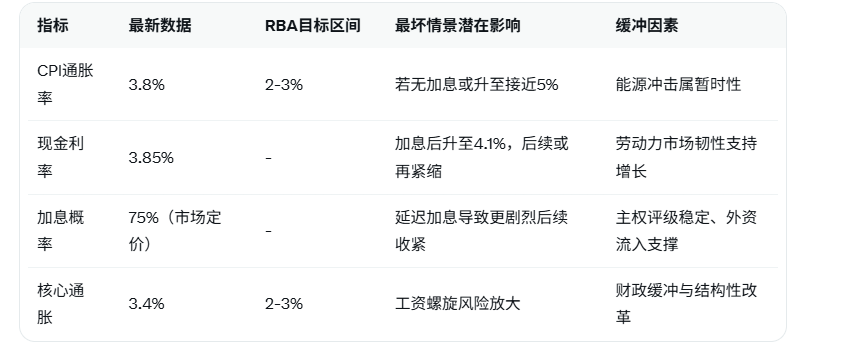
The following is a comparison of the latest data for key indicators with policy scenarios (based on official statistics and market consensus):
Nick Steiner's analysis further emphasizes that the Fed's decisions must take into account the principle of "evolutionary assessment": current inflation has exceeded the target for several consecutive months, coupled with oil price uncertainty, any delay could amplify public expectations of adapting to high prices. While the Australian economy is resilient (strong employment, diversified exports), the high-interest-rate environment will test the cash flow of mortgage holders and SMEs, potentially suppressing short-term consumption and investment.
Overall, the Reserve Bank of Australia's (RBA) meeting has become a global focus. While the timely interest rate hike will bring some pain, it effectively anchors inflation expectations and paves the way for subsequent economic growth. Investors and residents should closely monitor the meeting statement and quarterly inflation forecasts to assess borrowing costs and adjust asset allocation accordingly.
Frequently Asked Questions
1. Why would the conflict with Iran directly drive up inflation in Australia?
The conflict disrupted shipping in the Strait of Hormuz, causing global Brent crude oil prices to surpass $100 per barrel. This led to a surge in imported gasoline costs in Australia, with retail prices exceeding AU$2.3 per liter. This not only directly increased the transportation-related CPI component but also pushed up costs in food, retail, and manufacturing through the logistics chain, resulting in a broader price increase. Unlike purely domestic factors, this is an external supply shock, and even if energy prices subsequently decline, the initial impact will likely continue for several months.
2. What does it mean that the Reserve Bank of Australia has raised its cash rate from 3.85% to 4.1%?
This is equivalent to a 25 basis point tightening, which will further increase benchmark borrowing costs, raising average monthly mortgage payments by approximately AUD 50-80 (depending on loan amount), while also suppressing business investment and consumer demand. The Fed aims to cool demand and prevent the 3.8% inflation rate from spiraling out of control. The market has quickly adjusted from a 30% probability to 75%, reflecting an increased consensus among institutions regarding oil price risks.
3. What will happen if interest rates are not raised in March?
Nick Steiner warns that high inflation will embed itself in public expectations, causing wage negotiations and price settings to rise in tandem, creating a self-reinforcing cycle. At that point, the Fed may need to raise interest rates by more than 50 basis points in a single instance, either in May or later, causing greater economic volatility. Historical data shows that countries that hesitate to respond to supply shocks often face longer recovery periods.
4. How does a tight labor market amplify this risk?
Australia's unemployment rate remains low, with job vacancies still high, leaving businesses facing recruitment difficulties and upward pressure on wages. As oil prices push up the cost of living, union wage demands will intensify, creating a wage-price spiral. If the Reserve Bank does not tighten monetary policy in time, core inflation (already at 3.4%) could easily exceed 4%, far surpassing the 2-3% target, forcing more aggressive policy measures in the future.
Bank of America economist Nick Steiner recently stated explicitly on the topic: "The Iranian conflict poses a significant upside risk to inflation, and we expect overall inflation to approach 5%." He pointed out that given current price pressures and continued tightness in the labor market, the central bank has "virtually no room for maneuver." If interest rates are not raised in March, "it could lead to more drastic tightening later, as high inflation will persist longer and affect public expectations."
The core of this shock lies in the energy price transmission mechanism. Although Australia is a net energy exporter, it is highly dependent on imports for refined petroleum products such as gasoline. With Brent crude oil prices exceeding $100 per barrel and domestic retail fuel prices climbing to over AU$2.3 per liter, this directly pushes up transportation and logistics costs, subsequently spreading to a wide range of sectors including food and manufacturing. The latest core inflation (excluding volatility) has risen to 3.4%, a 16-month high. Strong price stickiness in services and a tight labor market further amplify the risk of a wage-price spiral. The Reserve Bank of Australia previously raised interest rates from 3.60% to 3.85% in February; a further 25 basis point increase would strengthen the inflation anchor and prevent expectations from deviating from it.
Unlike simple cyclical inflation, this round of pressure, compounded by geopolitical factors, is a "supply shock" type of upward movement. Historical experience shows that, similar to the oil price crisis of the 2000s, if central banks hesitate to raise interest rates, even more significant tightening is needed afterward to stabilize expectations. If timely action is taken this time, the peak inflation rate can be controlled at around 4.5%; conversely, if it is delayed until May, overall inflation may approach 5%, further eroding residents' real income and corporate financing costs.
The following is a comparison of the latest data for key indicators with policy scenarios (based on official statistics and market consensus):
Nick Steiner's analysis further emphasizes that the Fed's decisions must take into account the principle of "evolutionary assessment": current inflation has exceeded the target for several consecutive months, coupled with oil price uncertainty, any delay could amplify public expectations of adapting to high prices. While the Australian economy is resilient (strong employment, diversified exports), the high-interest-rate environment will test the cash flow of mortgage holders and SMEs, potentially suppressing short-term consumption and investment.
Overall, the Reserve Bank of Australia's (RBA) meeting has become a global focus. While the timely interest rate hike will bring some pain, it effectively anchors inflation expectations and paves the way for subsequent economic growth. Investors and residents should closely monitor the meeting statement and quarterly inflation forecasts to assess borrowing costs and adjust asset allocation accordingly.
Frequently Asked Questions
1. Why would the conflict with Iran directly drive up inflation in Australia?
The conflict disrupted shipping in the Strait of Hormuz, causing global Brent crude oil prices to surpass $100 per barrel. This led to a surge in imported gasoline costs in Australia, with retail prices exceeding AU$2.3 per liter. This not only directly increased the transportation-related CPI component but also pushed up costs in food, retail, and manufacturing through the logistics chain, resulting in a broader price increase. Unlike purely domestic factors, this is an external supply shock, and even if energy prices subsequently decline, the initial impact will likely continue for several months.
2. What does it mean that the Reserve Bank of Australia has raised its cash rate from 3.85% to 4.1%?
This is equivalent to a 25 basis point tightening, which will further increase benchmark borrowing costs, raising average monthly mortgage payments by approximately AUD 50-80 (depending on loan amount), while also suppressing business investment and consumer demand. The Fed aims to cool demand and prevent the 3.8% inflation rate from spiraling out of control. The market has quickly adjusted from a 30% probability to 75%, reflecting an increased consensus among institutions regarding oil price risks.
3. What will happen if interest rates are not raised in March?
Nick Steiner warns that high inflation will embed itself in public expectations, causing wage negotiations and price settings to rise in tandem, creating a self-reinforcing cycle. At that point, the Fed may need to raise interest rates by more than 50 basis points in a single instance, either in May or later, causing greater economic volatility. Historical data shows that countries that hesitate to respond to supply shocks often face longer recovery periods.
4. How does a tight labor market amplify this risk?
Australia's unemployment rate remains low, with job vacancies still high, leaving businesses facing recruitment difficulties and upward pressure on wages. As oil prices push up the cost of living, union wage demands will intensify, creating a wage-price spiral. If the Reserve Bank does not tighten monetary policy in time, core inflation (already at 3.4%) could easily exceed 4%, far surpassing the 2-3% target, forcing more aggressive policy measures in the future.
- Risk Warning and Disclaimer
- The market involves risk, and trading may not be suitable for all investors. This article is for reference only and does not constitute personal investment advice, nor does it take into account certain users’ specific investment objectives, financial situation, or other needs. Any investment decisions made based on this information are at your own risk.