Oil prices surged to $103, erasing all gains in US Treasury bonds this year; amid stagflation concerns, caution is advised to guard against continued downward pressure on yields.
2026-03-16 10:57:01
According to APP, the U.S. Treasury market has erased all of its year-to-date gains as soaring oil prices fuel investor concerns about inflation and economic growth risks. A leading indicator of U.S. Treasury performance has turned negative year-to-date after falling 1.7% since the end of February. Stagflation fears have pushed up yields, forcing Wall Street to lower its expectations for U.S. interest rate cuts over the next year. Morgan Stanley strategist Bradley Tian and others recently commented on the topic, stating, "Energy-driven inflation and policy uncertainty continue to put pressure on long-term U.S. Treasuries."
Bonds in the US, Japan, and Australia all fell, and a global bond index erased its year-to-date gains. Bob Savage, head of macro strategy at BNY Mellon, recently emphasized, "Geopolitical uncertainty and increased cross-asset volatility are likely to persist in the short term until markets gain confidence that the geopolitical conflict with Iran is stabilizing."

The core of this shock lies in the direct transmission of oil prices to inflation expectations. Latest data shows that Brent crude oil prices have broken through $103 per barrel, and disruptions to shipping in the Strait of Hormuz have led to supply shortages, directly increasing costs in energy, logistics, and manufacturing. The bond market is highly sensitive to stagflation risks: rising inflation pushes up nominal yields, while concerns about slowing economic growth limit real growth, creating a double squeeze. Bond prices and yields have an inverse relationship; the 10-year US Treasury yield recently climbed to approximately 4.27%, causing long-term bond prices to fall rapidly, erasing previously accumulated positive returns.
Unlike simple cyclical fluctuations, this round of upward pressure, compounded by geopolitical factors, is a typical supply-shock type. Wall Street institutions have lowered their expectations for interest rate cuts, shifting to a more cautious assessment of interest rate paths. The global bond market has shown a significant interconnected effect: as the benchmark market, the rapid rise in US yields has spilled over to Japanese government bonds (affected by the yen's exchange rate) and Australian bonds (due to energy import cost pressures), causing the global bond index's YTD performance to turn flat or even negative.
The following is a comparison of the latest performance of major bond markets under the current geopolitical shocks (based on authoritative indices and real-time market data):
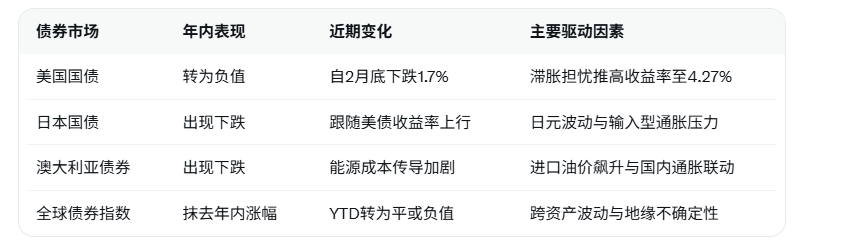
Bradley Tian's analysis further points out that policy uncertainty amplifies volatility: central banks face a difficult balance between inflation and growth, and any delay in response could exacerbate market turmoil. Bob Savage emphasizes that as long as geopolitical confidence remains unstable in the short term, bond volatility will remain high, and investors need to be wary of cross-asset contagion risks.
Overall, this oil price-driven reversal in the bond market highlights the vulnerability of global fixed-income assets to energy supply security. While rising yields offer depositors higher coupon opportunities, capital losses have already offset previous gains, and institutions are accelerating adjustments to their duration and allocation strategies.
Editor's Summary : The stagflation expectations triggered by oil prices breaking through $100 have completely reversed the optimism in the bond market at the beginning of the year, with US and global bond indices collectively weakening. Continued pressure on yields reflects the market's dual concerns about sticky inflation and slowing growth, while policy uncertainty further amplifies volatility. In the short term, geopolitical stability signals will be a key turning point; investors need to pay attention to changes in the yield curve and communication with central banks to dynamically balance risk exposure and return opportunities.
Frequently Asked Questions
1. Why did the surge in oil prices wipe out the year-to-date gains in US Treasury bonds?
Oil prices breaking through $103 led to a broad increase in energy costs, pushing up inflation expectations and prompting investors to demand higher yields to compensate for the risks. Bond prices and yields moved inversely, with the 10-year US Treasury yield rising to around 4.27%, directly triggering a price decline. The 1.7% drop since the end of February has completely offset the positive returns at the beginning of the year, resulting in a negative performance for the year.
2. What are stagflation concerns, and what are their specific impacts on the bond market?
Stagflation refers to high inflation accompanied by slowing economic growth. Energy supply shocks simultaneously raise prices and suppress demand, putting central banks in a dilemma: raising interest rates to control inflation would further suppress growth, while not raising rates would lead to uncontrolled inflation expectations. The bond market is therefore under pressure, with rising long-term bond yields accelerating capital losses, and global indices weakening in tandem.
3. What is the core of Morgan Stanley's Bradley Tian's warning?
Bradley Tian points out that energy-driven inflation, coupled with policy uncertainty, is putting continued pressure on long-term US Treasury bonds. Wall Street has therefore lowered its expectations for rate cuts over the next year, shifting to a more hawkish assessment, emphasizing that if geopolitical risks do not ease, yields will remain high, and bond allocation should be approached with caution.
4. Why did Japanese and Australian bonds also fall in tandem?
Japanese government bonds were affected by the spillover of US Treasury yields and yen volatility, while Australian domestic inflation was driven up by soaring energy import costs. Global bond indices, serving as an overall benchmark, have erased their year-to-date gains, reflecting cross-market linkages: the US, as a pricing anchor, saw its fluctuations rapidly transmitted to bonds in other developed markets.
Bonds in the US, Japan, and Australia all fell, and a global bond index erased its year-to-date gains. Bob Savage, head of macro strategy at BNY Mellon, recently emphasized, "Geopolitical uncertainty and increased cross-asset volatility are likely to persist in the short term until markets gain confidence that the geopolitical conflict with Iran is stabilizing."
The core of this shock lies in the direct transmission of oil prices to inflation expectations. Latest data shows that Brent crude oil prices have broken through $103 per barrel, and disruptions to shipping in the Strait of Hormuz have led to supply shortages, directly increasing costs in energy, logistics, and manufacturing. The bond market is highly sensitive to stagflation risks: rising inflation pushes up nominal yields, while concerns about slowing economic growth limit real growth, creating a double squeeze. Bond prices and yields have an inverse relationship; the 10-year US Treasury yield recently climbed to approximately 4.27%, causing long-term bond prices to fall rapidly, erasing previously accumulated positive returns.
Unlike simple cyclical fluctuations, this round of upward pressure, compounded by geopolitical factors, is a typical supply-shock type. Wall Street institutions have lowered their expectations for interest rate cuts, shifting to a more cautious assessment of interest rate paths. The global bond market has shown a significant interconnected effect: as the benchmark market, the rapid rise in US yields has spilled over to Japanese government bonds (affected by the yen's exchange rate) and Australian bonds (due to energy import cost pressures), causing the global bond index's YTD performance to turn flat or even negative.
The following is a comparison of the latest performance of major bond markets under the current geopolitical shocks (based on authoritative indices and real-time market data):
Bradley Tian's analysis further points out that policy uncertainty amplifies volatility: central banks face a difficult balance between inflation and growth, and any delay in response could exacerbate market turmoil. Bob Savage emphasizes that as long as geopolitical confidence remains unstable in the short term, bond volatility will remain high, and investors need to be wary of cross-asset contagion risks.
Overall, this oil price-driven reversal in the bond market highlights the vulnerability of global fixed-income assets to energy supply security. While rising yields offer depositors higher coupon opportunities, capital losses have already offset previous gains, and institutions are accelerating adjustments to their duration and allocation strategies.
Editor's Summary : The stagflation expectations triggered by oil prices breaking through $100 have completely reversed the optimism in the bond market at the beginning of the year, with US and global bond indices collectively weakening. Continued pressure on yields reflects the market's dual concerns about sticky inflation and slowing growth, while policy uncertainty further amplifies volatility. In the short term, geopolitical stability signals will be a key turning point; investors need to pay attention to changes in the yield curve and communication with central banks to dynamically balance risk exposure and return opportunities.
Frequently Asked Questions
1. Why did the surge in oil prices wipe out the year-to-date gains in US Treasury bonds?
Oil prices breaking through $103 led to a broad increase in energy costs, pushing up inflation expectations and prompting investors to demand higher yields to compensate for the risks. Bond prices and yields moved inversely, with the 10-year US Treasury yield rising to around 4.27%, directly triggering a price decline. The 1.7% drop since the end of February has completely offset the positive returns at the beginning of the year, resulting in a negative performance for the year.
2. What are stagflation concerns, and what are their specific impacts on the bond market?
Stagflation refers to high inflation accompanied by slowing economic growth. Energy supply shocks simultaneously raise prices and suppress demand, putting central banks in a dilemma: raising interest rates to control inflation would further suppress growth, while not raising rates would lead to uncontrolled inflation expectations. The bond market is therefore under pressure, with rising long-term bond yields accelerating capital losses, and global indices weakening in tandem.
3. What is the core of Morgan Stanley's Bradley Tian's warning?
Bradley Tian points out that energy-driven inflation, coupled with policy uncertainty, is putting continued pressure on long-term US Treasury bonds. Wall Street has therefore lowered its expectations for rate cuts over the next year, shifting to a more hawkish assessment, emphasizing that if geopolitical risks do not ease, yields will remain high, and bond allocation should be approached with caution.
4. Why did Japanese and Australian bonds also fall in tandem?
Japanese government bonds were affected by the spillover of US Treasury yields and yen volatility, while Australian domestic inflation was driven up by soaring energy import costs. Global bond indices, serving as an overall benchmark, have erased their year-to-date gains, reflecting cross-market linkages: the US, as a pricing anchor, saw its fluctuations rapidly transmitted to bonds in other developed markets.
- Risk Warning and Disclaimer
- The market involves risk, and trading may not be suitable for all investors. This article is for reference only and does not constitute personal investment advice, nor does it take into account certain users’ specific investment objectives, financial situation, or other needs. Any investment decisions made based on this information are at your own risk.