High oil prices are killing Trump’s re-election dream, and voters are angrily asking: Who is the war really for?
2026-03-16 11:32:47
More than two weeks have passed since Trump launched military action against Iran, and voter sentiment in northern Kentucky, a traditional Republican stronghold, is clearly divided. Many voters who were once staunch Trump supporters are beginning to worry: Is the war distracting the government from core domestic issues such as inflation, jobs, and immigration? Rapidly rising oil prices and a weak job market are the most direct sources of fear for the local population.
A local nurse who voted for Trump in 2024 said in an interview, "Rising oil prices and weak employment terrify me." She said she had hoped that Trump's second term would focus on the domestic economy and people's livelihoods, but now war spending, energy crisis, and inflation have increased the pressure on ordinary families.
Similar sentiments have been echoed in several towns and counties in northern Kentucky, with many voters beginning to question: "Who is this war really for?"
The latest poll shows that about 84% of Republicans as a whole still support Trump’s handling of the Iran issue; however, among non-MAGA (non-MAGA) Republican voters, support has plummeted to 54%.
This rift indicates that while Trump's core supporters remain highly united, there has been a noticeable wavering among fringe Republican voters (moderates, suburban voters, and those prioritizing the economy) . High oil prices and the uncertainty surrounding war are becoming invisible killers eroding his support in his home base.
Last week, Trump personally traveled to northern Kentucky to campaign for the removal of Republican Representative Thomas Massie, who has expressed dissent on Iran. Massie is one of the few Republicans in Congress who has publicly questioned the necessity and cost of military action against Iran.
This Republican primary, scheduled for May 19, has been seen as a "referendum" on Trump and his war decisions. If Massey is defeated in the primary, it will strengthen Trump's control over dissent within the party; if Massey wins, it will show that the rift within Trump's home base is quite serious.
Since the outbreak of the war, the average price of gasoline across the United States has risen by 23% to approximately $3.68 per gallon, with most gas stations in northern Kentucky seeing increases of more than 50 cents. Experts point out that the market premium caused by the disruption of shipping through the Strait of Hormuz has quickly been transmitted to the end-retail end. Prices of diesel, aviation fuel, and heating oil have also soared, directly driving up the cost of living and logistics costs.
Local voters generally reflected: "It used to cost more than $40 to fill up a tank of gas, but now it costs more than $60, which is not a small amount."
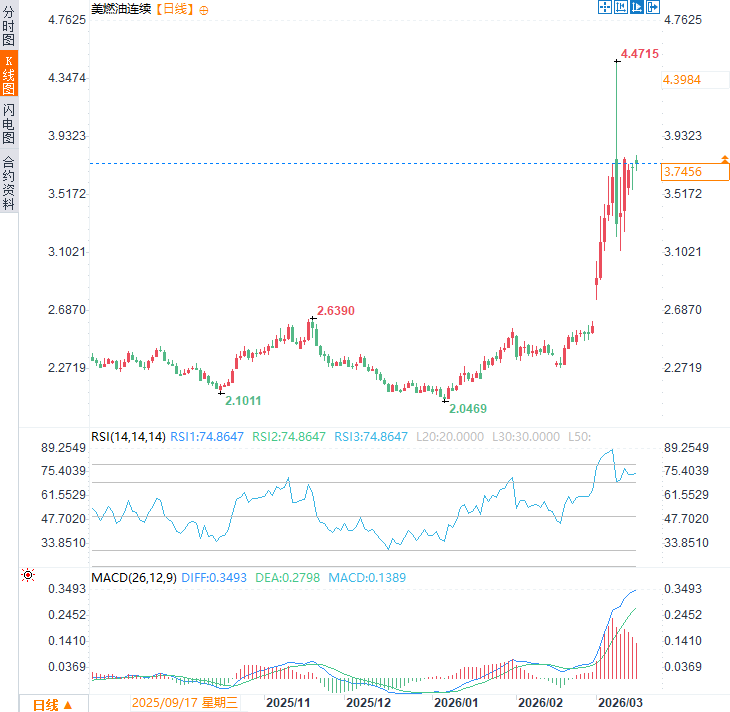
(US fuel oil daily chart, source: FX678)
Economists point out that the real threat of war to Republican voters is not just oil prices themselves, but the “economic anxiety” it triggers—a significant decrease in consumers’ willingness to make large, long-term investments (home purchases, car purchases, education).
One voter who voted for Trump in 2016 bluntly stated, "I don't see any benefit this war brings to ordinary American citizens." This sentiment is particularly prevalent among voters in swing districts and suburban areas, and is becoming an invisible force eroding Trump's support base.
Two weeks after Trump's military action against Iran, a clear rift has emerged in northern Kentucky, a Republican stronghold. Voters are worried that the war will distract them from domestic issues, with high oil prices and weak employment being the biggest sources of anxiety.
Polls show that 84% of Republicans overall support Trump's handling of the situation, but only 54% of non-MAGA voters support it. Trump personally traveled to the area to campaign for the recall of dissident Congressman Massey, making the May 19 primary a crucial "referendum."
The average price of gasoline across the United States rose 23% to $3.68, with local increases exceeding 50 cents. Economists warn that the greatest threat of war lies in the "economic anxiety" it triggers, rather than simply rising oil prices. Decreased consumer willingness to make large investments is becoming an invisible force eroding Trump's support base. Ahead of the midterm elections, Republican unity and voter confidence face a severe test.
At 11:32 Beijing time, US fuel oil futures were quoted at $3.75 per gallon.
Voters openly expressed their fear, with oil prices and employment being their biggest anxieties.
A local nurse who voted for Trump in 2024 said in an interview, "Rising oil prices and weak employment terrify me." She said she had hoped that Trump's second term would focus on the domestic economy and people's livelihoods, but now war spending, energy crisis, and inflation have increased the pressure on ordinary families.
Similar sentiments have been echoed in several towns and counties in northern Kentucky, with many voters beginning to question: "Who is this war really for?"
84% of Republicans support Trump, but only 54% of non-MAGA voters do.
The latest poll shows that about 84% of Republicans as a whole still support Trump’s handling of the Iran issue; however, among non-MAGA (non-MAGA) Republican voters, support has plummeted to 54%.
This rift indicates that while Trump's core supporters remain highly united, there has been a noticeable wavering among fringe Republican voters (moderates, suburban voters, and those prioritizing the economy) . High oil prices and the uncertainty surrounding war are becoming invisible killers eroding his support in his home base.
Trump personally traveled to the area to campaign for the recall of dissident Congressman Massey; the May 19 primary will be a crucial test.
Last week, Trump personally traveled to northern Kentucky to campaign for the removal of Republican Representative Thomas Massie, who has expressed dissent on Iran. Massie is one of the few Republicans in Congress who has publicly questioned the necessity and cost of military action against Iran.
This Republican primary, scheduled for May 19, has been seen as a "referendum" on Trump and his war decisions. If Massey is defeated in the primary, it will strengthen Trump's control over dissent within the party; if Massey wins, it will show that the rift within Trump's home base is quite serious.
The average price of gasoline rose 23% to $3.68, with a local increase of over 50 cents.
Since the outbreak of the war, the average price of gasoline across the United States has risen by 23% to approximately $3.68 per gallon, with most gas stations in northern Kentucky seeing increases of more than 50 cents. Experts point out that the market premium caused by the disruption of shipping through the Strait of Hormuz has quickly been transmitted to the end-retail end. Prices of diesel, aviation fuel, and heating oil have also soared, directly driving up the cost of living and logistics costs.
Local voters generally reflected: "It used to cost more than $40 to fill up a tank of gas, but now it costs more than $60, which is not a small amount."
(US fuel oil daily chart, source: FX678)
Economists say the biggest threat of war is economic anxiety, not just oil prices.
Economists point out that the real threat of war to Republican voters is not just oil prices themselves, but the “economic anxiety” it triggers—a significant decrease in consumers’ willingness to make large, long-term investments (home purchases, car purchases, education).
One voter who voted for Trump in 2016 bluntly stated, "I don't see any benefit this war brings to ordinary American citizens." This sentiment is particularly prevalent among voters in swing districts and suburban areas, and is becoming an invisible force eroding Trump's support base.
Editor's Summary
Two weeks after Trump's military action against Iran, a clear rift has emerged in northern Kentucky, a Republican stronghold. Voters are worried that the war will distract them from domestic issues, with high oil prices and weak employment being the biggest sources of anxiety.
Polls show that 84% of Republicans overall support Trump's handling of the situation, but only 54% of non-MAGA voters support it. Trump personally traveled to the area to campaign for the recall of dissident Congressman Massey, making the May 19 primary a crucial "referendum."
The average price of gasoline across the United States rose 23% to $3.68, with local increases exceeding 50 cents. Economists warn that the greatest threat of war lies in the "economic anxiety" it triggers, rather than simply rising oil prices. Decreased consumer willingness to make large investments is becoming an invisible force eroding Trump's support base. Ahead of the midterm elections, Republican unity and voter confidence face a severe test.
At 11:32 Beijing time, US fuel oil futures were quoted at $3.75 per gallon.
- Risk Warning and Disclaimer
- The market involves risk, and trading may not be suitable for all investors. This article is for reference only and does not constitute personal investment advice, nor does it take into account certain users’ specific investment objectives, financial situation, or other needs. Any investment decisions made based on this information are at your own risk.