"End in a few weeks"? Iran delivers a wake-up call: Refusal to negotiate! And oil prices refuse to fall?
2026-03-16 10:21:23
U.S. officials publicly predicted last Sunday (March 15) that the U.S.-Israel war against Iran would end within weeks, followed by a drop in energy costs. However, Iran responded strongly, stating that it remains "stable and strong" and refusing any negotiations with the United States. The Iranian Foreign Minister clearly stated, "We have never asked for a ceasefire, nor have we ever asked for negotiations."
The contrasting statements from both sides highlight the current stalemate on the battlefield and in diplomacy. Oil prices continue to fluctuate at high levels, further amplifying global inflationary and economic pressures. On Monday (March 16) during Asian trading hours, US crude oil prices fluctuated around $98.75 per barrel.

U.S. Energy Secretary Chris Wright stated, "This conflict will certainly be over in the coming weeks—or even sooner." He emphasized that once the military operation achieves its objectives and supplies to the Strait of Hormuz are restored, oil prices will subsequently fall.
Trump had previously claimed on multiple occasions that the war was "very close to being over," attempting to alleviate domestic pressures from high oil prices, inflation, and anti-war sentiment through optimistic signals. However, market confidence in the expectation of the war ending in "weeks" remained weak, and oil prices continued to fluctuate at high levels.
Iran responded strongly to the optimistic predictions from the United States, with newly appointed Supreme Leader Mojtaba Khamenei and the Foreign Minister both stating that Iran "can outlast its enemies" and refusing any negotiations.
Iran insists its regime is stable and its military capabilities have not been fundamentally weakened, its Revolutionary Guard remains active, and its proxy networks continue to retaliate.
The Iranian Foreign Minister emphasized, "We have never sought a ceasefire, nor have we ever asked for negotiations." This statement indicates that Iran has no intention of making a short-term compromise and intends to delay US and Israeli actions through a protracted war of attrition.
Despite signals from the US indicating an end to the conflict, fighting continues. Iran's Revolutionary Guard claimed on Sunday that it had launched more missiles at Israel and three US military bases in the region.
Trump threatened over the weekend to launch more strikes against Kharg Island, Iran’s main oil export hub, saying, “We might strike a few more times, just for fun.”
The Strait of Hormuz remains effectively closed, global oil supplies continue to be disrupted, and panic in the energy market has not subsided.
The Trump administration plans to announce as early as this week the formation of a multinational coalition to escort ships transiting the Strait of Hormuz. However, discussions are still ongoing regarding whether these operations will begin before or after hostilities have ended.
Trump previously stated that the U.S. Navy would begin escorting ships "soon," but a specific timeline remains unclear. The Pentagon assesses that a large-scale escort operation is too risky under the current circumstances and could trigger a larger-scale Iranian retaliation.
Israel and Lebanon are expected to hold ceasefire talks in the coming days, with Hezbollah required to disarm. Two Israeli officials revealed that the talks, aimed at reaching a ceasefire agreement, require the Iranian-backed Hezbollah to disarm. Successful negotiations could ease pressure on the northern border, but given the active network of Iranian proxies and Hezbollah's hardline stance, reaching an agreement in the short term is extremely difficult.
The International Energy Agency (IEA) stated that its emergency oil reserves will soon flow into the global market, with member countries pledging 411.9 million barrels of oil. This exceeds the 182 million barrels released during the 2022 Russia-Ukraine conflict, marking the largest reserve release in IEA history. While Trump called on countries like France and Japan to work together to reopen shipping lanes, logistical delays and ongoing threats from Iran have raised market doubts about the actual effectiveness of the release.
The optimistic signals from the US that the conflict will "end in a few weeks" contradict the reality on the battlefield: Iran refuses to negotiate, the Revolutionary Guard continues to retaliate, proxies are active, and the disruption in the Taiwan Strait has not been restored.
While Trump's threats to retake Kharg Island and form a maritime coalition demonstrate his resolve, Iran's resilience has exceeded expectations, making a short-term ceasefire unlikely.
Oil prices continue to fluctuate at high levels, further amplifying global inflationary and economic pressures. Investors should be wary of potential reversals triggered by unforeseen battlefield events, and pay close attention to the progress of the Israel-Lebanon negotiations, the formation of the escort coalition, and the actual implementation of the IEA's reserve releases.
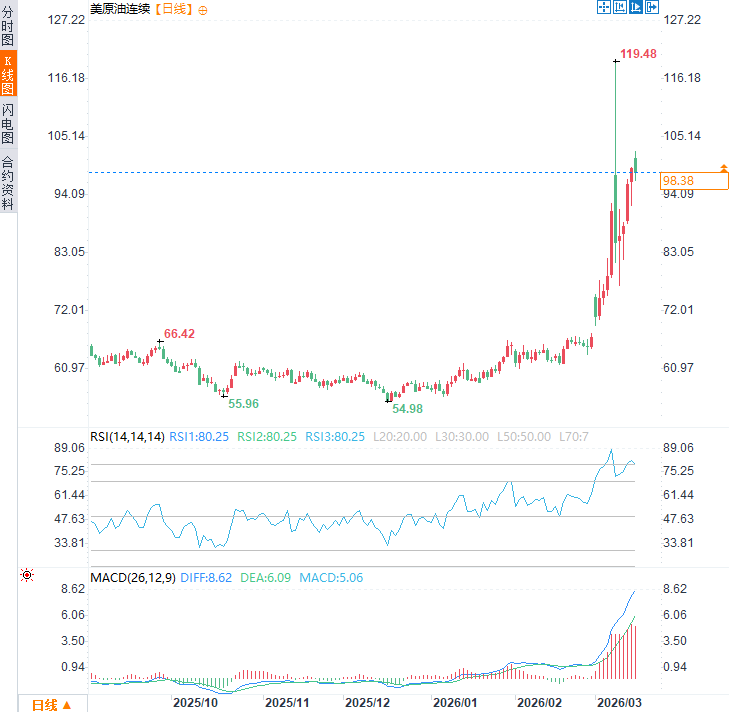
(US crude oil daily chart, source: FX678)
U.S. officials predict the war between the U.S. and Israel and Iran will end within weeks, after which energy costs will fall. Energy Secretary Wright stated that "the conflict will definitely end in the coming weeks—or even sooner." However, Iran has responded strongly, claiming it is "more resilient than its enemies" and refusing any negotiations or ceasefire.
Newly appointed Supreme Leader Mojtaba Khamenei warned of the closure of US military bases, and the Revolutionary Guard launched another missile, escalating the conflict. Trump threatened to attack Kharg Island's oil infrastructure again and planned to form a multinational maritime coalition. Israel and Lebanon are expected to hold ceasefire talks in the coming days, with Israel demanding Hezbollah disarm. The IEA pledged 411.9 million barrels of emergency reserves to be released into the market soon.
Short-term optimistic signals from the US clearly contradict the realities of the battlefield, leaving oil price trends highly uncertain. Investors need to be wary of a new round of supply shocks triggered by escalating Iranian retaliation, and pay attention to the progress of the Israel-Lebanon negotiations, the maritime coalition, and the effectiveness of the IEA's reserve releases.
At 10:21 Beijing time, US crude oil futures were trading at $98.72 per barrel.
The contrasting statements from both sides highlight the current stalemate on the battlefield and in diplomacy. Oil prices continue to fluctuate at high levels, further amplifying global inflationary and economic pressures. On Monday (March 16) during Asian trading hours, US crude oil prices fluctuated around $98.75 per barrel.
US Energy Secretary: Conflict to end within weeks
U.S. Energy Secretary Chris Wright stated, "This conflict will certainly be over in the coming weeks—or even sooner." He emphasized that once the military operation achieves its objectives and supplies to the Strait of Hormuz are restored, oil prices will subsequently fall.
Trump had previously claimed on multiple occasions that the war was "very close to being over," attempting to alleviate domestic pressures from high oil prices, inflation, and anti-war sentiment through optimistic signals. However, market confidence in the expectation of the war ending in "weeks" remained weak, and oil prices continued to fluctuate at high levels.
Iran insists on its stability and strength, stating that it can outlast its enemies.
Iran responded strongly to the optimistic predictions from the United States, with newly appointed Supreme Leader Mojtaba Khamenei and the Foreign Minister both stating that Iran "can outlast its enemies" and refusing any negotiations.
Iran insists its regime is stable and its military capabilities have not been fundamentally weakened, its Revolutionary Guard remains active, and its proxy networks continue to retaliate.
The Iranian Foreign Minister emphasized, "We have never sought a ceasefire, nor have we ever asked for negotiations." This statement indicates that Iran has no intention of making a short-term compromise and intends to delay US and Israeli actions through a protracted war of attrition.
Iranian Revolutionary Guard launches missiles again; Trump threatens to attack Kharg Island again.
Despite signals from the US indicating an end to the conflict, fighting continues. Iran's Revolutionary Guard claimed on Sunday that it had launched more missiles at Israel and three US military bases in the region.
Trump threatened over the weekend to launch more strikes against Kharg Island, Iran’s main oil export hub, saying, “We might strike a few more times, just for fun.”
The Strait of Hormuz remains effectively closed, global oil supplies continue to be disrupted, and panic in the energy market has not subsided.
Trump plans to form a multinational maritime escort coalition, but the timing is unclear.
The Trump administration plans to announce as early as this week the formation of a multinational coalition to escort ships transiting the Strait of Hormuz. However, discussions are still ongoing regarding whether these operations will begin before or after hostilities have ended.
Trump previously stated that the U.S. Navy would begin escorting ships "soon," but a specific timeline remains unclear. The Pentagon assesses that a large-scale escort operation is too risky under the current circumstances and could trigger a larger-scale Iranian retaliation.
Israel and Lebanon are expected to hold ceasefire talks in the coming days, with Hezbollah required to disarm. Two Israeli officials revealed that the talks, aimed at reaching a ceasefire agreement, require the Iranian-backed Hezbollah to disarm. Successful negotiations could ease pressure on the northern border, but given the active network of Iranian proxies and Hezbollah's hardline stance, reaching an agreement in the short term is extremely difficult.
The International Energy Agency has pledged 411.9 million barrels of emergency reserves to be released into the market soon.
The International Energy Agency (IEA) stated that its emergency oil reserves will soon flow into the global market, with member countries pledging 411.9 million barrels of oil. This exceeds the 182 million barrels released during the 2022 Russia-Ukraine conflict, marking the largest reserve release in IEA history. While Trump called on countries like France and Japan to work together to reopen shipping lanes, logistical delays and ongoing threats from Iran have raised market doubts about the actual effectiveness of the release.
Short-term optimistic signals contradict the realities of the battlefield, leaving oil price trends highly uncertain.
The optimistic signals from the US that the conflict will "end in a few weeks" contradict the reality on the battlefield: Iran refuses to negotiate, the Revolutionary Guard continues to retaliate, proxies are active, and the disruption in the Taiwan Strait has not been restored.
While Trump's threats to retake Kharg Island and form a maritime coalition demonstrate his resolve, Iran's resilience has exceeded expectations, making a short-term ceasefire unlikely.
Oil prices continue to fluctuate at high levels, further amplifying global inflationary and economic pressures. Investors should be wary of potential reversals triggered by unforeseen battlefield events, and pay close attention to the progress of the Israel-Lebanon negotiations, the formation of the escort coalition, and the actual implementation of the IEA's reserve releases.
(US crude oil daily chart, source: FX678)
Editor's Summary
U.S. officials predict the war between the U.S. and Israel and Iran will end within weeks, after which energy costs will fall. Energy Secretary Wright stated that "the conflict will definitely end in the coming weeks—or even sooner." However, Iran has responded strongly, claiming it is "more resilient than its enemies" and refusing any negotiations or ceasefire.
Newly appointed Supreme Leader Mojtaba Khamenei warned of the closure of US military bases, and the Revolutionary Guard launched another missile, escalating the conflict. Trump threatened to attack Kharg Island's oil infrastructure again and planned to form a multinational maritime coalition. Israel and Lebanon are expected to hold ceasefire talks in the coming days, with Israel demanding Hezbollah disarm. The IEA pledged 411.9 million barrels of emergency reserves to be released into the market soon.
Short-term optimistic signals from the US clearly contradict the realities of the battlefield, leaving oil price trends highly uncertain. Investors need to be wary of a new round of supply shocks triggered by escalating Iranian retaliation, and pay attention to the progress of the Israel-Lebanon negotiations, the maritime coalition, and the effectiveness of the IEA's reserve releases.
At 10:21 Beijing time, US crude oil futures were trading at $98.72 per barrel.
- Risk Warning and Disclaimer
- The market involves risk, and trading may not be suitable for all investors. This article is for reference only and does not constitute personal investment advice, nor does it take into account certain users’ specific investment objectives, financial situation, or other needs. Any investment decisions made based on this information are at your own risk.