Diplomatic window closed! Both the US and Iran refuse to negotiate, a global energy crisis may be imminent.
2026-03-17 09:04:12
US President Trump has explicitly rejected Iran's recent diplomatic attempts to restart negotiations and has instructed the White House team to refrain from responding, prioritizing military action. Although Iranian officials deny any attempts to "seek peace," the US believes the current battlefield situation is favorable and aims to completely destroy Iran's nuclear and missile capabilities through continued military strikes and economic sanctions.
With diplomatic channels completely closed, US-Iran relations have entered a "zero-contact" phase, and the war of attrition on the battlefield is expected to intensify further, potentially triggering extreme retaliation from Iran, thereby amplifying the global energy crisis and inflation risks. On Tuesday (March 17) in early Asian trading, US crude oil prices continued to fluctuate and strengthen, currently trading around $96.20 per barrel, with a daily increase of approximately 2.9%.
On Monday, local time in the United States, two senior White House officials revealed that Iran had recently tried to contact the Trump administration through various channels in hopes of restarting diplomatic negotiations, but US President Trump has now explicitly refused to resume any negotiations.
The White House has instructed its team to refrain from responding and prioritize military action. This decision marks the complete closure of diplomatic channels in the short term, signifying a "zero-contact" phase in current US-Iran relations.
Sources familiar with the matter said Iranian officials had attempted to contact U.S. Middle East envoy Witkov and other government officials directly to seek the restoration of diplomatic communication channels.
Iran's move is interpreted as an attempt to alleviate military pressure through diplomatic means amid ongoing airstrikes and economic stress. However, the Trump team believes the current battlefield situation is favorable to the US and refuses to give Iran any respite.
Iranian Foreign Minister Araqchi explicitly denied having any recent contact with Witkov. He stated that his last contact with Witkov occurred before the US launched a new round of military action against Iran. This statement was intended to demonstrate to the outside world that Iran had not sought peace, while simultaneously avoiding domestic criticism of "bowing to the US."
Iran's official position remains: it rejects any form of negotiation and ceasefire unless the US and Israel completely cease hostilities.
Iranian Ambassador to Austria, Asadora Eshlag Jahromi, also publicly denied any ceasefire or negotiation proposals. He emphasized that Iran has neither sought a ceasefire nor made any negotiation suggestions to the United States.
This series of official statements shows that the Iranian leadership remains highly hardline at this stage, rejecting any diplomatic moves that could be interpreted as a sign of weakness.
Senior White House officials revealed that Trump has clearly instructed his team to refrain from any negotiations and to continue military operations until the established objectives are achieved (destroying Iran's nuclear and missile capabilities and weakening the Revolutionary Guard).
The Trump team believes the current battlefield situation is favorable to the US, with Iran's financial and military capabilities being continuously depleted, and there is no need to give the other side diplomatic breathing room. This stance echoes Trump's previous optimistic statements that it would "end soon" and "be very close to completion," but it also means that diplomatic channels will be completely frozen in the short term.
Trump's refusal to restart negotiations and Iran's strong response of "rejecting any negotiations" mark the beginning of a "zero-contact" phase in US-Iran relations. The diplomatic window is completely closed in the short term, and the pressure of a war of attrition on the battlefield and economic sanctions will further intensify. Iran's fiscal revenue continues to shrink (due to a sharp decline in oil exports), but the regime's resilience has exceeded expectations, and the Revolutionary Guard and its proxy network remain active.
If the US continues its military operations, it could trigger more extreme Iranian retaliation (a complete blockade of the Hormuz, expanded proxy attacks), further amplifying the global energy crisis and inflation risks. Investors need to be wary of unforeseen battlefield events causing a reversal in oil prices, and pay attention to Iran's response, the White House's subsequent military plans, and the actual implementation of the G7/IEA's reserve releases.
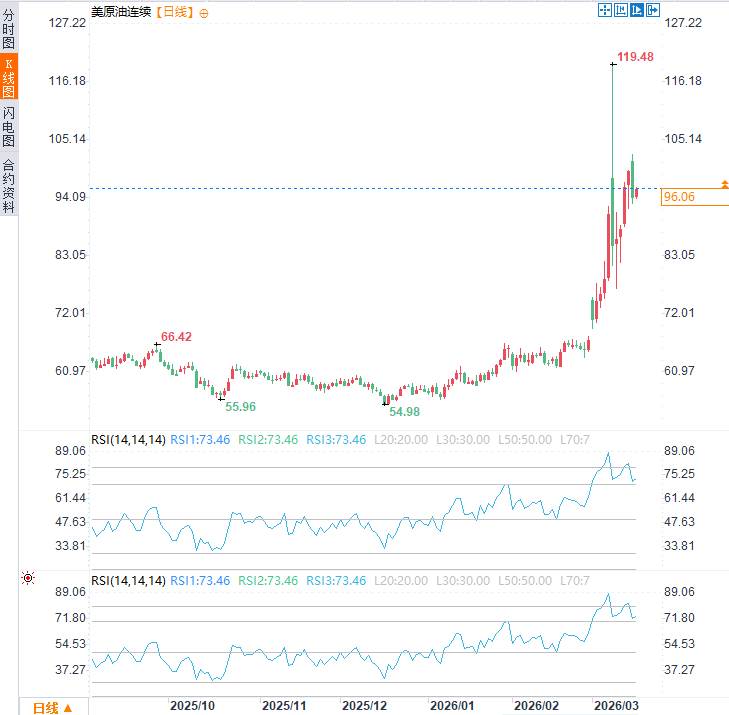
(US crude oil daily chart, source: FX678)
The Trump administration has explicitly rejected Iran's proposal to restart negotiations. A senior White House official revealed that Iran had attempted to make contact through various channels (including US Middle East envoy Witkov), but the US instructed that it would not respond for the time being and would prioritize military action.
Iranian Foreign Minister Araqchi and Ambassador to Austria Jahromi both publicly denied recent contact or any ceasefire/negotiation proposals, reiterating their rejection of any form of dialogue.
The US believes the current battlefield situation is favorable and there is no need to give Iran a diplomatic respite; Iran, however, insists it is "more resilient than its enemy" and refuses to show weakness. With the diplomatic window completely closed in the short term, the pressure of a war of attrition and economic sanctions will further intensify. Iran's fiscal revenue continues to shrink, but the regime's resilience has exceeded expectations, and the Revolutionary Guard and its proxy network remain active.
The market anticipates a very low probability of a ceasefire in the short term, and the global energy crisis and inflation risks continue to escalate. Investors need to be highly vigilant for unforeseen battlefield events that could trigger a reversal in oil prices, and pay close attention to Iran's response, White House military plans, and progress in international coordination.
At 09:03 Beijing time, US crude oil futures were trading at $95.94 per barrel.
With diplomatic channels completely closed, US-Iran relations have entered a "zero-contact" phase, and the war of attrition on the battlefield is expected to intensify further, potentially triggering extreme retaliation from Iran, thereby amplifying the global energy crisis and inflation risks. On Tuesday (March 17) in early Asian trading, US crude oil prices continued to fluctuate and strengthen, currently trading around $96.20 per barrel, with a daily increase of approximately 2.9%.
Trump explicitly rejected the proposal to restart negotiations with Iran, and the White House instructed that no response be given at this time.
On Monday, local time in the United States, two senior White House officials revealed that Iran had recently tried to contact the Trump administration through various channels in hopes of restarting diplomatic negotiations, but US President Trump has now explicitly refused to resume any negotiations.
The White House has instructed its team to refrain from responding and prioritize military action. This decision marks the complete closure of diplomatic channels in the short term, signifying a "zero-contact" phase in current US-Iran relations.
Iran attempted to reach out through various channels, including through US Special Envoy Witkov.
Sources familiar with the matter said Iranian officials had attempted to contact U.S. Middle East envoy Witkov and other government officials directly to seek the restoration of diplomatic communication channels.
Iran's move is interpreted as an attempt to alleviate military pressure through diplomatic means amid ongoing airstrikes and economic stress. However, the Trump team believes the current battlefield situation is favorable to the US and refuses to give Iran any respite.
Iranian Foreign Minister denies recent contact; last contact occurred before new US military action.
Iranian Foreign Minister Araqchi explicitly denied having any recent contact with Witkov. He stated that his last contact with Witkov occurred before the US launched a new round of military action against Iran. This statement was intended to demonstrate to the outside world that Iran had not sought peace, while simultaneously avoiding domestic criticism of "bowing to the US."
Iran's official position remains: it rejects any form of negotiation and ceasefire unless the US and Israel completely cease hostilities.
The Iranian ambassador to Austria reiterated that Iran has neither sought a ceasefire nor made any negotiation proposals.
Iranian Ambassador to Austria, Asadora Eshlag Jahromi, also publicly denied any ceasefire or negotiation proposals. He emphasized that Iran has neither sought a ceasefire nor made any negotiation suggestions to the United States.
This series of official statements shows that the Iranian leadership remains highly hardline at this stage, rejecting any diplomatic moves that could be interpreted as a sign of weakness.
Trump wants military action to continue, and the door to negotiations is temporarily closed.
Senior White House officials revealed that Trump has clearly instructed his team to refrain from any negotiations and to continue military operations until the established objectives are achieved (destroying Iran's nuclear and missile capabilities and weakening the Revolutionary Guard).
The Trump team believes the current battlefield situation is favorable to the US, with Iran's financial and military capabilities being continuously depleted, and there is no need to give the other side diplomatic breathing room. This stance echoes Trump's previous optimistic statements that it would "end soon" and "be very close to completion," but it also means that diplomatic channels will be completely frozen in the short term.
The diplomatic window is temporarily closed, and pressure from the battlefield and sanctions may intensify.
Trump's refusal to restart negotiations and Iran's strong response of "rejecting any negotiations" mark the beginning of a "zero-contact" phase in US-Iran relations. The diplomatic window is completely closed in the short term, and the pressure of a war of attrition on the battlefield and economic sanctions will further intensify. Iran's fiscal revenue continues to shrink (due to a sharp decline in oil exports), but the regime's resilience has exceeded expectations, and the Revolutionary Guard and its proxy network remain active.
If the US continues its military operations, it could trigger more extreme Iranian retaliation (a complete blockade of the Hormuz, expanded proxy attacks), further amplifying the global energy crisis and inflation risks. Investors need to be wary of unforeseen battlefield events causing a reversal in oil prices, and pay attention to Iran's response, the White House's subsequent military plans, and the actual implementation of the G7/IEA's reserve releases.
(US crude oil daily chart, source: FX678)
Editor's Summary
The Trump administration has explicitly rejected Iran's proposal to restart negotiations. A senior White House official revealed that Iran had attempted to make contact through various channels (including US Middle East envoy Witkov), but the US instructed that it would not respond for the time being and would prioritize military action.
Iranian Foreign Minister Araqchi and Ambassador to Austria Jahromi both publicly denied recent contact or any ceasefire/negotiation proposals, reiterating their rejection of any form of dialogue.
The US believes the current battlefield situation is favorable and there is no need to give Iran a diplomatic respite; Iran, however, insists it is "more resilient than its enemy" and refuses to show weakness. With the diplomatic window completely closed in the short term, the pressure of a war of attrition and economic sanctions will further intensify. Iran's fiscal revenue continues to shrink, but the regime's resilience has exceeded expectations, and the Revolutionary Guard and its proxy network remain active.
The market anticipates a very low probability of a ceasefire in the short term, and the global energy crisis and inflation risks continue to escalate. Investors need to be highly vigilant for unforeseen battlefield events that could trigger a reversal in oil prices, and pay close attention to Iran's response, White House military plans, and progress in international coordination.
At 09:03 Beijing time, US crude oil futures were trading at $95.94 per barrel.
- Risk Warning and Disclaimer
- The market involves risk, and trading may not be suitable for all investors. This article is for reference only and does not constitute personal investment advice, nor does it take into account certain users’ specific investment objectives, financial situation, or other needs. Any investment decisions made based on this information are at your own risk.