The Fed's March dot plot may further reduce expectations of rate cuts, and the market tends to remain silent in response to uncertainty.
2026-03-17 11:12:00
According to APP, Nick Timiraos recently pointed out that the Federal Reserve is inclined to adopt a relatively restrained communication strategy at this week's (March 17-18) policy meeting, avoiding releasing too many new signals to address ongoing uncertainty. However, this meeting requires the release of an updated Summary of Economic Projections (SEP) and a dot plot, which necessitates policymakers outlining a general path for future interest rates. Two former Fed chairs recently advised him to avoid predicting near-term rate cuts to maintain policy credibility and operational flexibility. Whether current officials will adopt a similar cautious stance has become the biggest focus of this meeting.
Hawks and doves are likely to cite the same external shocks (such as a surge in energy prices triggered by geopolitical conflicts in the Middle East and rising global inflation expectations) to defend their respective views: Hawks emphasize that such shocks exacerbate the risk of persistent inflation and that higher interest rates need to be maintained for a longer period of time; Doves, on the other hand, point out the same factor's negative drag on economic growth and advocate maintaining a high degree of data dependence and avoiding premature easing.
The Federal Reserve's target range for the benchmark interest rate remains at 3.50%-3.75%, marking the second consecutive pause in adjustments after three consecutive rate cuts at the end of 2025. The latest CME FedWatch tool shows a 99.9% probability of maintaining the current rate at this meeting, with only about a 0.1% chance of a 25 basis point cut. The dot plot, a key focus, previously projected only one 25 basis point rate cut in 2026 (median in December 2025). However, due to recent oil price surges, uncertainty surrounding potential tariffs, and slowing economic growth, this update may further reduce the number of rate cuts—some members may even move their targets to zero or higher. This reflects growing internal disagreement over the dual pressures of persistent inflation and weak growth: core inflation remains above the 2% target, and external supply shocks (such as energy costs) continue to push up prices; meanwhile, signs of weakness in the labor market (such as recent downward revisions to employment data) and a slowdown in quarterly GDP growth to around 1.5%-1.8% have raised concerns among doves about the risk of a hard landing.
Timiraos's analysis emphasizes that the current chair's team may employ neutral language (such as "closely monitoring risks" and "data-driven decision-making") to achieve "silent" communication, balancing hawkish and dovish differences and avoiding market overreaction. Hawks can use the energy shock to argue for preventing runaway inflation, while doves emphasize its demand-suppressing effect and advocate for a pause in tightening. This phenomenon of "the same shock, different interpretations" highlights the inherent tension of the Fed's dual mandate: seeking a balance between combating inflation and supporting employment, with new external shocks further amplifying the difficulty of decision-making.
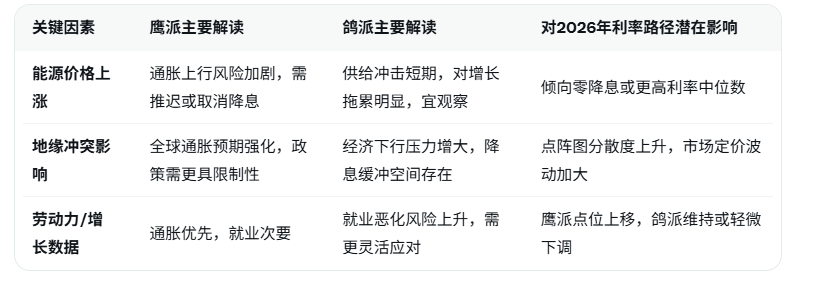
Overall, while this meeting almost certainly confirms no interest rate adjustments, the updated dot plot and the chairman's press conference will be key to shaping expectations for monetary policy in 2026. If the dot plot shows a further reduction in expectations for rate cuts, it will strengthen the dollar, push up US Treasury yields, and suppress risk assets; if the path remains relatively moderate, it will provide breathing room for global liquidity. The Federal Reserve is currently in a predicament of "no perfect path," with external shocks continuing to test the art of its forward guidance.
Editor's Summary:
The Federal Reserve faced a trade-off between cautious communication and transparent forecasting at this week's meeting. While the updated dot plot provided clues, the overall tone leaned towards conservatism to address persistent inflation and growth uncertainty. The divergence between hawks and doves, manifested through the same external factors, highlights the complexity of simultaneously safeguarding dual objectives. The market should closely monitor the details of the Special Economic Zones (SEP) and the Chairman's statements to assess whether the pace of rate cuts in 2026 will be further delayed or reduced.
Frequently Asked Questions
1. Why did the Federal Reserve tend to remain silent at this meeting?
The current environment is highly uncertain, including rising energy costs due to the Middle East conflict, the potential effects of tariffs, and slowing domestic growth. Excessive forward guidance could lock in policy or trigger sharp market volatility; therefore, a neutral stance is preferred, avoiding promises of short-term rate cuts, while providing limited guidance through the dot plot to retain maximum flexibility in responding to new shocks.
2. What practical impact do the views of former Federal Reserve chairmen have on current policy decisions?
The recent emphasis by the two former chairs on avoiding predicting short-term rate cuts reflects concerns about the credibility of inflation control: prematurely signaling easing could undermine the resolve to combat inflation. If current officials continue to be cautious, it will reinforce market expectations of "higher and longer rates"; if they lean dovish, it could amplify internal disputes and affect the consistency of the dot plot.
3. How do hawks and doves use the "same shock" to support opposing positions?
The same external factor (such as rising oil prices due to Middle East geopolitical conflicts) can be interpreted in two ways: hawks see it as a persistent risk to inflation and advocate maintaining restrictive policies and postponing interest rate cuts; doves, on the other hand, view it as a negative supply shock to economic growth, emphasizing the need for data-driven decisions and not rushing into further tightening. This divergence leads to a more dispersed dot plot, making it difficult for the market to accurately predict the median path.
4. What are the potential implications of this dot plot update for the interest rate path in 2026?
The median forecast previously predicted only one rate cut in 2026. If this cut is further reduced to zero or very little, it will push up US Treasury yields, support the dollar, and suppress risk assets such as stocks. If rates remain stable or are moderately lowered, it will improve liquidity. While the dot plot is not an informal commitment, its historical changes often trigger significant market repricing.
5. What impact might the outcome of this meeting have on global financial markets?
If expectations of no or minimal interest rate cuts reinforce, the US dollar index may continue to strengthen, putting pressure on emerging markets and pushing bond yields higher. Conversely, a more moderate approach would support a recovery in risk appetite, benefiting equities and commodities. Investors should pay close attention to Fed Chair Powell's remarks at the press conference to determine whether the Fed prioritizes inflation or growth concerns.
Hawks and doves are likely to cite the same external shocks (such as a surge in energy prices triggered by geopolitical conflicts in the Middle East and rising global inflation expectations) to defend their respective views: Hawks emphasize that such shocks exacerbate the risk of persistent inflation and that higher interest rates need to be maintained for a longer period of time; Doves, on the other hand, point out the same factor's negative drag on economic growth and advocate maintaining a high degree of data dependence and avoiding premature easing.
The Federal Reserve's target range for the benchmark interest rate remains at 3.50%-3.75%, marking the second consecutive pause in adjustments after three consecutive rate cuts at the end of 2025. The latest CME FedWatch tool shows a 99.9% probability of maintaining the current rate at this meeting, with only about a 0.1% chance of a 25 basis point cut. The dot plot, a key focus, previously projected only one 25 basis point rate cut in 2026 (median in December 2025). However, due to recent oil price surges, uncertainty surrounding potential tariffs, and slowing economic growth, this update may further reduce the number of rate cuts—some members may even move their targets to zero or higher. This reflects growing internal disagreement over the dual pressures of persistent inflation and weak growth: core inflation remains above the 2% target, and external supply shocks (such as energy costs) continue to push up prices; meanwhile, signs of weakness in the labor market (such as recent downward revisions to employment data) and a slowdown in quarterly GDP growth to around 1.5%-1.8% have raised concerns among doves about the risk of a hard landing.
Timiraos's analysis emphasizes that the current chair's team may employ neutral language (such as "closely monitoring risks" and "data-driven decision-making") to achieve "silent" communication, balancing hawkish and dovish differences and avoiding market overreaction. Hawks can use the energy shock to argue for preventing runaway inflation, while doves emphasize its demand-suppressing effect and advocate for a pause in tightening. This phenomenon of "the same shock, different interpretations" highlights the inherent tension of the Fed's dual mandate: seeking a balance between combating inflation and supporting employment, with new external shocks further amplifying the difficulty of decision-making.
Overall, while this meeting almost certainly confirms no interest rate adjustments, the updated dot plot and the chairman's press conference will be key to shaping expectations for monetary policy in 2026. If the dot plot shows a further reduction in expectations for rate cuts, it will strengthen the dollar, push up US Treasury yields, and suppress risk assets; if the path remains relatively moderate, it will provide breathing room for global liquidity. The Federal Reserve is currently in a predicament of "no perfect path," with external shocks continuing to test the art of its forward guidance.
Editor's Summary:
The Federal Reserve faced a trade-off between cautious communication and transparent forecasting at this week's meeting. While the updated dot plot provided clues, the overall tone leaned towards conservatism to address persistent inflation and growth uncertainty. The divergence between hawks and doves, manifested through the same external factors, highlights the complexity of simultaneously safeguarding dual objectives. The market should closely monitor the details of the Special Economic Zones (SEP) and the Chairman's statements to assess whether the pace of rate cuts in 2026 will be further delayed or reduced.
Frequently Asked Questions
1. Why did the Federal Reserve tend to remain silent at this meeting?
The current environment is highly uncertain, including rising energy costs due to the Middle East conflict, the potential effects of tariffs, and slowing domestic growth. Excessive forward guidance could lock in policy or trigger sharp market volatility; therefore, a neutral stance is preferred, avoiding promises of short-term rate cuts, while providing limited guidance through the dot plot to retain maximum flexibility in responding to new shocks.
2. What practical impact do the views of former Federal Reserve chairmen have on current policy decisions?
The recent emphasis by the two former chairs on avoiding predicting short-term rate cuts reflects concerns about the credibility of inflation control: prematurely signaling easing could undermine the resolve to combat inflation. If current officials continue to be cautious, it will reinforce market expectations of "higher and longer rates"; if they lean dovish, it could amplify internal disputes and affect the consistency of the dot plot.
3. How do hawks and doves use the "same shock" to support opposing positions?
The same external factor (such as rising oil prices due to Middle East geopolitical conflicts) can be interpreted in two ways: hawks see it as a persistent risk to inflation and advocate maintaining restrictive policies and postponing interest rate cuts; doves, on the other hand, view it as a negative supply shock to economic growth, emphasizing the need for data-driven decisions and not rushing into further tightening. This divergence leads to a more dispersed dot plot, making it difficult for the market to accurately predict the median path.
4. What are the potential implications of this dot plot update for the interest rate path in 2026?
The median forecast previously predicted only one rate cut in 2026. If this cut is further reduced to zero or very little, it will push up US Treasury yields, support the dollar, and suppress risk assets such as stocks. If rates remain stable or are moderately lowered, it will improve liquidity. While the dot plot is not an informal commitment, its historical changes often trigger significant market repricing.
5. What impact might the outcome of this meeting have on global financial markets?
If expectations of no or minimal interest rate cuts reinforce, the US dollar index may continue to strengthen, putting pressure on emerging markets and pushing bond yields higher. Conversely, a more moderate approach would support a recovery in risk appetite, benefiting equities and commodities. Investors should pay close attention to Fed Chair Powell's remarks at the press conference to determine whether the Fed prioritizes inflation or growth concerns.
- Risk Warning and Disclaimer
- The market involves risk, and trading may not be suitable for all investors. This article is for reference only and does not constitute personal investment advice, nor does it take into account certain users’ specific investment objectives, financial situation, or other needs. Any investment decisions made based on this information are at your own risk.