Crude oil trading alert: The premium for Middle East conflict is nearing its limit; WTI oil prices may peak after approaching $95.
2026-03-17 09:26:47
The international crude oil market has maintained its strong performance recently, with WTI crude oil prices rising to around $94.20 per barrel , nearing a recent high. The core driver of this surge remains supply concerns stemming from the escalating tensions in the Middle East, but from a market structure perspective, the upward momentum in oil prices has begun to show signs of weakening.
Market research indicates that the conflict between Israel and Iran continues to escalate, with missile attacks and defensive actions intensifying. Measures such as the UAE closing its airspace have further heightened market concerns about a potential loss of control over the regional situation. Meanwhile, potential threats to oil tankers, ports, and critical infrastructure have made energy transport security a key focus of market attention. The Strait of Hormuz handles approximately 20% of global seaborne crude oil transport , and its stability directly impacts global supply expectations.
However, from a pricing perspective, current oil prices not only reflect actual supply and demand but also, to a greater extent, factor in "extreme risk scenarios." In other words, without any substantial supply disruptions, the market has already priced in most of the potential for price increases. Traders have generally priced in potential future supply shocks in advance, causing oil prices to gradually deviate from fundamentals and become driven by sentiment.
Meanwhile, policy-level countercyclical measures are strengthening. The International Energy Agency has stated that it is considering releasing approximately 400 million barrels of strategic petroleum reserves . This scale represents a historic level of intervention, aimed at stabilizing market expectations and alleviating supply tensions. Although reserve releases typically provide only a short-term buffer, in the current high-price environment, this expectation itself is already exerting significant downward pressure on oil prices.
From a macroeconomic perspective, high oil prices are beginning to have a "counterproductive effect." On the one hand, rising energy costs are pushing up global inflation, making major central banks more inclined to maintain tight monetary policies, thereby suppressing demand growth. On the other hand, high oil prices are squeezing out consumption and industrial activity, and market expectations for future demand are gradually being revised downwards. This means that the higher the oil price, the more pronounced the damage to demand, thus weakening the basis for continued price increases.
In terms of market sentiment, while safe-haven demand still exists, typical "top-frenzy" characteristics have not yet emerged, such as accelerated price increases or extreme speculative behavior. This indicates that oil prices are still in a high-level consolidation and top-forming phase, rather than having completed a reversal.
From a global market perspective, the high oil prices have begun to impact other asset classes. Bond yields have risen due to increasing inflation expectations, while stocks are under pressure from cost constraints, and commodities are showing divergent trends. This cross-market impact further indicates that oil prices have entered a phase where they exert a counter-constraint on the macroeconomic environment.
From a technical perspective, on the daily chart, WTI crude oil maintains its upward trend, with prices holding above $90 and moving averages in a bullish alignment, indicating the trend remains intact. However, it's important to note that the $95-$97 range has become a key resistance area, with multiple attempts to break through failing, suggesting increasing selling pressure. Meanwhile, while momentum indicators remain in bullish territory, upward momentum is slowing, suggesting the trend is entering its later stages.
On the 4-hour chart, oil prices are exhibiting a high-level consolidation pattern. Although the lows are still rising, the upward slope has slowed significantly, and short-term momentum indicators show signs of bearish divergence. This is typically one of the important signals of a trend's end. If prices subsequently fall below the $90 mark , it could confirm the formation of a short-term top and open up further downside potential; conversely, if prices break above $97, the top structure will be delayed.
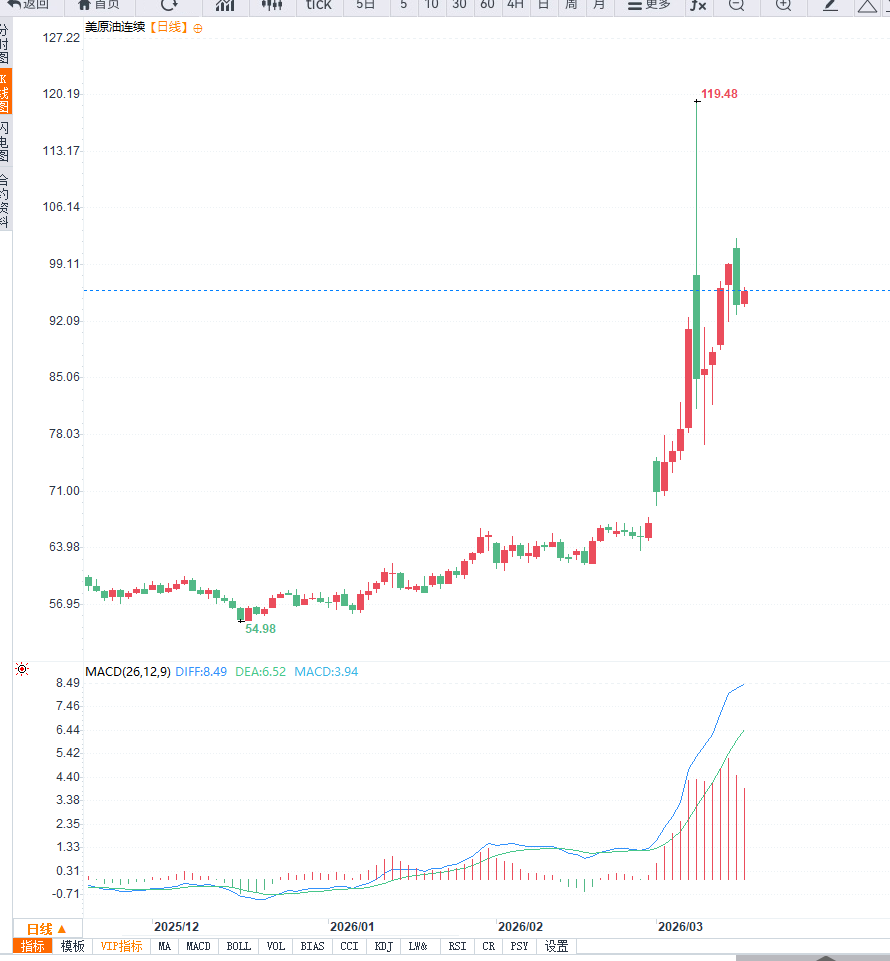
Editor's Summary <br/>Overall, WTI crude oil is currently operating at high levels driven by geopolitical risks. However, as the risk premium is gradually absorbed by the market and expectations of policy hedging strengthen, the upward momentum of oil prices has clearly weakened. Although the trend has not completely reversed, the market has entered a phase of topping out. The key to future price movements lies in whether the conflict escalates further and whether supply is actually disrupted. Against this backdrop, oil prices may maintain high-level fluctuations in the short term, but in the medium term, the risk of a gradual pullback should be monitored.
Frequently Asked Questions (FAQ)
Question 1: Why is the current oil price considered to be near a temporary peak?
The core reason why current oil prices are nearing a temporary peak is that "expectations have already been fully priced in." The market has already priced in the worst-case scenario that could result from the Middle East conflict, including risks such as supply disruptions and transportation disruptions. However, large-scale supply disruptions have not yet occurred, meaning that oil price increases are more dependent on expectations than actual fundamentals. At the same time, expectations of policy intervention (such as the release of strategic reserves) are strengthening, putting downward pressure on prices. Furthermore, high oil prices themselves are beginning to suppress demand, weakening the basis for further increases. Therefore, the market is gradually entering a topping-out phase.
Question 2: Why would the International Energy Agency's release of reserves limit the rise in oil prices?
The release of strategic petroleum reserves essentially alleviates market tensions by increasing short-term supply. When the market anticipates a potential increase in supply, traders reduce their concerns about future shortages, thereby decreasing risk premiums. Furthermore, large-scale releases (such as 400 million barrels) have a strong psychological impact, altering the structure of market expectations. However, this measure is typically only effective in the short term because reserves are limited and cannot replace normal production in the long term. Therefore, its main function is to "suppress price increases" rather than fundamentally change the trend.
Question 3: Why do high oil prices, in turn, suppress their own rise?
Rising oil prices will suppress demand through several channels. First, high energy costs will increase transportation and production expenses, thereby pushing up commodity prices and reducing consumer spending power. Second, corporate profits will be squeezed, reducing investment willingness. Finally, rising inflation may prompt central banks to maintain a high-interest-rate environment, further suppressing economic activity. These factors combined will lower future expectations for crude oil demand, thus weakening the momentum for further oil price increases.
Question 4: How can we determine from a technical perspective whether oil prices have truly peaked?
Technical analysis of a top typically requires confirmation from multiple signals. First, a key resistance level is repeatedly tested but not broken, such as in the $95-$97 range; second, momentum indicators show divergence, meaning the price makes new highs but the indicators do not strengthen accordingly; and third, the price breaks below a key support level, such as the $90 mark. Once these conditions occur simultaneously, it usually indicates a potential trend reversal. In addition, changes in trading volume and volatility can also serve as supplementary indicators.
Question 5: What are the key variables for future oil price trends?
Future oil price trends will depend on three core variables. First, geopolitical developments: if conflicts escalate and lead to actual supply disruptions, oil prices could continue to rise. Second, the extent of policy intervention, including the scale and implementation of strategic reserve releases. Third, changes in global demand, particularly whether the economy experiences a significant slowdown against the backdrop of high oil prices. In addition, the dollar's performance and financial market sentiment will also significantly impact oil prices. Overall, oil prices are driven by geopolitical factors in the short term, but will return to supply and demand fundamentals in the medium term.
Market research indicates that the conflict between Israel and Iran continues to escalate, with missile attacks and defensive actions intensifying. Measures such as the UAE closing its airspace have further heightened market concerns about a potential loss of control over the regional situation. Meanwhile, potential threats to oil tankers, ports, and critical infrastructure have made energy transport security a key focus of market attention. The Strait of Hormuz handles approximately 20% of global seaborne crude oil transport , and its stability directly impacts global supply expectations.
However, from a pricing perspective, current oil prices not only reflect actual supply and demand but also, to a greater extent, factor in "extreme risk scenarios." In other words, without any substantial supply disruptions, the market has already priced in most of the potential for price increases. Traders have generally priced in potential future supply shocks in advance, causing oil prices to gradually deviate from fundamentals and become driven by sentiment.
Meanwhile, policy-level countercyclical measures are strengthening. The International Energy Agency has stated that it is considering releasing approximately 400 million barrels of strategic petroleum reserves . This scale represents a historic level of intervention, aimed at stabilizing market expectations and alleviating supply tensions. Although reserve releases typically provide only a short-term buffer, in the current high-price environment, this expectation itself is already exerting significant downward pressure on oil prices.
From a macroeconomic perspective, high oil prices are beginning to have a "counterproductive effect." On the one hand, rising energy costs are pushing up global inflation, making major central banks more inclined to maintain tight monetary policies, thereby suppressing demand growth. On the other hand, high oil prices are squeezing out consumption and industrial activity, and market expectations for future demand are gradually being revised downwards. This means that the higher the oil price, the more pronounced the damage to demand, thus weakening the basis for continued price increases.
In terms of market sentiment, while safe-haven demand still exists, typical "top-frenzy" characteristics have not yet emerged, such as accelerated price increases or extreme speculative behavior. This indicates that oil prices are still in a high-level consolidation and top-forming phase, rather than having completed a reversal.
From a global market perspective, the high oil prices have begun to impact other asset classes. Bond yields have risen due to increasing inflation expectations, while stocks are under pressure from cost constraints, and commodities are showing divergent trends. This cross-market impact further indicates that oil prices have entered a phase where they exert a counter-constraint on the macroeconomic environment.
From a technical perspective, on the daily chart, WTI crude oil maintains its upward trend, with prices holding above $90 and moving averages in a bullish alignment, indicating the trend remains intact. However, it's important to note that the $95-$97 range has become a key resistance area, with multiple attempts to break through failing, suggesting increasing selling pressure. Meanwhile, while momentum indicators remain in bullish territory, upward momentum is slowing, suggesting the trend is entering its later stages.
On the 4-hour chart, oil prices are exhibiting a high-level consolidation pattern. Although the lows are still rising, the upward slope has slowed significantly, and short-term momentum indicators show signs of bearish divergence. This is typically one of the important signals of a trend's end. If prices subsequently fall below the $90 mark , it could confirm the formation of a short-term top and open up further downside potential; conversely, if prices break above $97, the top structure will be delayed.
Editor's Summary <br/>Overall, WTI crude oil is currently operating at high levels driven by geopolitical risks. However, as the risk premium is gradually absorbed by the market and expectations of policy hedging strengthen, the upward momentum of oil prices has clearly weakened. Although the trend has not completely reversed, the market has entered a phase of topping out. The key to future price movements lies in whether the conflict escalates further and whether supply is actually disrupted. Against this backdrop, oil prices may maintain high-level fluctuations in the short term, but in the medium term, the risk of a gradual pullback should be monitored.
Frequently Asked Questions (FAQ)
Question 1: Why is the current oil price considered to be near a temporary peak?
The core reason why current oil prices are nearing a temporary peak is that "expectations have already been fully priced in." The market has already priced in the worst-case scenario that could result from the Middle East conflict, including risks such as supply disruptions and transportation disruptions. However, large-scale supply disruptions have not yet occurred, meaning that oil price increases are more dependent on expectations than actual fundamentals. At the same time, expectations of policy intervention (such as the release of strategic reserves) are strengthening, putting downward pressure on prices. Furthermore, high oil prices themselves are beginning to suppress demand, weakening the basis for further increases. Therefore, the market is gradually entering a topping-out phase.
Question 2: Why would the International Energy Agency's release of reserves limit the rise in oil prices?
The release of strategic petroleum reserves essentially alleviates market tensions by increasing short-term supply. When the market anticipates a potential increase in supply, traders reduce their concerns about future shortages, thereby decreasing risk premiums. Furthermore, large-scale releases (such as 400 million barrels) have a strong psychological impact, altering the structure of market expectations. However, this measure is typically only effective in the short term because reserves are limited and cannot replace normal production in the long term. Therefore, its main function is to "suppress price increases" rather than fundamentally change the trend.
Question 3: Why do high oil prices, in turn, suppress their own rise?
Rising oil prices will suppress demand through several channels. First, high energy costs will increase transportation and production expenses, thereby pushing up commodity prices and reducing consumer spending power. Second, corporate profits will be squeezed, reducing investment willingness. Finally, rising inflation may prompt central banks to maintain a high-interest-rate environment, further suppressing economic activity. These factors combined will lower future expectations for crude oil demand, thus weakening the momentum for further oil price increases.
Question 4: How can we determine from a technical perspective whether oil prices have truly peaked?
Technical analysis of a top typically requires confirmation from multiple signals. First, a key resistance level is repeatedly tested but not broken, such as in the $95-$97 range; second, momentum indicators show divergence, meaning the price makes new highs but the indicators do not strengthen accordingly; and third, the price breaks below a key support level, such as the $90 mark. Once these conditions occur simultaneously, it usually indicates a potential trend reversal. In addition, changes in trading volume and volatility can also serve as supplementary indicators.
Question 5: What are the key variables for future oil price trends?
Future oil price trends will depend on three core variables. First, geopolitical developments: if conflicts escalate and lead to actual supply disruptions, oil prices could continue to rise. Second, the extent of policy intervention, including the scale and implementation of strategic reserve releases. Third, changes in global demand, particularly whether the economy experiences a significant slowdown against the backdrop of high oil prices. In addition, the dollar's performance and financial market sentiment will also significantly impact oil prices. Overall, oil prices are driven by geopolitical factors in the short term, but will return to supply and demand fundamentals in the medium term.
- Risk Warning and Disclaimer
- The market involves risk, and trading may not be suitable for all investors. This article is for reference only and does not constitute personal investment advice, nor does it take into account certain users’ specific investment objectives, financial situation, or other needs. Any investment decisions made based on this information are at your own risk.