Gold prices continued their consolidation as inflation expectations rose and the Federal Reserve postponed interest rate cuts.
2026-03-17 09:44:19
The international gold market has recently seen a pullback from its highs, with spot gold (XAU/USD) trading around $5,000 during the Asian session, a slight decline from previous highs. The core factor driving this correction is not a decrease in safe-haven demand, but rather a renewed shift in macroeconomic expectations, particularly changes in the path of inflation and interest rates.
Market research indicates that the escalating tensions in the Middle East have kept international crude oil prices around $95 per barrel , with market concerns about energy supply disruptions continuing to grow. Against this backdrop, inflation expectations have resurfaced, challenging the previously widely anticipated path of loose monetary policy. As a typical non-yielding asset, gold's attractiveness has temporarily decreased with interest rates remaining high or even experiencing delayed declines.

"As oil prices rise, inflationary pressures will increase again, which will weaken the incentive for central banks to cut interest rates, thus putting downward pressure on gold." — Market analysts' opinion
From a policy perspective, the Federal Reserve is highly likely to maintain interest rates at the 3.50%-3.75% range at its upcoming policy meeting. Meanwhile, interest rate futures markets indicate that traders have largely ruled out the possibility of multiple rate cuts this year, even postponing the first rate cut until the end of the year. This shift in expectations has directly boosted the US dollar and put downward pressure on gold.
Logically, the current correction in gold prices is a typical example of a "real interest rate-driven pullback." When the market expects interest rates to remain high for a longer period, the opportunity cost of holding gold increases, and funds tend to flow to assets with higher yields, such as the US dollar or US Treasury bonds, thus causing gold prices to fall.
Meanwhile, despite persistent geopolitical risks, market allocation to safe-haven assets has become more differentiated. Some funds are shifting towards the US dollar rather than gold, indicating that the dollar's "interest rate attribute" is currently outweighing gold's "safe-haven attribute." This structural change is one of the key reasons for the recent gold price correction.
From a longer-term perspective, the core supporting logic for gold has not completely changed. Global economic uncertainties persist, structural inflationary pressures remain, and the path of central bank policy remains uncertain; these factors continue to provide medium-term support for gold. Therefore, the current correction is more likely a trend adjustment than a trend reversal.
From a technical perspective, on the daily chart, gold had previously maintained a strong upward trend, but showed clear signs of stalling after approaching the $5,000 mark. Multiple attempts to break through this level failed, indicating increasing selling pressure. Currently, the key support level to watch is the $4,850-$4,800 range . A break below this area could trigger a deeper correction; however, the overall structure remains in a high-level consolidation pattern, and the trend has not yet fully turned bearish.
On the 4-hour chart, gold has entered a consolidation phase, with the price action slightly downwards. Short-term moving averages are flattening or even turning downwards, indicating weak short-term momentum. Meanwhile, momentum indicators show a bearish divergence that is gradually correcting, suggesting the market is digesting previous upward momentum. If the US dollar continues to strengthen, gold may further test lower support levels; conversely, if the dollar weakens, it is expected to return to its upward trend.
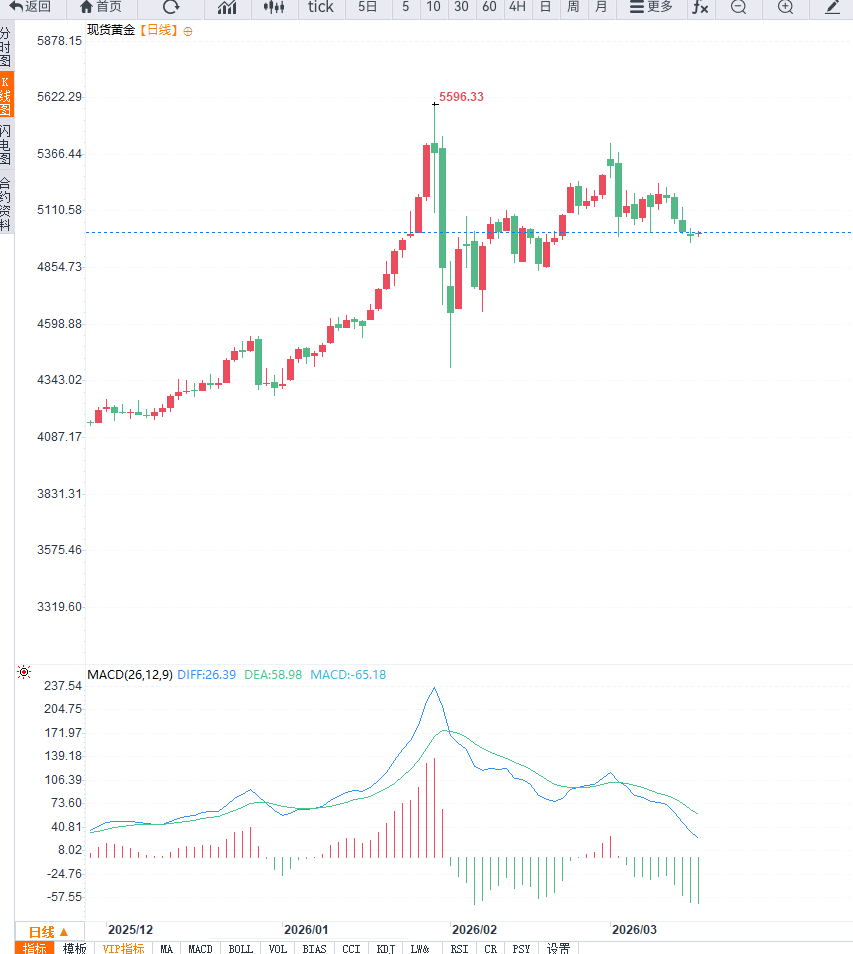
Editor's Summary : Overall, the current pullback in gold prices is primarily due to rising inflation expectations and adjustments in interest rate paths, rather than a disappearance of safe-haven demand. With oil prices remaining high, expectations of a Fed rate cut have been significantly delayed, and a stronger dollar is putting downward pressure on gold. In the short term, gold may maintain a volatile consolidation pattern, awaiting new driving factors. In the medium term, as long as global uncertainty persists, the bullish structure for gold remains fundamentally sound, but it needs a weakening dollar and a decline in oil price risk premiums to reopen upward potential.
Frequently Asked Questions (FAQ)
Question 1: Why does rising oil prices actually put downward pressure on gold?
Rising oil prices typically drive up inflation expectations, and rising inflation influences central bank monetary policy. When inflationary pressures increase, central banks are more likely to maintain higher interest rates, thus suppressing expectations of rate cuts. For gold, this means higher holding costs, as gold itself does not generate interest income. Therefore, in an environment where interest rates remain high or even rise, gold's attractiveness decreases, putting downward pressure on its price.
Question 2: How much impact will the Fed's postponement of interest rate cuts have on gold?
The Federal Reserve's interest rate policy is one of the core factors influencing gold prices. When the market anticipates a delay in interest rate cuts, yields on dollar-denominated assets remain high, leading to a greater preference for dollar-denominated assets and reduced demand for gold. Furthermore, higher interest rates also push up real interest rates, which directly suppresses gold prices. Therefore, changes in expectations of interest rate cuts often trigger significant fluctuations in gold prices.
Question 3: Is the current gold price movement a trend reversal or a normal correction?
From the current structure, this is more likely a normal pullback within a trend. The long-term supporting factors for gold, such as global economic uncertainty, inflationary pressures, and geopolitical risks, have not fundamentally changed. This pullback is more due to adjustments in short-term macroeconomic expectations, such as changes in interest rate paths and a stronger dollar. Therefore, as long as key support levels are not effectively broken, the medium-term bullish structure for gold remains intact.
Question 4: Why does the US dollar suppress gold?
The US dollar and gold typically exhibit a negative correlation. A stronger dollar increases the attractiveness of holding dollar-denominated assets, while dollar-denominated gold becomes more expensive for investors in other currencies, thus reducing demand. Furthermore, a stronger dollar is often accompanied by rising interest rates or rising expectations, which further increases the opportunity cost of holding gold, thus putting downward pressure on gold prices.
Question 5: When might gold re-enter an upward trend?
Several key conditions are needed for gold to re-enter an upward trend. First, a trend of weakening in the US dollar is required, which is typically associated with renewed expectations of interest rate cuts. Second, a decline in oil prices would ease inflationary pressures, giving central banks more room to implement easing policies. Finally, market risk aversion would rise again, for example, due to escalating geopolitical risks or increased financial market volatility. When these conditions are gradually met, gold is expected to re-enter an upward channel.
Market research indicates that the escalating tensions in the Middle East have kept international crude oil prices around $95 per barrel , with market concerns about energy supply disruptions continuing to grow. Against this backdrop, inflation expectations have resurfaced, challenging the previously widely anticipated path of loose monetary policy. As a typical non-yielding asset, gold's attractiveness has temporarily decreased with interest rates remaining high or even experiencing delayed declines.
"As oil prices rise, inflationary pressures will increase again, which will weaken the incentive for central banks to cut interest rates, thus putting downward pressure on gold." — Market analysts' opinion
From a policy perspective, the Federal Reserve is highly likely to maintain interest rates at the 3.50%-3.75% range at its upcoming policy meeting. Meanwhile, interest rate futures markets indicate that traders have largely ruled out the possibility of multiple rate cuts this year, even postponing the first rate cut until the end of the year. This shift in expectations has directly boosted the US dollar and put downward pressure on gold.
Logically, the current correction in gold prices is a typical example of a "real interest rate-driven pullback." When the market expects interest rates to remain high for a longer period, the opportunity cost of holding gold increases, and funds tend to flow to assets with higher yields, such as the US dollar or US Treasury bonds, thus causing gold prices to fall.
Meanwhile, despite persistent geopolitical risks, market allocation to safe-haven assets has become more differentiated. Some funds are shifting towards the US dollar rather than gold, indicating that the dollar's "interest rate attribute" is currently outweighing gold's "safe-haven attribute." This structural change is one of the key reasons for the recent gold price correction.
From a longer-term perspective, the core supporting logic for gold has not completely changed. Global economic uncertainties persist, structural inflationary pressures remain, and the path of central bank policy remains uncertain; these factors continue to provide medium-term support for gold. Therefore, the current correction is more likely a trend adjustment than a trend reversal.
From a technical perspective, on the daily chart, gold had previously maintained a strong upward trend, but showed clear signs of stalling after approaching the $5,000 mark. Multiple attempts to break through this level failed, indicating increasing selling pressure. Currently, the key support level to watch is the $4,850-$4,800 range . A break below this area could trigger a deeper correction; however, the overall structure remains in a high-level consolidation pattern, and the trend has not yet fully turned bearish.
On the 4-hour chart, gold has entered a consolidation phase, with the price action slightly downwards. Short-term moving averages are flattening or even turning downwards, indicating weak short-term momentum. Meanwhile, momentum indicators show a bearish divergence that is gradually correcting, suggesting the market is digesting previous upward momentum. If the US dollar continues to strengthen, gold may further test lower support levels; conversely, if the dollar weakens, it is expected to return to its upward trend.
Editor's Summary : Overall, the current pullback in gold prices is primarily due to rising inflation expectations and adjustments in interest rate paths, rather than a disappearance of safe-haven demand. With oil prices remaining high, expectations of a Fed rate cut have been significantly delayed, and a stronger dollar is putting downward pressure on gold. In the short term, gold may maintain a volatile consolidation pattern, awaiting new driving factors. In the medium term, as long as global uncertainty persists, the bullish structure for gold remains fundamentally sound, but it needs a weakening dollar and a decline in oil price risk premiums to reopen upward potential.
Frequently Asked Questions (FAQ)
Question 1: Why does rising oil prices actually put downward pressure on gold?
Rising oil prices typically drive up inflation expectations, and rising inflation influences central bank monetary policy. When inflationary pressures increase, central banks are more likely to maintain higher interest rates, thus suppressing expectations of rate cuts. For gold, this means higher holding costs, as gold itself does not generate interest income. Therefore, in an environment where interest rates remain high or even rise, gold's attractiveness decreases, putting downward pressure on its price.
Question 2: How much impact will the Fed's postponement of interest rate cuts have on gold?
The Federal Reserve's interest rate policy is one of the core factors influencing gold prices. When the market anticipates a delay in interest rate cuts, yields on dollar-denominated assets remain high, leading to a greater preference for dollar-denominated assets and reduced demand for gold. Furthermore, higher interest rates also push up real interest rates, which directly suppresses gold prices. Therefore, changes in expectations of interest rate cuts often trigger significant fluctuations in gold prices.
Question 3: Is the current gold price movement a trend reversal or a normal correction?
From the current structure, this is more likely a normal pullback within a trend. The long-term supporting factors for gold, such as global economic uncertainty, inflationary pressures, and geopolitical risks, have not fundamentally changed. This pullback is more due to adjustments in short-term macroeconomic expectations, such as changes in interest rate paths and a stronger dollar. Therefore, as long as key support levels are not effectively broken, the medium-term bullish structure for gold remains intact.
Question 4: Why does the US dollar suppress gold?
The US dollar and gold typically exhibit a negative correlation. A stronger dollar increases the attractiveness of holding dollar-denominated assets, while dollar-denominated gold becomes more expensive for investors in other currencies, thus reducing demand. Furthermore, a stronger dollar is often accompanied by rising interest rates or rising expectations, which further increases the opportunity cost of holding gold, thus putting downward pressure on gold prices.
Question 5: When might gold re-enter an upward trend?
Several key conditions are needed for gold to re-enter an upward trend. First, a trend of weakening in the US dollar is required, which is typically associated with renewed expectations of interest rate cuts. Second, a decline in oil prices would ease inflationary pressures, giving central banks more room to implement easing policies. Finally, market risk aversion would rise again, for example, due to escalating geopolitical risks or increased financial market volatility. When these conditions are gradually met, gold is expected to re-enter an upward channel.
- Risk Warning and Disclaimer
- The market involves risk, and trading may not be suitable for all investors. This article is for reference only and does not constitute personal investment advice, nor does it take into account certain users’ specific investment objectives, financial situation, or other needs. Any investment decisions made based on this information are at your own risk.