With Trump's allies absent from the escort mission, who will save Hormuz? Oil prices respond with a rebound.
2026-03-17 10:28:26
Brent crude oil prices rebounded during Asian trading hours on Tuesday (March 17), currently trading around $103.10 per barrel, up about 2.2% on the day. Market concerns about a near-complete blockade of the Strait of Hormuz have intensified again, with US allies refusing to participate in escort operations further exacerbating supply disruption fears. IG analysts warned, "Just one missile or mine would be enough to escalate the situation again."
The rebound in oil prices reflects the market's repricing of long-term supply disruptions: shipping in the Hormuz has essentially ground to a halt, more than 1,000 oil tankers and gas carriers have been blocked, and production cuts by Gulf oil-producing countries have exacerbated the global supply gap.
The US-Israel war against Iran has entered its third week, with shipping through the Strait of Hormuz essentially blocked, disrupting approximately 20% of global oil and liquefied natural gas trade. Iranian threats and attacks have led to a mass exodus of ship owners, causing insurance premiums to skyrocket.
The UAE's national oil company has been forced to drastically cut production, reducing daily output by more than half. Iran has demanded that India release its detained oil tanker as a condition for negotiations on safe passage. The supply disruptions continue to escalate, reigniting panic in the energy market.
Note: In early February 2026, the Indian Coast Guard seized three oil tankers linked to Iran in international waters of the Arabian Sea. This move was seen as a targeted action by India to comply with US sanctions and adjust its foreign and energy policies. India claimed at the time that the operation aimed to "crack down on transnational oil smuggling networks," accusing the tankers of disabling their Aerospace Positioning System (AIS) and conducting illegal ship-to-ship transfers on the high seas to conceal the origin of the oil and evade sanctions and tariffs.
On Sunday, Trump again called on allies to help ensure the safety of navigation in the Strait of Hormuz, complaining that some countries were "unenthusiastic," saying, "Some countries have been protected by us for years but haven't been very proactive." European allies such as Germany, Spain, and Italy explicitly refused to participate in the escort mission, showing a lukewarm response.
Trump stated that some countries have offered assistance, but did not disclose the list. European countries are highly dependent on energy, but have limited willingness to directly intervene militarily, preferring instead to exert diplomatic pressure.
The United Arab Emirates' national oil company (ADNOC) has been forced to drastically cut production, reducing daily output by more than half, primarily due to export disruptions caused by the Hormuz trade dispute. Iran has demanded that India release its detained oil tanker as part of negotiations for safe passage.
The International Energy Agency (IEA) stated that it would release more oil reserves if necessary, but the short-term effect would be limited due to logistical delays compared to the actual gap size.
Several banks have raised their long-term oil price forecasts: Bank of America raised its forecast for the average Brent crude oil price in 2026 from $61 to $77.50, and Standard Chartered raised its forecast from $70 to $85.50.
The report presents two scenarios: a swift resolution to the conflict would see oil prices fall back to $70, while a disruption lasting into the second quarter would push prices above $85. Analysts believe the duration of the Hormuz disruption will be the decisive factor.
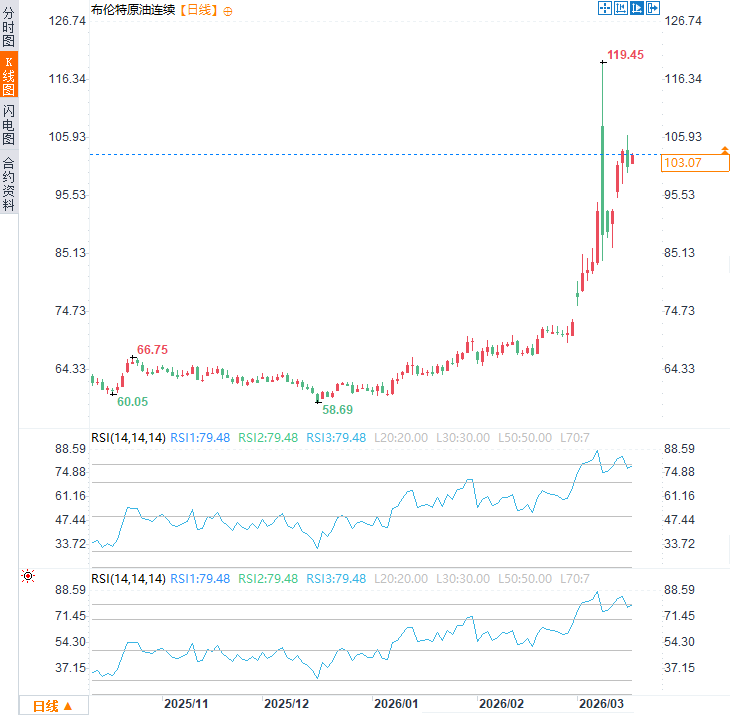
(Brent crude oil daily chart, source: EasyForex)
Oil prices rebounded in Asian trading on Tuesday, mainly due to the near-complete blockade of the Strait of Hormuz and allies refusing to provide escort, exacerbating supply concerns. The US-Israel war against Iran entered its third week, disrupting 20% of global oil and LNG trade. The UAE cut production by half, and Iran demanded India release its seized ships. Germany, Spain, Italy, and other countries rejected Trump's call for escort, drawing criticism for being "ungrateful."
Bank of America and Standard Chartered raised their 2026 oil price forecast to a high of $85.50, reflecting the ongoing risks of conflict. The IEA stated it would release reserves further if necessary, but short-term logistical delays are unlikely to fundamentally alleviate the gap.
Oil prices continue to fluctuate at high levels, while global inflationary and economic slowdown pressures intensify. Investors should be wary of a new wave of panic triggered by escalating Iranian retaliation, and pay attention to the progress of the maritime security coalition and signals regarding the reopening of the Taiwan Strait.
At 10:27 Beijing time, Brent crude oil futures were trading at $103.00 per barrel.
The rebound in oil prices reflects the market's repricing of long-term supply disruptions: shipping in the Hormuz has essentially ground to a halt, more than 1,000 oil tankers and gas carriers have been blocked, and production cuts by Gulf oil-producing countries have exacerbated the global supply gap.
The near-total blockade of the Hormuz region has disrupted 20% of global oil and LNG trade.
The US-Israel war against Iran has entered its third week, with shipping through the Strait of Hormuz essentially blocked, disrupting approximately 20% of global oil and liquefied natural gas trade. Iranian threats and attacks have led to a mass exodus of ship owners, causing insurance premiums to skyrocket.
The UAE's national oil company has been forced to drastically cut production, reducing daily output by more than half. Iran has demanded that India release its detained oil tanker as a condition for negotiations on safe passage. The supply disruptions continue to escalate, reigniting panic in the energy market.
Note: In early February 2026, the Indian Coast Guard seized three oil tankers linked to Iran in international waters of the Arabian Sea. This move was seen as a targeted action by India to comply with US sanctions and adjust its foreign and energy policies. India claimed at the time that the operation aimed to "crack down on transnational oil smuggling networks," accusing the tankers of disabling their Aerospace Positioning System (AIS) and conducting illegal ship-to-ship transfers on the high seas to conceal the origin of the oil and evade sanctions and tariffs.
Germany, Spain, Italy, and other countries rejected Trump's call for escort missions, drawing criticism for being ungrateful.
On Sunday, Trump again called on allies to help ensure the safety of navigation in the Strait of Hormuz, complaining that some countries were "unenthusiastic," saying, "Some countries have been protected by us for years but haven't been very proactive." European allies such as Germany, Spain, and Italy explicitly refused to participate in the escort mission, showing a lukewarm response.
Trump stated that some countries have offered assistance, but did not disclose the list. European countries are highly dependent on energy, but have limited willingness to directly intervene militarily, preferring instead to exert diplomatic pressure.
The UAE cuts production by half, and Iran demands India release seized ships.
The United Arab Emirates' national oil company (ADNOC) has been forced to drastically cut production, reducing daily output by more than half, primarily due to export disruptions caused by the Hormuz trade dispute. Iran has demanded that India release its detained oil tanker as part of negotiations for safe passage.
The International Energy Agency (IEA) stated that it would release more oil reserves if necessary, but the short-term effect would be limited due to logistical delays compared to the actual gap size.
Bank of America and Standard Chartered raised their 2026 average oil price forecast to a high of $85.50.
Several banks have raised their long-term oil price forecasts: Bank of America raised its forecast for the average Brent crude oil price in 2026 from $61 to $77.50, and Standard Chartered raised its forecast from $70 to $85.50.
The report presents two scenarios: a swift resolution to the conflict would see oil prices fall back to $70, while a disruption lasting into the second quarter would push prices above $85. Analysts believe the duration of the Hormuz disruption will be the decisive factor.
(Brent crude oil daily chart, source: EasyForex)
Editor's Summary
Oil prices rebounded in Asian trading on Tuesday, mainly due to the near-complete blockade of the Strait of Hormuz and allies refusing to provide escort, exacerbating supply concerns. The US-Israel war against Iran entered its third week, disrupting 20% of global oil and LNG trade. The UAE cut production by half, and Iran demanded India release its seized ships. Germany, Spain, Italy, and other countries rejected Trump's call for escort, drawing criticism for being "ungrateful."
Bank of America and Standard Chartered raised their 2026 oil price forecast to a high of $85.50, reflecting the ongoing risks of conflict. The IEA stated it would release reserves further if necessary, but short-term logistical delays are unlikely to fundamentally alleviate the gap.
Oil prices continue to fluctuate at high levels, while global inflationary and economic slowdown pressures intensify. Investors should be wary of a new wave of panic triggered by escalating Iranian retaliation, and pay attention to the progress of the maritime security coalition and signals regarding the reopening of the Taiwan Strait.
At 10:27 Beijing time, Brent crude oil futures were trading at $103.00 per barrel.
- Risk Warning and Disclaimer
- The market involves risk, and trading may not be suitable for all investors. This article is for reference only and does not constitute personal investment advice, nor does it take into account certain users’ specific investment objectives, financial situation, or other needs. Any investment decisions made based on this information are at your own risk.