The yen faces policy pressure, limiting the short-term rebound of the USD/JPY exchange rate.
2026-03-17 10:46:56
The US dollar rebounded against the Japanese yen (USD/JPY) to around 159.40 during Asian trading hours, extending the previous day's gains, but further increases may be limited by potential yen intervention. Japanese Finance Minister Satsuki Katayama stated that recent exchange rate fluctuations are inconsistent with economic fundamentals, and the deviation remains significant. Katayama pointed out that considering the impact of exchange rates on people's daily lives, Japanese authorities are prepared to respond at any time, including possible intervention in the foreign exchange market. She emphasized that significant volatility in the overall financial markets has exacerbated market concerns about intervention, thereby limiting the dollar's short-term upside potential.
Akira Moroga, chief market strategist at Aozora Bank, pointed out that Katayama's use of the term "decisive action" was almost the strongest possible wording, reinforcing the market's sensitivity to potential intervention. Teppei Ino, head of global markets research at MUFG Bank in Tokyo, stated that while government officials may continue to issue verbal warnings, these statements are unlikely to substantially change market sentiment in the short term. However, the USD/JPY pair could still approach 160 again, and market volatility should be watched closely.
Brian Martin, head of G3 economies research at ANZ Bank, noted that the Bank of Japan (BoJ) is expected to keep its interest rate unchanged at 0.75% this week, but may release hawkish signals to address stagflationary pressures from rising energy costs and a weaker yen. Core inflation is gradually approaching the 2% target, and the central bank will guide monetary policy as needed to achieve stable and sustainable inflation. The market expects the BoJ to raise rates by 25 basis points at its April meeting, bringing the policy rate to 1.0%. The rise in the US dollar against the yen was also influenced by the Middle East conflict pushing up oil prices, reducing expectations of a short-term rate cut by the Federal Reserve and supporting a stronger dollar. According to the CME FedWatch tool, the Federal Reserve is expected to keep its benchmark interest rate unchanged in the 3.50%-3.75% range on Wednesday, marking the second consecutive pause since the last round of easing.
In summary, while the USD/JPY pair has short-term upward momentum, its upside is limited by Katayama's warning and hawkish signals from the BoJ. Meanwhile, soaring Middle Eastern oil prices and the Fed's continued policy support are providing support for the dollar. Investors should pay attention to potential Japanese intervention, oil price fluctuations, and policy statements to determine the direction of short-term market movements.
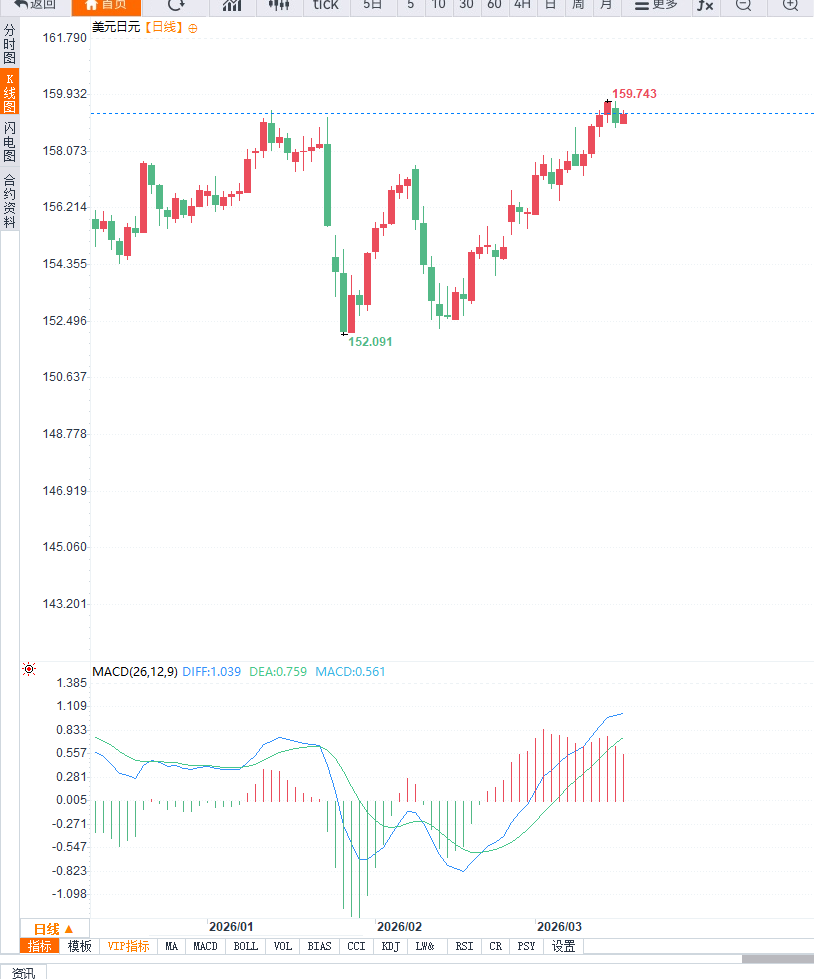
The USD/JPY daily chart shows the exchange rate has rebounded from recent lows, forming a short-term upward trend, currently consolidating around 159.40. Key resistance levels are at 159.80, 160.20, and 160.50; a break above these levels could trigger a short-term acceleration. Support levels are at 158.80, 158.40, and 157.90; a break below these levels would increase the risk of a pullback. The 4-hour chart shows short-term oscillation within the 159.20-159.60 range, with bullish and bearish forces temporarily balanced. Moving averages are flattening, and the MACD is hovering near the zero line, indicating weak short-term momentum. The market is focused on the BoJ and Fed policy statements, Katayama's intervention comments, and Middle East oil price fluctuations; a range-bound consolidation pattern is likely in the short term.
Editor's Summary : The USD/JPY pair is showing a short-term volatile rebound, but its upside potential may be limited by potential Japanese government intervention, warnings from Satsuki Katayama, and hawkish signals from the BoJ. The dollar's strength is supported by rising oil prices due to the Middle East conflict and the Fed's continued policy stance. The market is likely to fluctuate between 158.80 and 160.50 in the short term.
Frequently Asked Questions (FAQ)
Question 1: What impact will Katayama Satsuki's statement have on the USD/JPY exchange rate?
Katayama Satsuki pointed out that the exchange rate was deviating from economic fundamentals and warned that authorities might take action. This statement increased market concerns about intervention, temporarily curbing further gains in the USD/JPY exchange rate while simultaneously increasing market sensitivity to yen support.
Question 2: How does the BoJ's policy stance affect the USD/JPY exchange rate in the short term?
The BoJ kept its interest rate unchanged at 0.75%, but released hawkish signals, suggesting a possible future rate hike. In the short term, the USD/JPY exchange rate may be limited by potential central bank intervention, but in the medium to long term, the yen may receive policy support.
Question 3: What impact do the situation in the Middle East and oil prices have on the USD/JPY exchange rate?
The Middle East conflict has driven up oil prices and global inflation expectations, supporting a stronger dollar and providing upward momentum for the dollar against the yen, but expectations of yen intervention need to be balanced.
Akira Moroga, chief market strategist at Aozora Bank, pointed out that Katayama's use of the term "decisive action" was almost the strongest possible wording, reinforcing the market's sensitivity to potential intervention. Teppei Ino, head of global markets research at MUFG Bank in Tokyo, stated that while government officials may continue to issue verbal warnings, these statements are unlikely to substantially change market sentiment in the short term. However, the USD/JPY pair could still approach 160 again, and market volatility should be watched closely.
Brian Martin, head of G3 economies research at ANZ Bank, noted that the Bank of Japan (BoJ) is expected to keep its interest rate unchanged at 0.75% this week, but may release hawkish signals to address stagflationary pressures from rising energy costs and a weaker yen. Core inflation is gradually approaching the 2% target, and the central bank will guide monetary policy as needed to achieve stable and sustainable inflation. The market expects the BoJ to raise rates by 25 basis points at its April meeting, bringing the policy rate to 1.0%. The rise in the US dollar against the yen was also influenced by the Middle East conflict pushing up oil prices, reducing expectations of a short-term rate cut by the Federal Reserve and supporting a stronger dollar. According to the CME FedWatch tool, the Federal Reserve is expected to keep its benchmark interest rate unchanged in the 3.50%-3.75% range on Wednesday, marking the second consecutive pause since the last round of easing.
In summary, while the USD/JPY pair has short-term upward momentum, its upside is limited by Katayama's warning and hawkish signals from the BoJ. Meanwhile, soaring Middle Eastern oil prices and the Fed's continued policy support are providing support for the dollar. Investors should pay attention to potential Japanese intervention, oil price fluctuations, and policy statements to determine the direction of short-term market movements.
The USD/JPY daily chart shows the exchange rate has rebounded from recent lows, forming a short-term upward trend, currently consolidating around 159.40. Key resistance levels are at 159.80, 160.20, and 160.50; a break above these levels could trigger a short-term acceleration. Support levels are at 158.80, 158.40, and 157.90; a break below these levels would increase the risk of a pullback. The 4-hour chart shows short-term oscillation within the 159.20-159.60 range, with bullish and bearish forces temporarily balanced. Moving averages are flattening, and the MACD is hovering near the zero line, indicating weak short-term momentum. The market is focused on the BoJ and Fed policy statements, Katayama's intervention comments, and Middle East oil price fluctuations; a range-bound consolidation pattern is likely in the short term.
Editor's Summary : The USD/JPY pair is showing a short-term volatile rebound, but its upside potential may be limited by potential Japanese government intervention, warnings from Satsuki Katayama, and hawkish signals from the BoJ. The dollar's strength is supported by rising oil prices due to the Middle East conflict and the Fed's continued policy stance. The market is likely to fluctuate between 158.80 and 160.50 in the short term.
Frequently Asked Questions (FAQ)
Question 1: What impact will Katayama Satsuki's statement have on the USD/JPY exchange rate?
Katayama Satsuki pointed out that the exchange rate was deviating from economic fundamentals and warned that authorities might take action. This statement increased market concerns about intervention, temporarily curbing further gains in the USD/JPY exchange rate while simultaneously increasing market sensitivity to yen support.
Question 2: How does the BoJ's policy stance affect the USD/JPY exchange rate in the short term?
The BoJ kept its interest rate unchanged at 0.75%, but released hawkish signals, suggesting a possible future rate hike. In the short term, the USD/JPY exchange rate may be limited by potential central bank intervention, but in the medium to long term, the yen may receive policy support.
Question 3: What impact do the situation in the Middle East and oil prices have on the USD/JPY exchange rate?
The Middle East conflict has driven up oil prices and global inflation expectations, supporting a stronger dollar and providing upward momentum for the dollar against the yen, but expectations of yen intervention need to be balanced.
- Risk Warning and Disclaimer
- The market involves risk, and trading may not be suitable for all investors. This article is for reference only and does not constitute personal investment advice, nor does it take into account certain users’ specific investment objectives, financial situation, or other needs. Any investment decisions made based on this information are at your own risk.