JPMorgan Chase adjusts Bank of England interest rate forecast: unchanged for the whole of 2026, next rate cut may be delayed until early 2027.
2026-03-17 17:30:49
According to APP, JPMorgan Chase now predicts the Bank of England will keep interest rates unchanged in 2026, down from its previous forecast of 25 basis point cuts in April and June, with the next cut expected to be delayed until the first quarter of 2027. This significant adjustment reflects a reassessment of UK economic data and external risks. The UK benchmark interest rate is currently stable at 3.75%, and it is highly likely that the Bank of England will remain unchanged at its March 19th meeting.

The core driver behind this shift in forecasts lies in the uncertainty surrounding the inflation path. Recent geopolitical conflicts in the Middle East have led to a rebound in energy prices, pushing up overall price pressures. While there are signs of easing in service sector inflation and wage growth, the decline has been slower than expected. Meanwhile, although the UK labor market has shown some easing, the economy has demonstrated greater resilience than initially anticipated, with consumption and investment remaining relatively stable. These combined factors have led the Bank of England to adopt a more cautious "wait and see" approach, avoiding the risk of a double-dip inflation triggered by premature easing.
From a market perspective, persistently high interest rates will directly push up mortgage costs. Currently, most floating-rate loans have already followed the benchmark rate down to near historical lows, but if there are no further rate cuts in 2026, household monthly mortgage payments may rise again, thereby suppressing the housing market recovery and consumer spending. Regarding the pound sterling exchange rate, the interest rate differential may continue to support its relative strength against the dollar, but if the Federal Reserve maintains high interest rates in tandem, the pound's appreciation potential will be limited, and the competitiveness of export companies will face challenges.
Investors should pay close attention to subsequent data releases. The April inflation report, labor market employment data, and global energy price trends will be key variables. If the energy shock subsides and inflation quickly falls back to near the 2% target, the market may still reprice a slight easing in late 2026; conversely, if geopolitical risks persist, the timing of a rate cut in the first quarter of 2027 may be further delayed.
The table below visually compares the key differences between JPMorgan Chase's two forecasts:
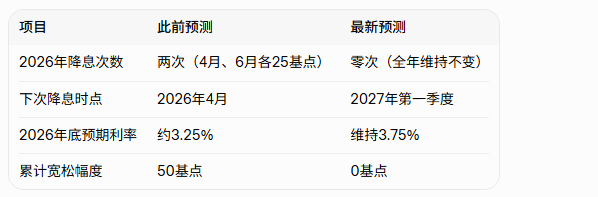
This adjustment highlights the delicate trade-off between growth and inflation in central bank policy. Overall, the UK's monetary policy path is becoming more conservative, providing new risk warnings for global asset allocation. Market participants should dynamically adjust their positions based on the latest economic indicators.
Editor's Summary : JPMorgan Chase's revised forecasts reflect the complexity of the current monetary policy environment: sticky inflation and geopolitical risks are forcing a slowdown in the pace of easing, while economic resilience limits the scope for aggressive rate cuts. Investors should closely monitor key data from March and April to identify early signals of a potential policy shift.
Frequently Asked Questions
1. Why did JPMorgan Chase change its 2026 Bank of England interest rate forecast from two rate cuts to no change for the whole year?
The main reason is that the rebound in energy prices due to geopolitical conflicts has slowed the decline in inflation, while the UK economy has shown strong resilience, with the labor market easing but not deteriorating significantly. Institutions believe that premature interest rate cuts could trigger recurring inflation, therefore adjusting their previous plans of 25 basis points each in April and June to zero easing. This change reflects a risk-management-first logic and helps the market understand the external drivers of the policy shift.
2. What is the current level of the UK benchmark interest rate, and will there be a rate cut at the March meeting?
The latest data shows that the benchmark interest rate remains stable at 3.75%, the level adjusted for December 2025. The market consensus at the March 19th meeting was to maintain the current rate, with over 85% of economists expecting it to hold steady, primarily due to rising energy prices pushing up short-term inflation risks. This aligns closely with JPMorgan Chase's view of maintaining the current rate throughout the year, leaving a window for observation regarding a potential rate cut in the first quarter of 2027.
3. What impact will this forecast adjustment have on ordinary people's mortgage loans and daily lives?
If interest rates remain unchanged throughout the year, monthly payments on floating-rate loans will remain high, potentially increasing household repayment pressure and suppressing housing demand. Meanwhile, savings yields will remain attractive, but rising overall borrowing costs will indirectly impact consumption and the real estate market. Readers can monitor April's inflation data to determine whether they need to lock in fixed-rate products in advance to cope with a potentially prolonged high-interest-rate environment.
4. What makes JPMorgan Chase's conservative forecasts unique compared to other institutions?
Some institutions still expect at least one or two small interest rate cuts in 2026, while JPMorgan Chase has postponed it to 2027, reflecting a greater vigilance regarding sticky inflation and global risks. This difference helps investors compare different scenarios: in an optimistic scenario, the pound may strengthen slightly, while in a conservative scenario, exchange rate volatility needs to be guarded against, providing a reference for diversified asset allocation.
5. How should investors deal with the risk of a delayed interest rate cut by the Bank of England?
We recommend closely monitoring energy prices, wage growth, and service sector inflation indicators. If the data continues to exceed expectations, consider increasing holdings of defensive assets or adjusting currency exposure. Meanwhile, the first quarter of 2027 is a potential turning point; proactively positioning oneself in long-term bonds or foreign exchange hedging tools can effectively buffer against volatility caused by policy uncertainty.
The core driver behind this shift in forecasts lies in the uncertainty surrounding the inflation path. Recent geopolitical conflicts in the Middle East have led to a rebound in energy prices, pushing up overall price pressures. While there are signs of easing in service sector inflation and wage growth, the decline has been slower than expected. Meanwhile, although the UK labor market has shown some easing, the economy has demonstrated greater resilience than initially anticipated, with consumption and investment remaining relatively stable. These combined factors have led the Bank of England to adopt a more cautious "wait and see" approach, avoiding the risk of a double-dip inflation triggered by premature easing.
From a market perspective, persistently high interest rates will directly push up mortgage costs. Currently, most floating-rate loans have already followed the benchmark rate down to near historical lows, but if there are no further rate cuts in 2026, household monthly mortgage payments may rise again, thereby suppressing the housing market recovery and consumer spending. Regarding the pound sterling exchange rate, the interest rate differential may continue to support its relative strength against the dollar, but if the Federal Reserve maintains high interest rates in tandem, the pound's appreciation potential will be limited, and the competitiveness of export companies will face challenges.
Investors should pay close attention to subsequent data releases. The April inflation report, labor market employment data, and global energy price trends will be key variables. If the energy shock subsides and inflation quickly falls back to near the 2% target, the market may still reprice a slight easing in late 2026; conversely, if geopolitical risks persist, the timing of a rate cut in the first quarter of 2027 may be further delayed.
The table below visually compares the key differences between JPMorgan Chase's two forecasts:
This adjustment highlights the delicate trade-off between growth and inflation in central bank policy. Overall, the UK's monetary policy path is becoming more conservative, providing new risk warnings for global asset allocation. Market participants should dynamically adjust their positions based on the latest economic indicators.
Editor's Summary : JPMorgan Chase's revised forecasts reflect the complexity of the current monetary policy environment: sticky inflation and geopolitical risks are forcing a slowdown in the pace of easing, while economic resilience limits the scope for aggressive rate cuts. Investors should closely monitor key data from March and April to identify early signals of a potential policy shift.
Frequently Asked Questions
1. Why did JPMorgan Chase change its 2026 Bank of England interest rate forecast from two rate cuts to no change for the whole year?
The main reason is that the rebound in energy prices due to geopolitical conflicts has slowed the decline in inflation, while the UK economy has shown strong resilience, with the labor market easing but not deteriorating significantly. Institutions believe that premature interest rate cuts could trigger recurring inflation, therefore adjusting their previous plans of 25 basis points each in April and June to zero easing. This change reflects a risk-management-first logic and helps the market understand the external drivers of the policy shift.
2. What is the current level of the UK benchmark interest rate, and will there be a rate cut at the March meeting?
The latest data shows that the benchmark interest rate remains stable at 3.75%, the level adjusted for December 2025. The market consensus at the March 19th meeting was to maintain the current rate, with over 85% of economists expecting it to hold steady, primarily due to rising energy prices pushing up short-term inflation risks. This aligns closely with JPMorgan Chase's view of maintaining the current rate throughout the year, leaving a window for observation regarding a potential rate cut in the first quarter of 2027.
3. What impact will this forecast adjustment have on ordinary people's mortgage loans and daily lives?
If interest rates remain unchanged throughout the year, monthly payments on floating-rate loans will remain high, potentially increasing household repayment pressure and suppressing housing demand. Meanwhile, savings yields will remain attractive, but rising overall borrowing costs will indirectly impact consumption and the real estate market. Readers can monitor April's inflation data to determine whether they need to lock in fixed-rate products in advance to cope with a potentially prolonged high-interest-rate environment.
4. What makes JPMorgan Chase's conservative forecasts unique compared to other institutions?
Some institutions still expect at least one or two small interest rate cuts in 2026, while JPMorgan Chase has postponed it to 2027, reflecting a greater vigilance regarding sticky inflation and global risks. This difference helps investors compare different scenarios: in an optimistic scenario, the pound may strengthen slightly, while in a conservative scenario, exchange rate volatility needs to be guarded against, providing a reference for diversified asset allocation.
5. How should investors deal with the risk of a delayed interest rate cut by the Bank of England?
We recommend closely monitoring energy prices, wage growth, and service sector inflation indicators. If the data continues to exceed expectations, consider increasing holdings of defensive assets or adjusting currency exposure. Meanwhile, the first quarter of 2027 is a potential turning point; proactively positioning oneself in long-term bonds or foreign exchange hedging tools can effectively buffer against volatility caused by policy uncertainty.
- Risk Warning and Disclaimer
- The market involves risk, and trading may not be suitable for all investors. This article is for reference only and does not constitute personal investment advice, nor does it take into account certain users’ specific investment objectives, financial situation, or other needs. Any investment decisions made based on this information are at your own risk.