Gold's desperate defense of $5,000: Trump's escort plan falls through, when will the market break out?
2026-03-17 17:37:54
International Maritime Organization Secretary General Arsenio Dominguez recently stated in an interview that military escort is not a long-term sustainable solution for the Strait of Hormuz. This statement directly addresses the US proposal to push allies to send warships to escort oil tankers amid escalating tensions in the Middle East. As of Tuesday, March 17, shipping disruptions in the Strait of Hormuz had entered their third week. Iran announced the closure of the strait on March 4 and has continued to threaten and attack ships attempting to pass, leading to a significant contraction in global oil and gas transport. International shipping data shows that approximately 3,200 ships are currently stranded in the western part of the strait, with oil tanker traffic virtually halted.

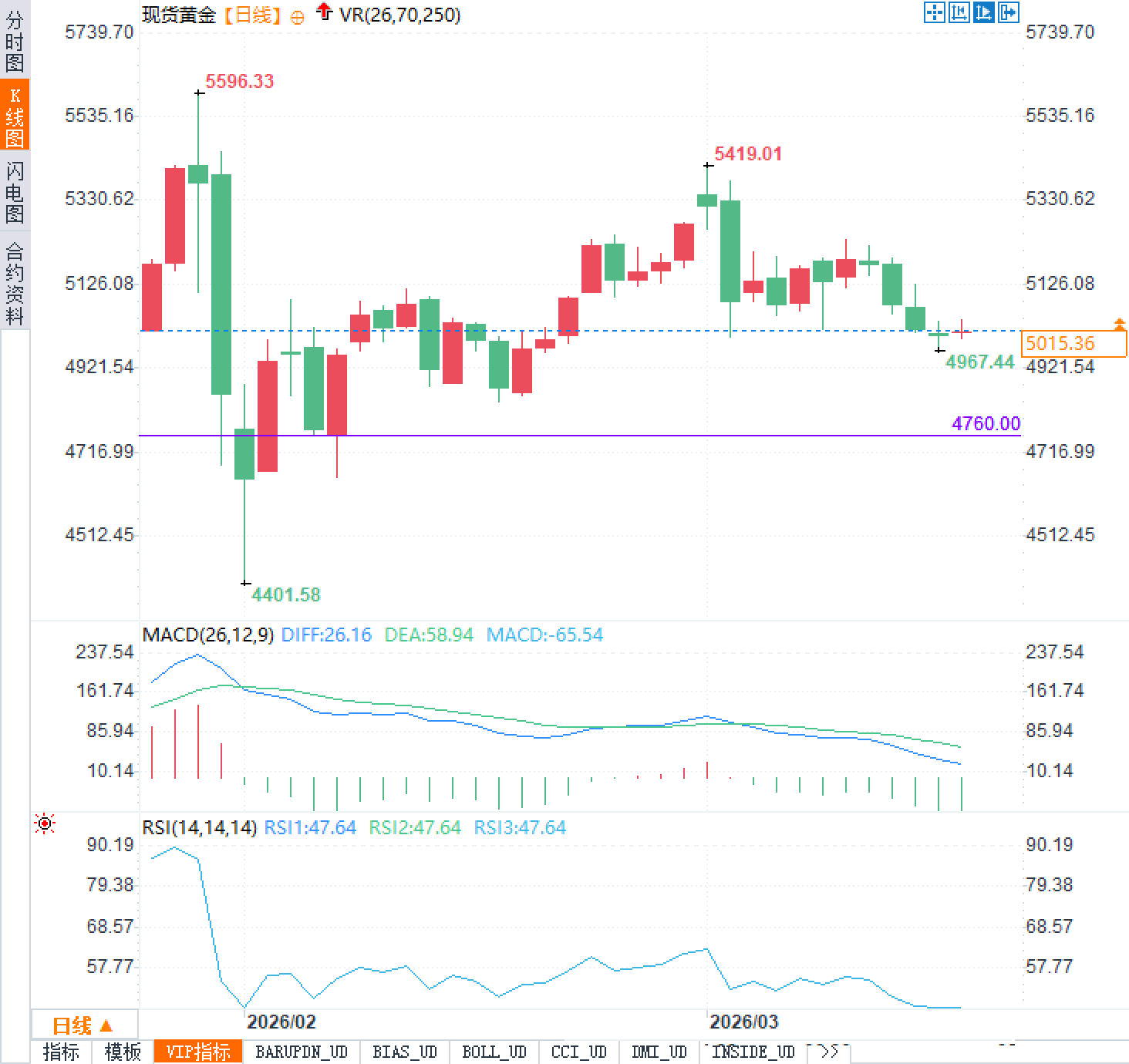
Gold prices remained range-bound above $5,000 per ounce. Spot gold is currently trading around $5,015 per ounce, with an intraday trading range of $4,995-$5,044, a slight increase of about 0.2% from the previous trading day. Market sentiment remains dominated by geopolitical conflicts, lacking a clear catalyst for a breakout.
International Maritime Organization Secretary General Arsenio Dominguez clearly pointed out that while military escorts can reduce some risks, they cannot provide "100% protection." He emphasized, "It reduces risk, but risk still exists. Merchant ships and crews may still be affected." This view reflects the structural flaws of escort mechanisms in complex battlefield environments. Currently, the Strait of Hormuz is riddled with thousands of naval mines, and the threat of Iranian shore-based missiles and drones continues. Escort fleets must contend with GPS interference and AIS signal jamming, significantly increasing the difficulty of ship navigation. Even with the formation of escort formations, actual passage speed will be limited by the slowest vessels, creating a slow "trickle" rather than a normal flow recovery. Allies generally refuse to participate in escort operations due to a lack of sufficient political returns and the potential for unilateral military intervention to exacerbate the spillover effects of conflict. Traders should be wary that if any escort attempt fails to completely clear mine and missile sites, the risk premium in the Strait of Hormuz will be embedded in oil price pricing in the long term.
The disruption of the Strait of Hormuz has directly cut off approximately one-fifth of the world's oil and a significant amount of liquefied natural gas (LNG) shipping routes. Iran's blockade has forced oil tankers to detour around the Cape of Good Hope in Africa, extending the voyage by 10-15 days, causing freight rates to soar and increasing restocking costs for global refineries. While crude oil futures have not yet experienced extreme price spikes, implied volatility has risen significantly, indicating that the market has partially priced in the supply disruption. Recent Iranian missile and drone strikes against neighboring Persian Gulf countries have further exacerbated regional uncertainty. The United States has increased its military deployments in the Middle East, but has failed to effectively restore passage. Traders are focused on the possibility that if the conflict continues for several months, global energy inventory depletion will accelerate, and the peak winter demand season may amplify the supply gap effect.
Gold is currently anchored between the $5,000 support level and the $5,200 resistance level, lacking new catalysts. Geopolitical conflicts provide safe-haven support, but rumors of direct contact between the US and Iran, while briefly boosting optimism, were quickly denied by Iran, and the market returned to a wait-and-see approach. The Federal Reserve's interest rate meeting this week is highly anticipated, with the market widely expecting it to maintain its current policy. A dovish statement could provide mild support for gold prices; a hawkish stance could trigger a break below $5,000. Subsequent weak US economic data could reignite expectations of interest rate cuts, which would benefit gold; conversely, if the data remains resilient, gold prices may continue to trade within a range or remain weak. Currently, gold prices are consolidating at high levels with shrinking trading volume; a breakout requires an external event.
The following is a comparison of key recent gold levels (USD/ounce):
In the short term, geopolitical tensions will dominate market pricing. Gold's value as a safe-haven asset remains, but its range-bound trading pattern is unlikely to change. Unless there is a substantial de-escalation or escalation of the conflict, gold prices are unlikely to see a directional breakout. Traders need to closely monitor the tone of the Federal Reserve's statements and military developments in the Middle East, as any unexpected events could trigger significant volatility.
Gold prices remained range-bound above $5,000 per ounce. Spot gold is currently trading around $5,015 per ounce, with an intraday trading range of $4,995-$5,044, a slight increase of about 0.2% from the previous trading day. Market sentiment remains dominated by geopolitical conflicts, lacking a clear catalyst for a breakout.
The practical limitations of the escort plan in the Strait of Hormuz
International Maritime Organization Secretary General Arsenio Dominguez clearly pointed out that while military escorts can reduce some risks, they cannot provide "100% protection." He emphasized, "It reduces risk, but risk still exists. Merchant ships and crews may still be affected." This view reflects the structural flaws of escort mechanisms in complex battlefield environments. Currently, the Strait of Hormuz is riddled with thousands of naval mines, and the threat of Iranian shore-based missiles and drones continues. Escort fleets must contend with GPS interference and AIS signal jamming, significantly increasing the difficulty of ship navigation. Even with the formation of escort formations, actual passage speed will be limited by the slowest vessels, creating a slow "trickle" rather than a normal flow recovery. Allies generally refuse to participate in escort operations due to a lack of sufficient political returns and the potential for unilateral military intervention to exacerbate the spillover effects of conflict. Traders should be wary that if any escort attempt fails to completely clear mine and missile sites, the risk premium in the Strait of Hormuz will be embedded in oil price pricing in the long term.
The profound impact of geopolitical risks on the energy supply chain
The disruption of the Strait of Hormuz has directly cut off approximately one-fifth of the world's oil and a significant amount of liquefied natural gas (LNG) shipping routes. Iran's blockade has forced oil tankers to detour around the Cape of Good Hope in Africa, extending the voyage by 10-15 days, causing freight rates to soar and increasing restocking costs for global refineries. While crude oil futures have not yet experienced extreme price spikes, implied volatility has risen significantly, indicating that the market has partially priced in the supply disruption. Recent Iranian missile and drone strikes against neighboring Persian Gulf countries have further exacerbated regional uncertainty. The United States has increased its military deployments in the Middle East, but has failed to effectively restore passage. Traders are focused on the possibility that if the conflict continues for several months, global energy inventory depletion will accelerate, and the peak winter demand season may amplify the supply gap effect.
Macroeconomic drivers and potential breakout points for gold's range-bound trading
Gold is currently anchored between the $5,000 support level and the $5,200 resistance level, lacking new catalysts. Geopolitical conflicts provide safe-haven support, but rumors of direct contact between the US and Iran, while briefly boosting optimism, were quickly denied by Iran, and the market returned to a wait-and-see approach. The Federal Reserve's interest rate meeting this week is highly anticipated, with the market widely expecting it to maintain its current policy. A dovish statement could provide mild support for gold prices; a hawkish stance could trigger a break below $5,000. Subsequent weak US economic data could reignite expectations of interest rate cuts, which would benefit gold; conversely, if the data remains resilient, gold prices may continue to trade within a range or remain weak. Currently, gold prices are consolidating at high levels with shrinking trading volume; a breakout requires an external event.
The following is a comparison of key recent gold levels (USD/ounce):
| level | price | significance |
|---|---|---|
| Current spot price | Approximately 5015 | intraday center |
| Key support | 5000 | Psychological threshold, whether to break through or accelerate |
| Recent lows | 4995-4985 | Short-term defensive position |
| Key resistance | 5200 | A strong catalyst is needed to break through the upper limit of the range. |
| 200-period moving average | Approximately 5065 | Technical resistance |
Market Outlook and Risk Balance
In the short term, geopolitical tensions will dominate market pricing. Gold's value as a safe-haven asset remains, but its range-bound trading pattern is unlikely to change. Unless there is a substantial de-escalation or escalation of the conflict, gold prices are unlikely to see a directional breakout. Traders need to closely monitor the tone of the Federal Reserve's statements and military developments in the Middle East, as any unexpected events could trigger significant volatility.
Frequently Asked Questions
Question 1: Why can't military escorts completely solve the problem of passage through the Strait of Hormuz?
A: Escorts only reduce some risks and cannot eliminate the complex threats of mines, missiles, drones, and electronic jamming. The slow speed and limited coverage of convoys make it difficult to restore normal traffic flow. International Maritime Organization Secretary General Arsenio Dominguez emphasized that this is not a long-term sustainable solution, and merchant ships still face the possibility of actual attacks. In the current conflict environment, escorts are more of a stopgap measure than a fundamental solution to the problem.
Question 2: Why has gold maintained its range-bound trading between $5,000 and $5,200?
A: Geopolitical conflicts provide a lower limit for safe-haven demand, but the lack of new developments has resulted in insufficient bullish momentum. The market is cautious ahead of the Fed meeting, with expectations of no change limiting directional volatility. A dovish statement could push gold prices higher; conversely, a hawkish shift or easing of tensions would put downward pressure. Currently, there are no strong catalysts, and range-bound trading is logical.
Question 3: When will the impact of a disruption in the Strait of Hormuz on the global energy market become more pronounced?
A: In the short term, inventory buffers and alternative routes will mitigate the impact, but continued disruptions will accelerate global crude oil inventory reduction. Peak winter demand coupled with rising detouring costs could push up end-energy prices within months. Traders need to pay attention to inventory data and potential OPEC+ responses; a widening supply gap will amplify volatility.
- Risk Warning and Disclaimer
- The market involves risk, and trading may not be suitable for all investors. This article is for reference only and does not constitute personal investment advice, nor does it take into account certain users’ specific investment objectives, financial situation, or other needs. Any investment decisions made based on this information are at your own risk.