













Trump is in a difficult position; maintaining crude oil prices above $100 could lead to a grim future.
2026-03-17 19:00:17
The war has entered its third week, and the US-Israel military action against Iran, initially anticipated as a "rapid and precise strike," is developing in an unexpected direction. All indications suggest that the conflict is far from "ending quickly" as the Trump administration initially portrayed, instead gradually dragging the US into a quagmire. Trump himself has also shifted from initial optimism to pragmatism: his March 16 speech focused on calling for allies to jointly "escort" ships and demanding that multiple countries send warships to reopen the Strait of Hormuz; his planned visit to China at the end of March has also been explicitly stated by the White House as "possibly postponed" or delayed by a month to concentrate on dealing with the war situation.
After suffering multiple rounds of attacks, Iran has not yielded but has instead hardened its stance. President Pesashyan and Foreign Minister Araghchi publicly demanded that the United States and Israel pay war reparations, recognize Iran's legitimate rights, and provide international guarantees to prevent future invasions; otherwise, they would refuse to negotiate. "This war must not be repeated," Iran clearly stated, indicating that a ceasefire would only be possible with reparations and a commitment to permanent security. Meanwhile, several high-ranking Iranian officials (including key figures in the intelligence ministry) were killed in the airstrikes. The deaths of these influential figures within Iran, who wielded significant power in negotiations, have made the already difficult path to peace even more arduous, further closing the door to talks.
The US and Israel, having expended enormous resources and political capital with the intention of weakening the Iranian regime and controlling the Middle East, have unexpectedly "made Khamenei younger"—the CIA's pre-assessed scenario of a "stronger IRGC (Islamic Revolutionary Guard) successor" has become a reality after the Supreme Leader Khamenei's death in the February 28 airstrike. Iran's retaliation has intensified, with drone strikes against the UAE and Bahrain, and the blockade of the Strait of Hormuz (a 20% global oil shipping route), directly driving up global oil prices. The worst possible outcome that Trump least wanted—a more uncooperative and radical supreme leadership—has already occurred.
Soaring oil prices: the most direct quagmire and pressure
The most direct pressure comes from oil prices. Before the conflict, Brent crude was around $73 per barrel; now it has repeatedly broken through $100, reaching a high of $119, and is currently still hovering in the $90-$100 range, with a cumulative increase of over 40%. The de facto closure of the Strait of Hormuz has led to supply disruptions, and it has become a market consensus that oil prices will remain above $100 under a prolonged blockade.
Recent analyses from several investment banks corroborate this predicament: Goldman Sachs predicts the average Brent price will exceed $100 in March and fall back to $85 in April, but this is contingent on a swift end to the conflict; if it drags on, the pressure will persist. Bank of America raised its full-year 2026 Brent average price forecast to $77.50 (previously $61), and Standard Chartered raised it to $85.50 (previously $70), citing supply constraints caused by the Straits closure.
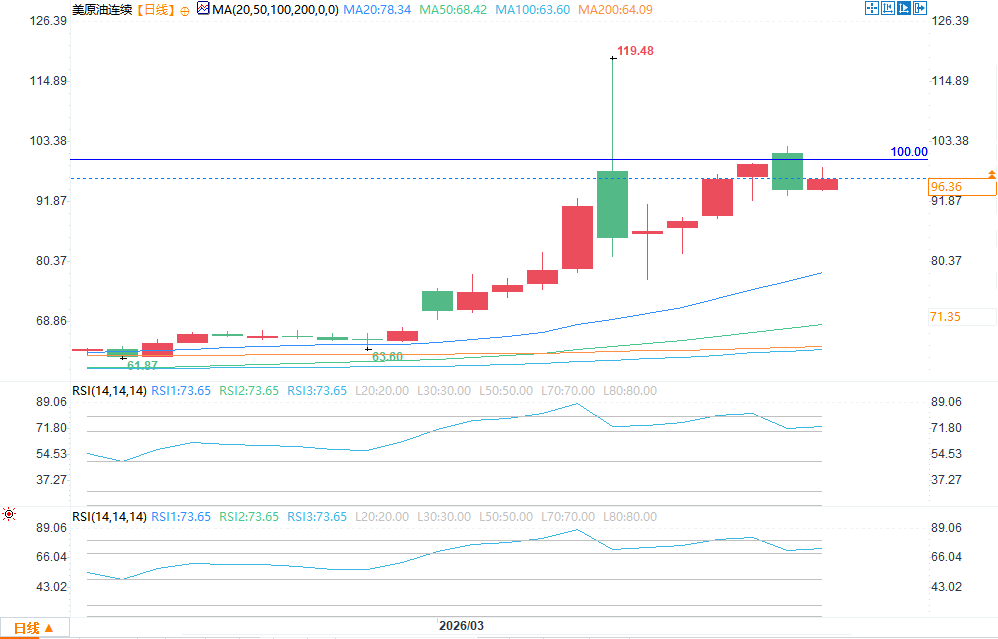
(WTI crude oil daily chart source: FX678)
In a more pessimistic scenario, Schroders warned that if the conflict continues for months, oil prices could surge to $150-$200; Chatham House predicts that the conflict will push prices up to $130 before slowly declining; Capital Economics even suggests that prices could reach $150 first under lockdown conditions before stabilizing at $130.
Trump is in a bind: Three concerns trap his escape route.
The United States is deeply mired in a "no-exit" dilemma. Trump's reluctance to announce a troop withdrawal stems from three main concerns:
His political image has mirrored his worst-case scenario: he once predicted the worst outcome would be "an even less cooperative leader," and now Iran's new leadership is even more hardline, making continued war an unavoidable situation. Giving up halfway would be tantamount to admitting strategic failure, conflicting with his hardline "America First" image.
The impact of oil prices on the midterm elections: High oil prices have already triggered domestic gasoline price increases, casting a shadow over the Republican Party's midterm election prospects (Al Jazira has warned that a price of $200 would severely damage the election). Although Trump claims that "rising oil prices are a small price to pay" and "will soon fall like a rock," it is clear within the White House that prolonged lockdowns will drag down the economy, and voters will not buy it.
Strategic flexibility and long-term risks: Trump has consistently emphasized the "art of the deal." If the conflict drags on for another 6-8 weeks (Israel has planned to fight for at least another 3 weeks), the war could solidify into a protracted conflict, including attacks against Gulf allies. The door to peace talks will then close—Iran demands war reparations from the US and Israel, recognition of Iranian rights, and permanent security guarantees; otherwise, it will refuse to negotiate.
Strait of Hormuz: An Unexpected Battlefield Focus
It was initially expected that Iran would not dare to completely block the Strait of Hormuz (which accounts for approximately 20% of global oil shipping routes), but in reality, Iran has effectively blocked passage, leading to a sharp decline in tanker traffic and a surge in insurance costs. While the US and Israel attacked military facilities on Kharg Island, Iran's main oil export hub, Trump explicitly avoided directly destroying oil and gas infrastructure to prevent further enraging the market. However, Iran's "asymmetric retaliation" has made the Strait a focal point of the conflict, forcing Trump to turn to appealing to allies for "joint escort" and demanding that warships from multiple countries reopen the passage. This marks a shift from "unilateral precision strikes" to a "multilateral escort and attrition war."
Crude oil future trend: high-level fluctuation
In the short term (within a few weeks), both sides will continue their rhetoric and limited escalation—Trump emphasizes the maritime coalition, while Iran insists on its bottom line of "compensation + guarantees." Oil prices are fluctuating at high levels (probably above $100), and may briefly surge if Iran attacks targets in the Gulf again.
In the medium term (several months), the possibility of the US being dragged into a war of attrition lasting 6-8 weeks or more is increasing. If Trump successfully "declares victory" and reopens the Strait of Hormuz, oil prices are expected to fall back to $80-90; otherwise, maintaining the new normal of $100 will come at a cost to the global economy.
In the long run, this "unexpected" war has reshaped the Middle East landscape, with the US bogged down and Iran becoming more aggressive. Trump's flexibility will be key—but currently, he seems more inclined to remain in a difficult situation than to hastily withdraw.
This war has transformed from a "precision operation" into an "unexpected quagmire," with oil prices and geopolitical realities becoming the cruelest judges. The core reason Trump is unwilling to withdraw is that acknowledging something "exceeded expectations" is tantamount to admitting the worst-case scenario has come true.
After suffering multiple rounds of attacks, Iran has not yielded but has instead hardened its stance. President Pesashyan and Foreign Minister Araghchi publicly demanded that the United States and Israel pay war reparations, recognize Iran's legitimate rights, and provide international guarantees to prevent future invasions; otherwise, they would refuse to negotiate. "This war must not be repeated," Iran clearly stated, indicating that a ceasefire would only be possible with reparations and a commitment to permanent security. Meanwhile, several high-ranking Iranian officials (including key figures in the intelligence ministry) were killed in the airstrikes. The deaths of these influential figures within Iran, who wielded significant power in negotiations, have made the already difficult path to peace even more arduous, further closing the door to talks.
The US and Israel, having expended enormous resources and political capital with the intention of weakening the Iranian regime and controlling the Middle East, have unexpectedly "made Khamenei younger"—the CIA's pre-assessed scenario of a "stronger IRGC (Islamic Revolutionary Guard) successor" has become a reality after the Supreme Leader Khamenei's death in the February 28 airstrike. Iran's retaliation has intensified, with drone strikes against the UAE and Bahrain, and the blockade of the Strait of Hormuz (a 20% global oil shipping route), directly driving up global oil prices. The worst possible outcome that Trump least wanted—a more uncooperative and radical supreme leadership—has already occurred.
Soaring oil prices: the most direct quagmire and pressure
The most direct pressure comes from oil prices. Before the conflict, Brent crude was around $73 per barrel; now it has repeatedly broken through $100, reaching a high of $119, and is currently still hovering in the $90-$100 range, with a cumulative increase of over 40%. The de facto closure of the Strait of Hormuz has led to supply disruptions, and it has become a market consensus that oil prices will remain above $100 under a prolonged blockade.
Recent analyses from several investment banks corroborate this predicament: Goldman Sachs predicts the average Brent price will exceed $100 in March and fall back to $85 in April, but this is contingent on a swift end to the conflict; if it drags on, the pressure will persist. Bank of America raised its full-year 2026 Brent average price forecast to $77.50 (previously $61), and Standard Chartered raised it to $85.50 (previously $70), citing supply constraints caused by the Straits closure.
(WTI crude oil daily chart source: FX678)
In a more pessimistic scenario, Schroders warned that if the conflict continues for months, oil prices could surge to $150-$200; Chatham House predicts that the conflict will push prices up to $130 before slowly declining; Capital Economics even suggests that prices could reach $150 first under lockdown conditions before stabilizing at $130.
Trump is in a bind: Three concerns trap his escape route.
The United States is deeply mired in a "no-exit" dilemma. Trump's reluctance to announce a troop withdrawal stems from three main concerns:
His political image has mirrored his worst-case scenario: he once predicted the worst outcome would be "an even less cooperative leader," and now Iran's new leadership is even more hardline, making continued war an unavoidable situation. Giving up halfway would be tantamount to admitting strategic failure, conflicting with his hardline "America First" image.
The impact of oil prices on the midterm elections: High oil prices have already triggered domestic gasoline price increases, casting a shadow over the Republican Party's midterm election prospects (Al Jazira has warned that a price of $200 would severely damage the election). Although Trump claims that "rising oil prices are a small price to pay" and "will soon fall like a rock," it is clear within the White House that prolonged lockdowns will drag down the economy, and voters will not buy it.
Strategic flexibility and long-term risks: Trump has consistently emphasized the "art of the deal." If the conflict drags on for another 6-8 weeks (Israel has planned to fight for at least another 3 weeks), the war could solidify into a protracted conflict, including attacks against Gulf allies. The door to peace talks will then close—Iran demands war reparations from the US and Israel, recognition of Iranian rights, and permanent security guarantees; otherwise, it will refuse to negotiate.
Strait of Hormuz: An Unexpected Battlefield Focus
It was initially expected that Iran would not dare to completely block the Strait of Hormuz (which accounts for approximately 20% of global oil shipping routes), but in reality, Iran has effectively blocked passage, leading to a sharp decline in tanker traffic and a surge in insurance costs. While the US and Israel attacked military facilities on Kharg Island, Iran's main oil export hub, Trump explicitly avoided directly destroying oil and gas infrastructure to prevent further enraging the market. However, Iran's "asymmetric retaliation" has made the Strait a focal point of the conflict, forcing Trump to turn to appealing to allies for "joint escort" and demanding that warships from multiple countries reopen the passage. This marks a shift from "unilateral precision strikes" to a "multilateral escort and attrition war."
Crude oil future trend: high-level fluctuation
In the short term (within a few weeks), both sides will continue their rhetoric and limited escalation—Trump emphasizes the maritime coalition, while Iran insists on its bottom line of "compensation + guarantees." Oil prices are fluctuating at high levels (probably above $100), and may briefly surge if Iran attacks targets in the Gulf again.
In the medium term (several months), the possibility of the US being dragged into a war of attrition lasting 6-8 weeks or more is increasing. If Trump successfully "declares victory" and reopens the Strait of Hormuz, oil prices are expected to fall back to $80-90; otherwise, maintaining the new normal of $100 will come at a cost to the global economy.
In the long run, this "unexpected" war has reshaped the Middle East landscape, with the US bogged down and Iran becoming more aggressive. Trump's flexibility will be key—but currently, he seems more inclined to remain in a difficult situation than to hastily withdraw.
This war has transformed from a "precision operation" into an "unexpected quagmire," with oil prices and geopolitical realities becoming the cruelest judges. The core reason Trump is unwilling to withdraw is that acknowledging something "exceeded expectations" is tantamount to admitting the worst-case scenario has come true.
- Risk Warning and Disclaimer
- The market involves risk, and trading may not be suitable for all investors. This article is for reference only and does not constitute personal investment advice, nor does it take into account certain users’ specific investment objectives, financial situation, or other needs. Any investment decisions made based on this information are at your own risk.

